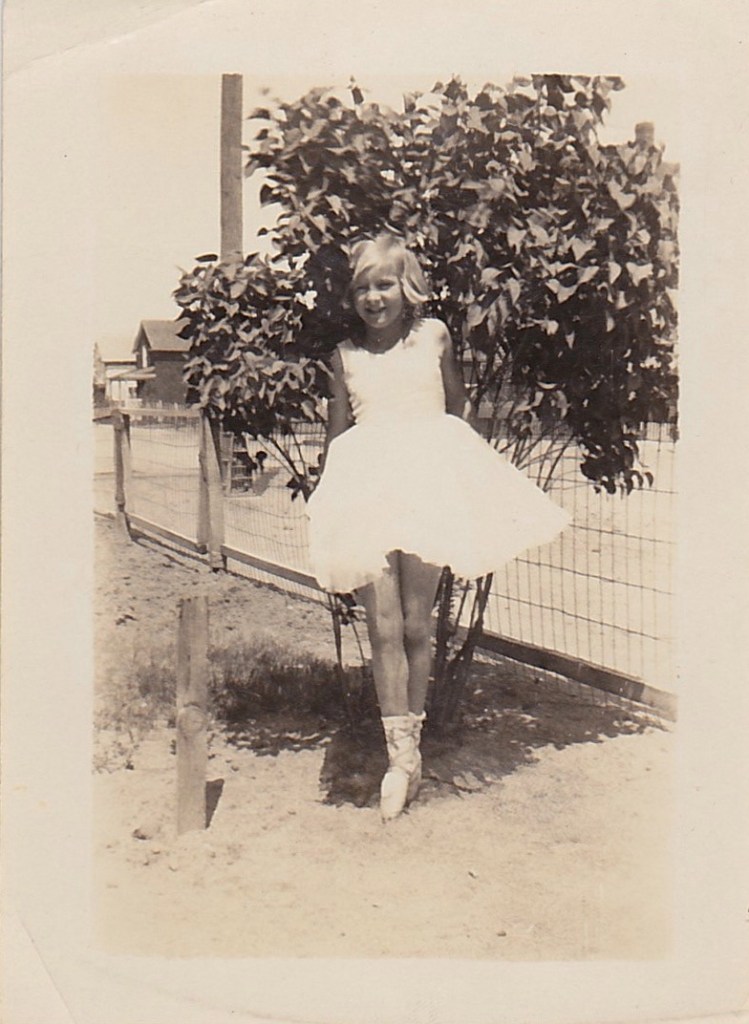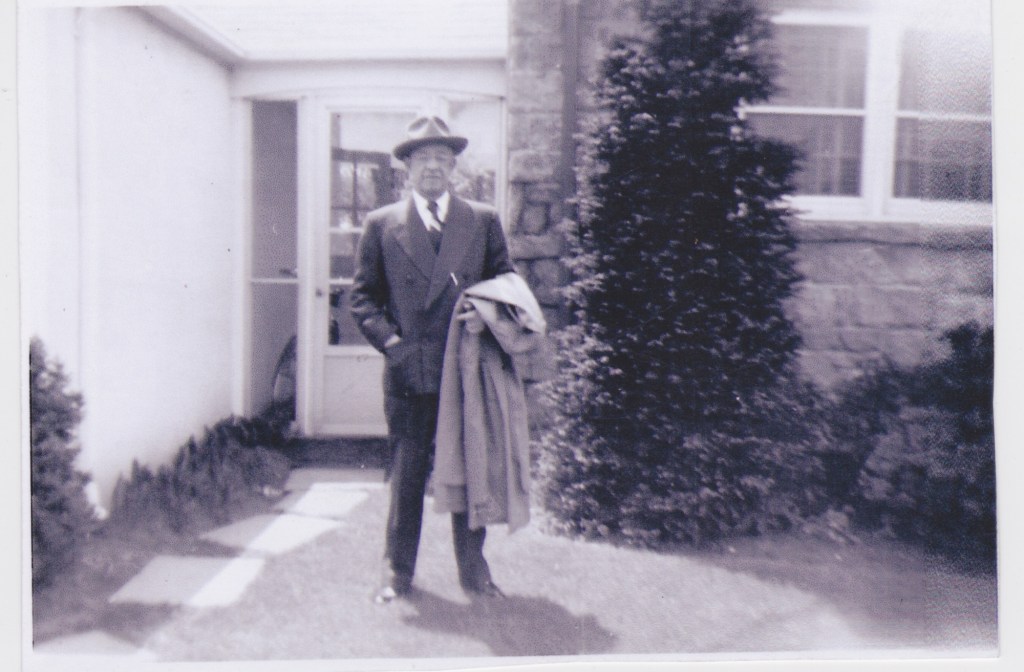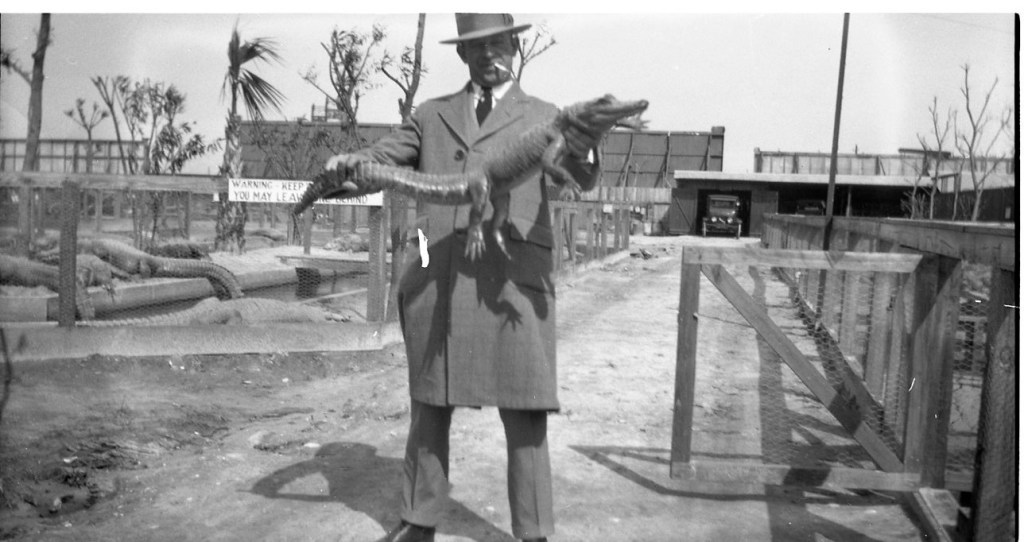
The Mikula Boys

I wrote about the Mikula Family in April of 2024, and at the end, I said I would tell you about Walter and Stanley, the two oldest boys in the family.

Quick recap, Aniela Liro Mikula was my grandmother Antonia’s older sister. Aniela and her husband, Josef, immigrated to the United States in 1903. Walter was born in 1903, and Stanley in 1904, about 18 months apart.

The Mikula children and the Jakiela children were not similar in age at all. My Uncle Steve was born in 1913, and Uncle Eddie in 1915, and they were the two oldest. The other three Jakiela siblings were born in 1920, 1922, and 1924. So even before Helen was born in 1920, three Mikula boys had died, as well as Aniela. I still marvel that my grandfather and Uncle Steve were able to lean on Josef to take Helen and Walter when their mother died in 1927, and again in 1935 when my grandfather died. The stories from Auntie Helen and Uncle Eddie were invaluable to my research and I’m so thankful that I had those conversations with them.
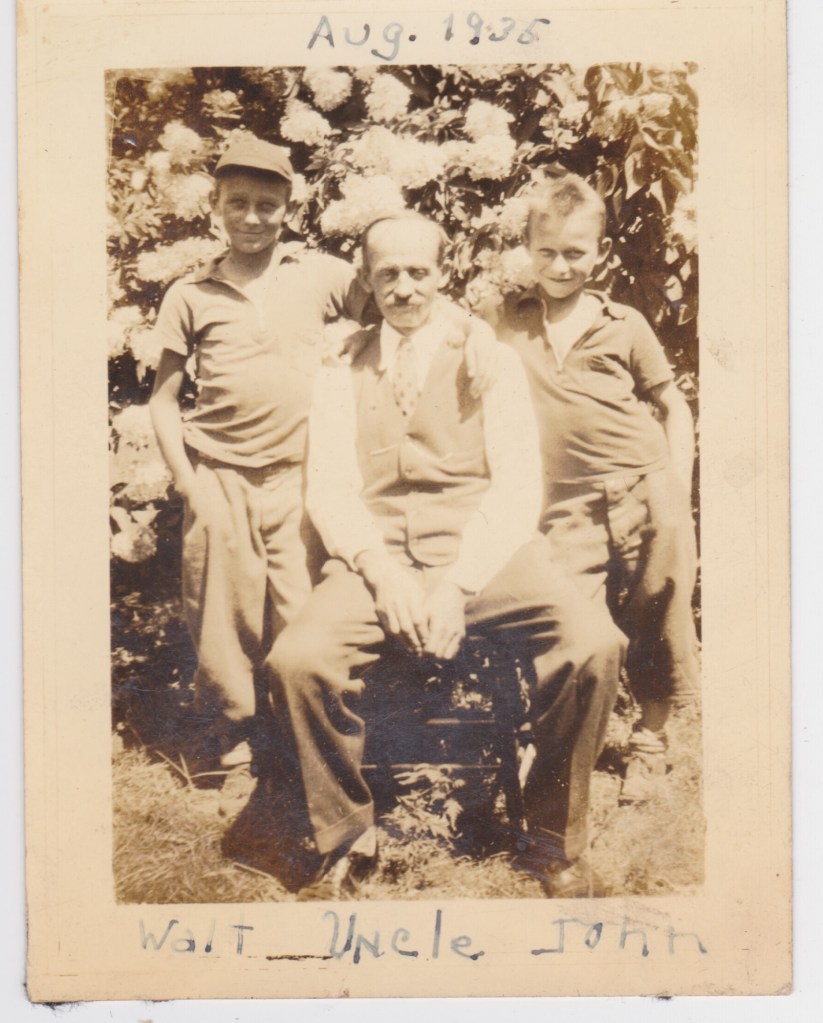
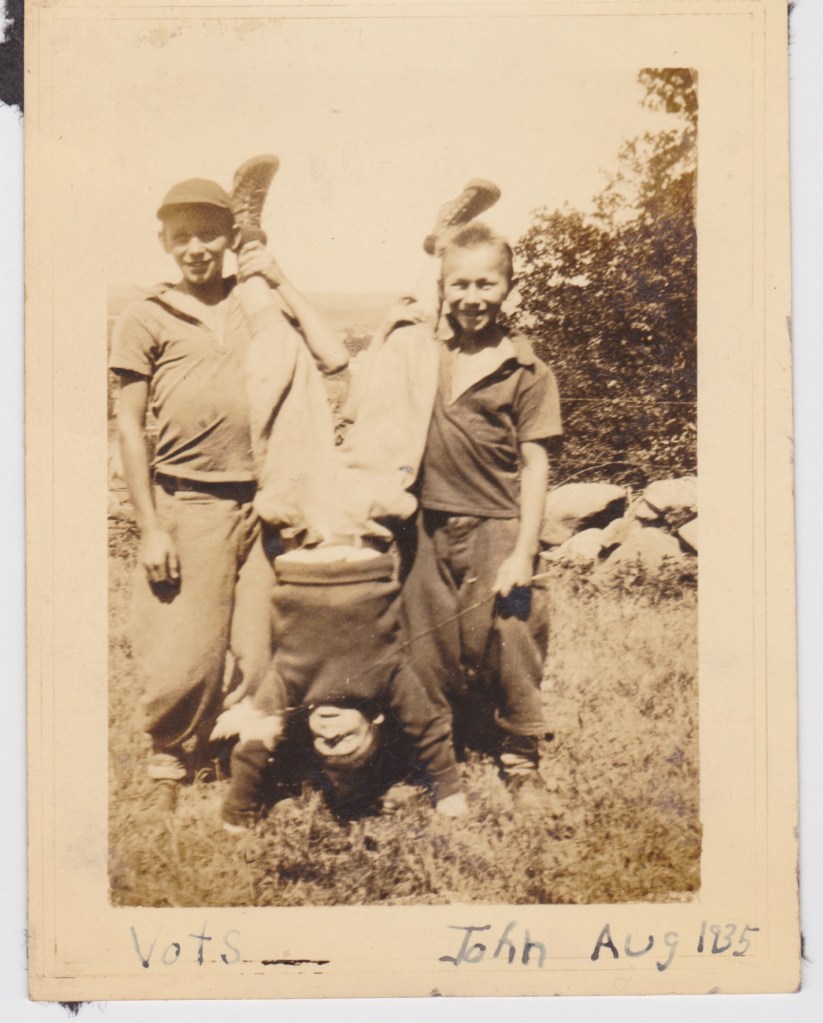
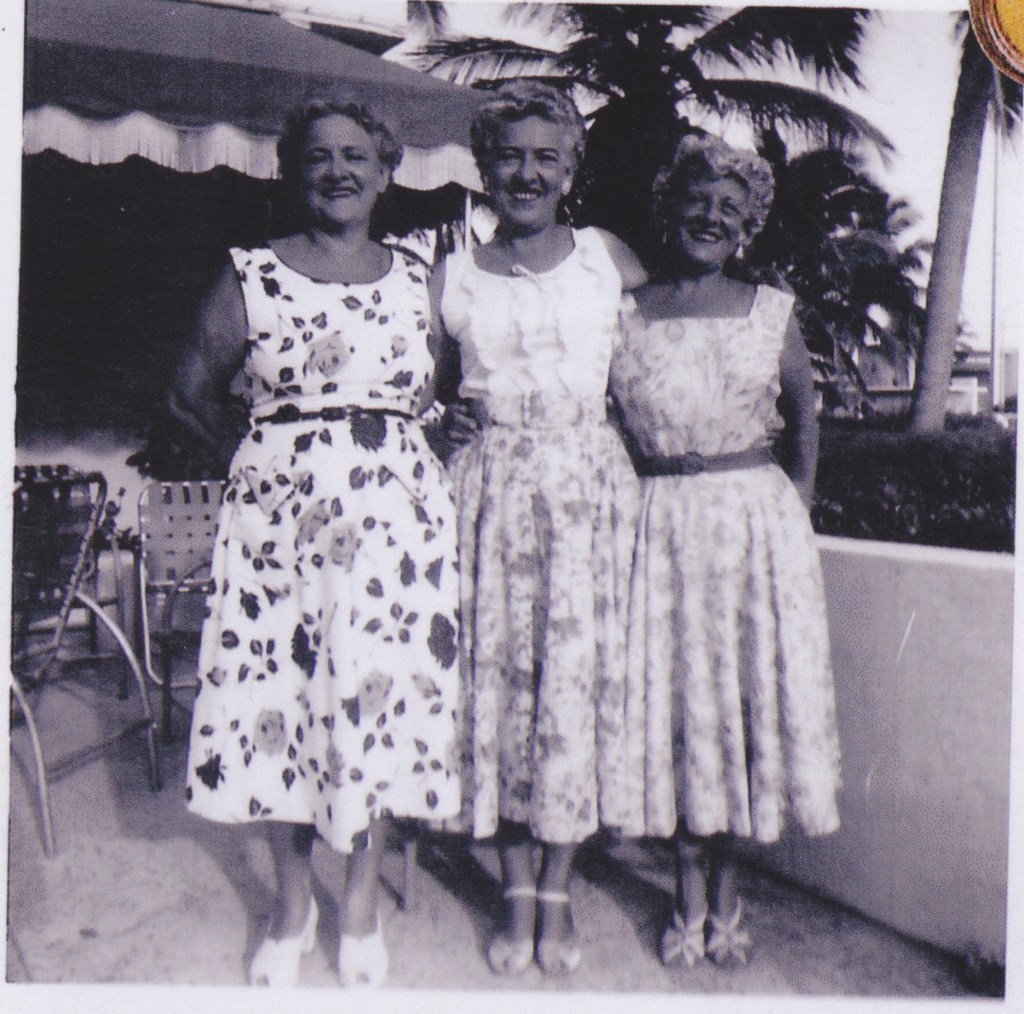
My Auntie Helen told me that the Mikula brothers lived with their family in Wallingford for a while, but they were “trouble” and her brother Steve told them to leave.
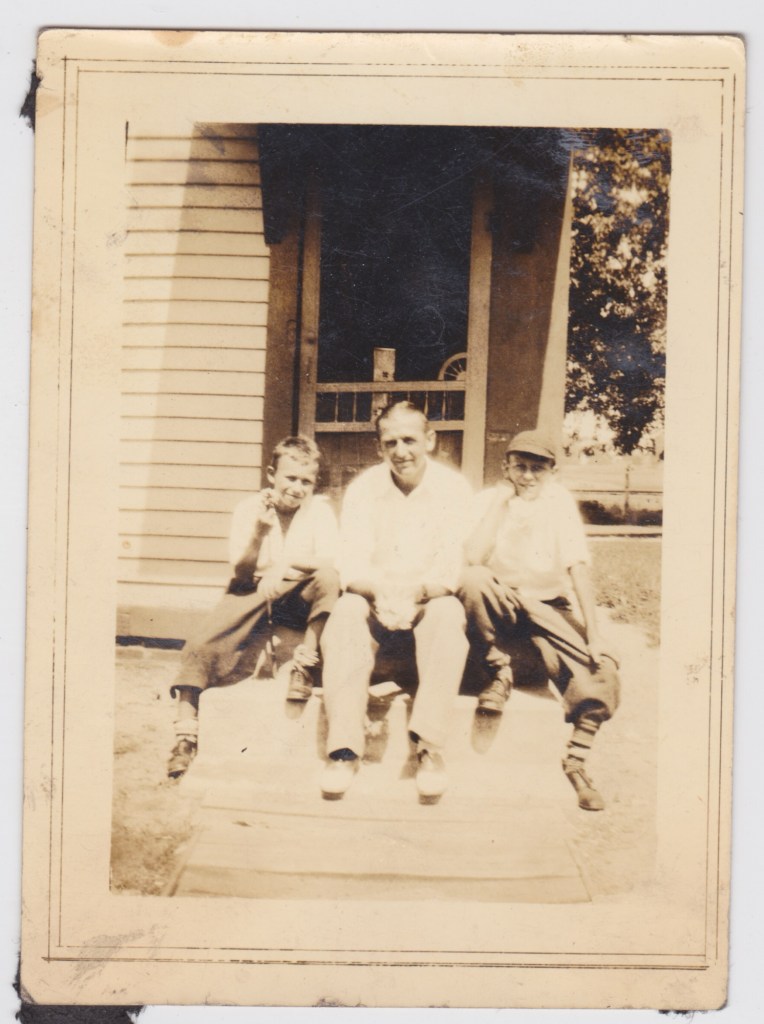
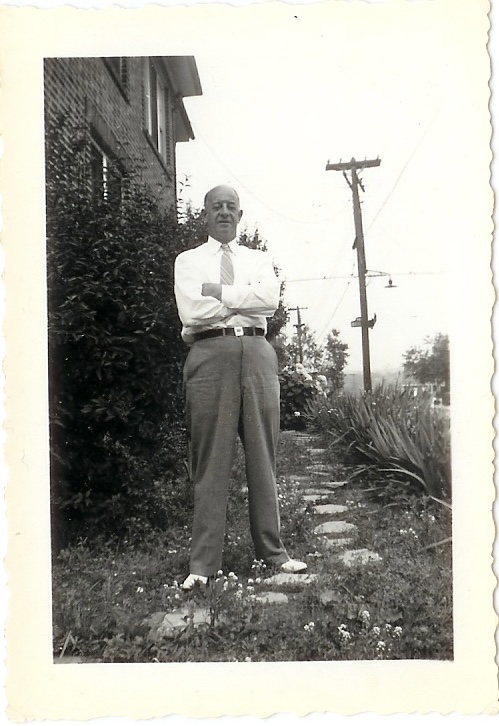
John, Walter Mikula, Walter Jakiela – after 1935, location unknown.

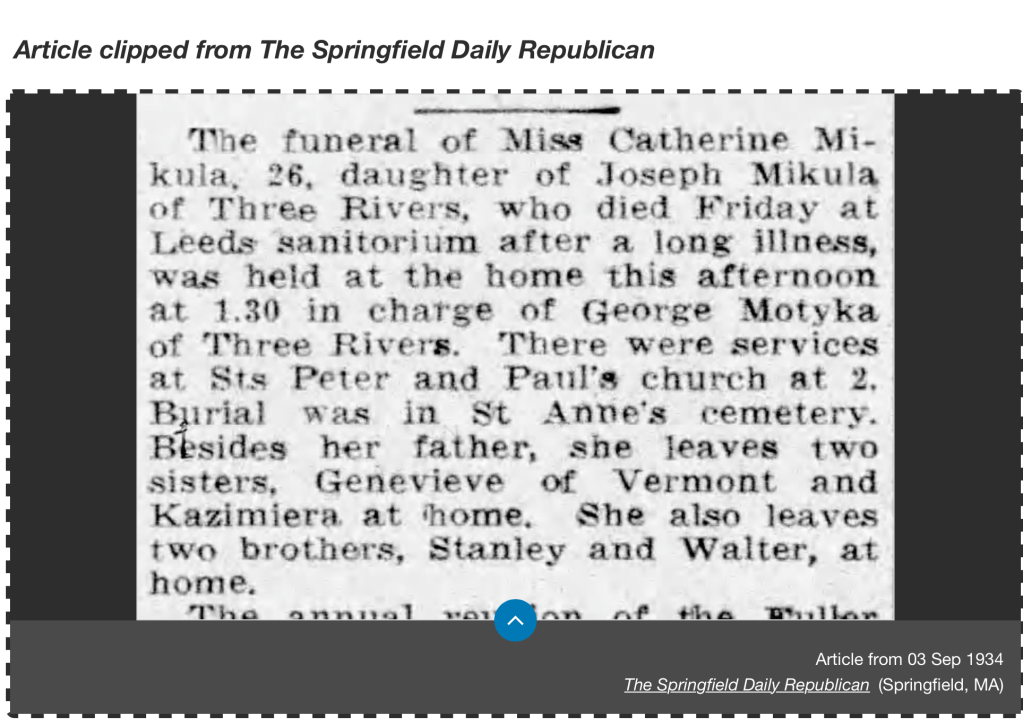
While searching Newspapers.com, I uncovered several newspaper articles recounting charges against Walter of drunkenness and disorderly conduct. Sometimes alone, and sometimes with Stanley. The most egregious charge was against both of them in September 1934 for drunkenness and assaulting their 54-year-old father and 19-year-old sister, Kazmiera. Just terrible! I found additional articles for Walter’s drunken escapades after that incident.
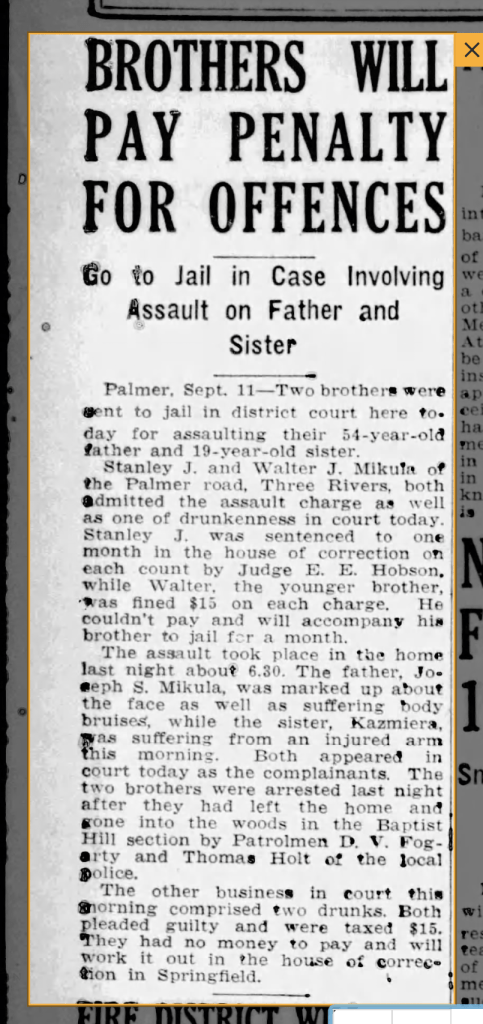
Walter and Stanley’s assault case

A copy of Walter’s 1942 Draft Card has six addresses written and crossed out. Two of those addresses are locations in Waterbury, Connecticut. Another Auntie Helen story was that Walter worked for the New Haven railroad and coming back from a wedding he was driving and killed someone. The family attached his wages so he quit his job and took jobs they “couldn’t keep track of”.

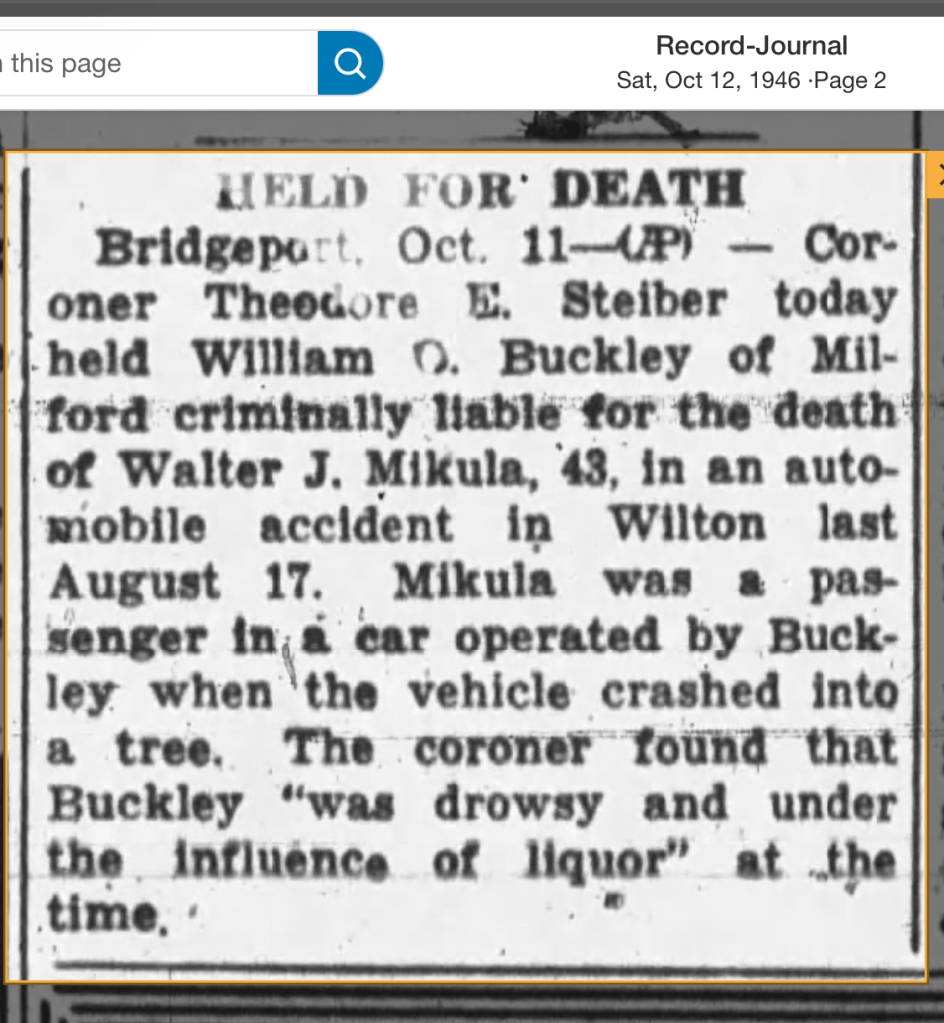
Well, karma took care of that. The last article I found was for a car accident that occurred on Route 7 in Georgetown, Connecticut, on August 17, 1946. A man by the name of Walter J. Mikula, age 43, a resident of Bridgeport, died instantly in a car accident when the car went out of control and crashed into a tree. The driver sustained injuries. Take note, the accident occurred at 7:30 am. A subsequent article in the Record-Journal in October said the driver was criminally liable for Walter’s death.
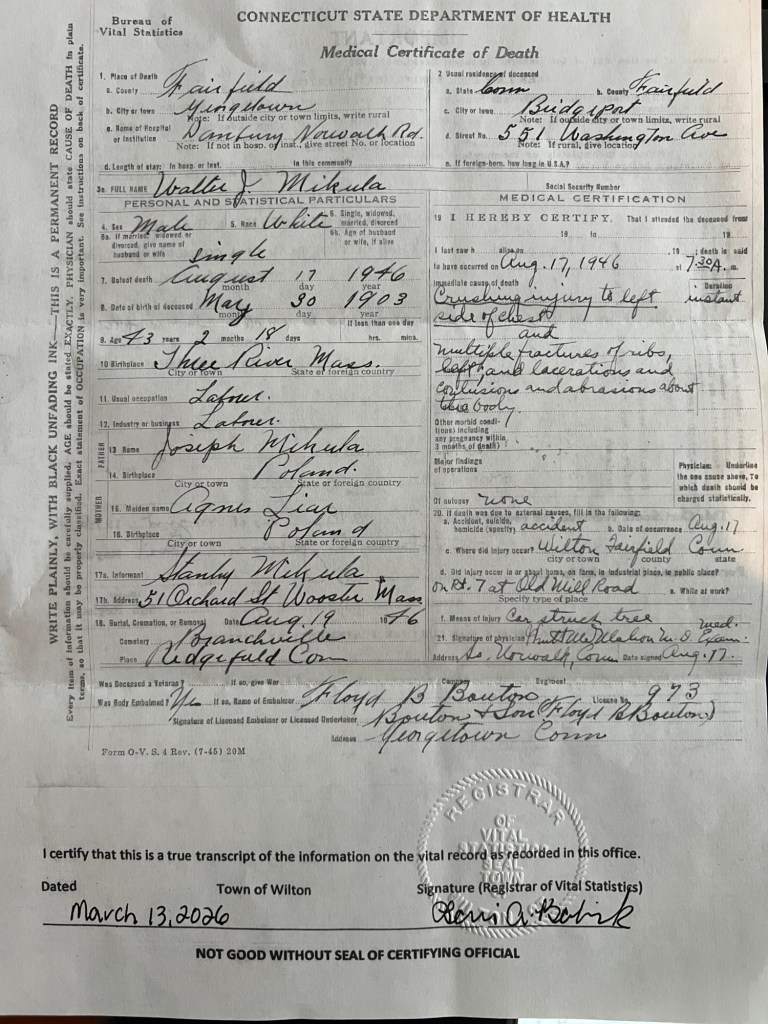
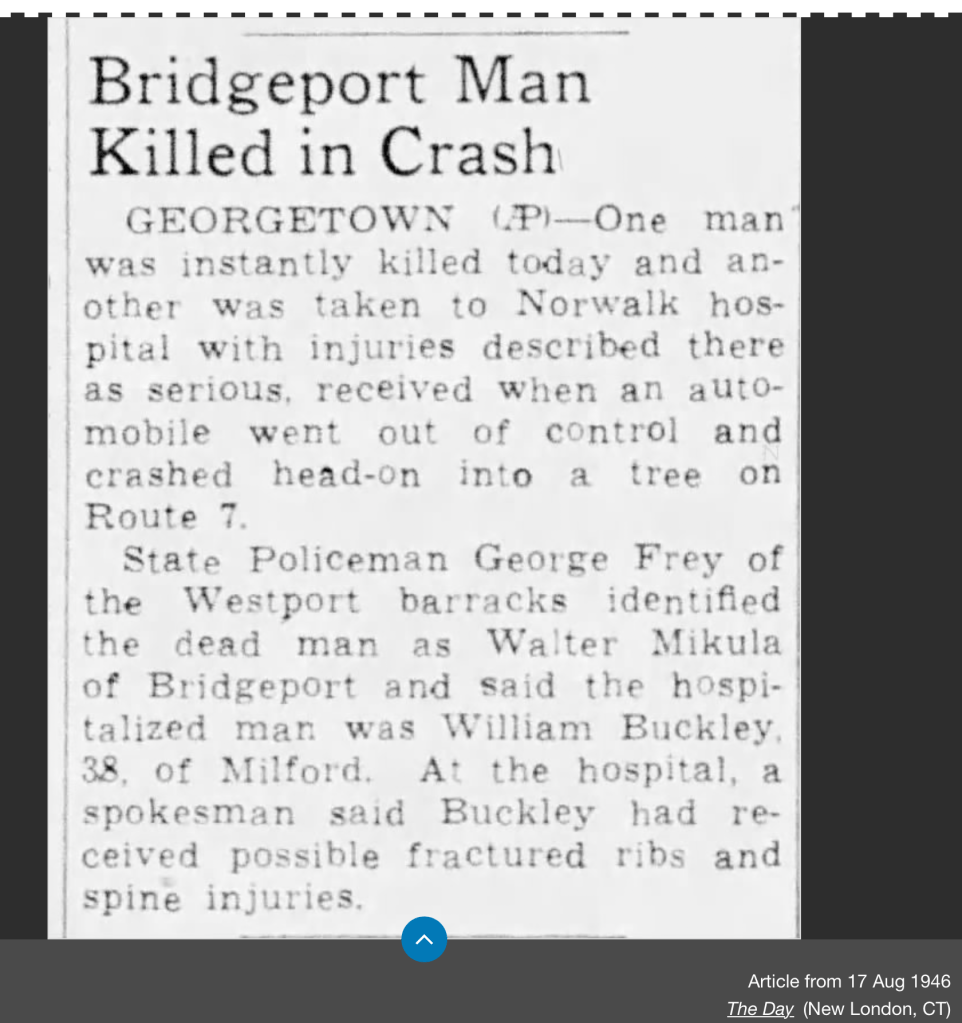
I took the information from the articles, put on my Nancy Drew sleuthing cap, and tracked down where the death certificate would possibly be located. I’d forgotten there was even a Georgetown Connecticut! I made a call to the Wilton town clerk’s office and they had it there. $20 and I had it within the week.

A sad ending for a sad life.


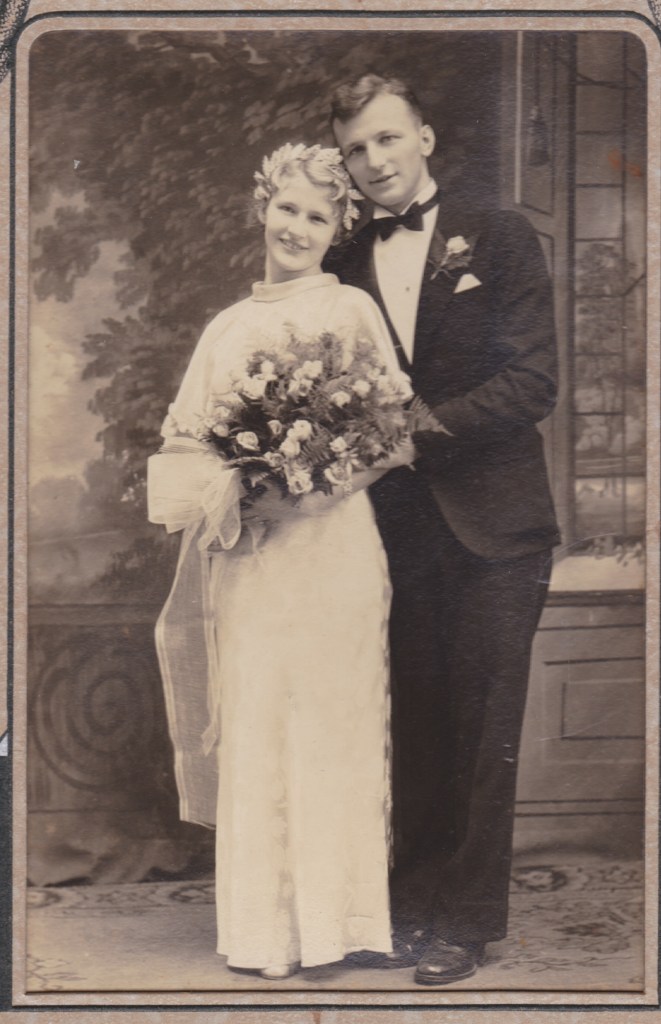
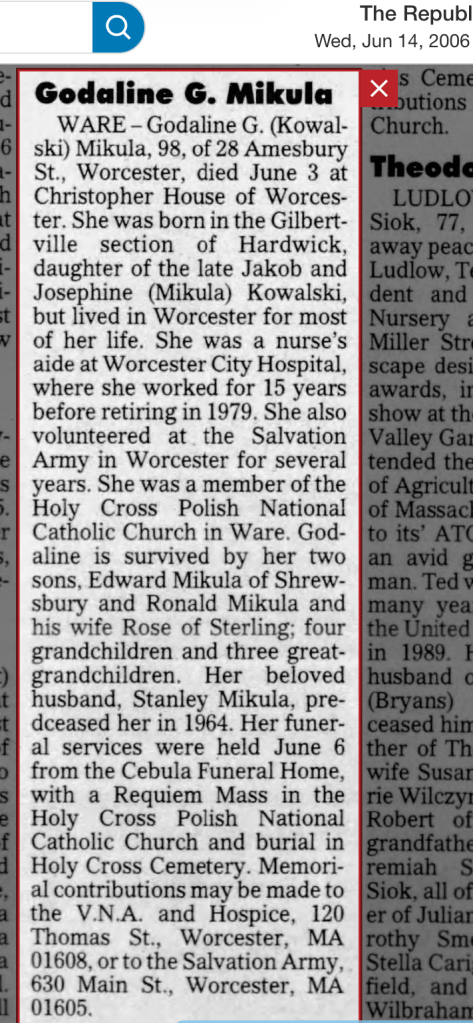
Stanley appeared to get his life together. In 1936, He married Godaline Kowalski. They had a son, Edward, born in 1938, and a son, Ronald, born in 1942. Stanley worked for American Steel and Wire Company for many years, and they lived in Worcester, Massachusetts.
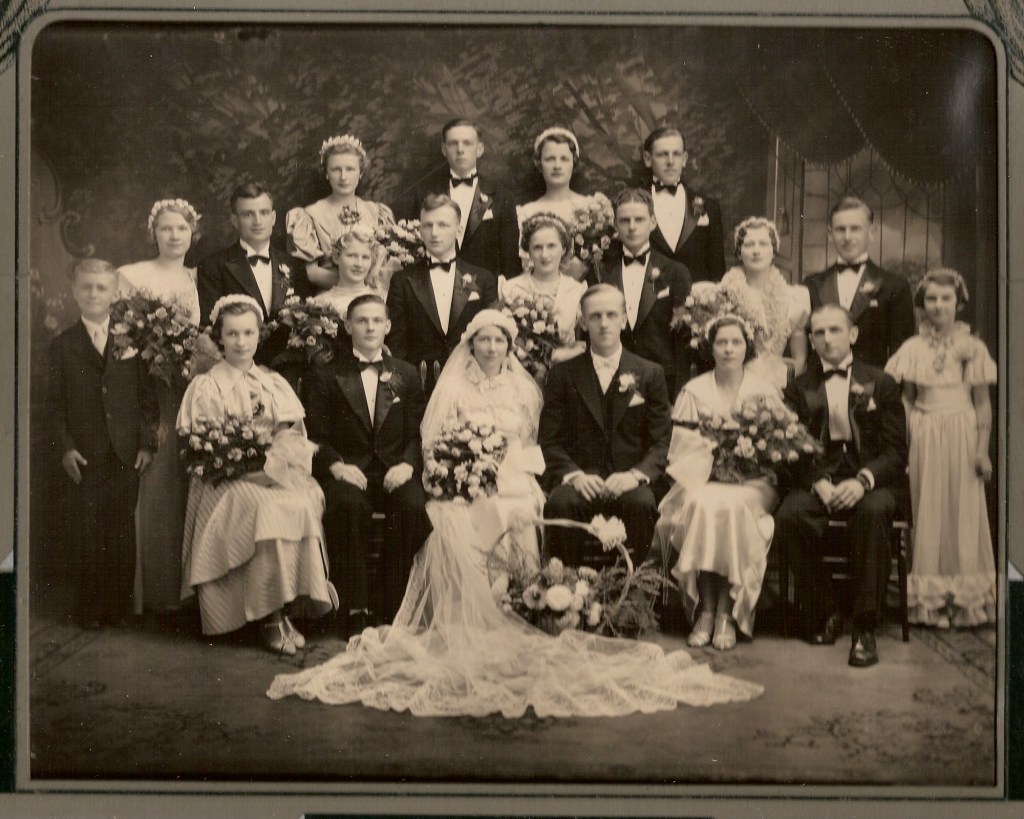
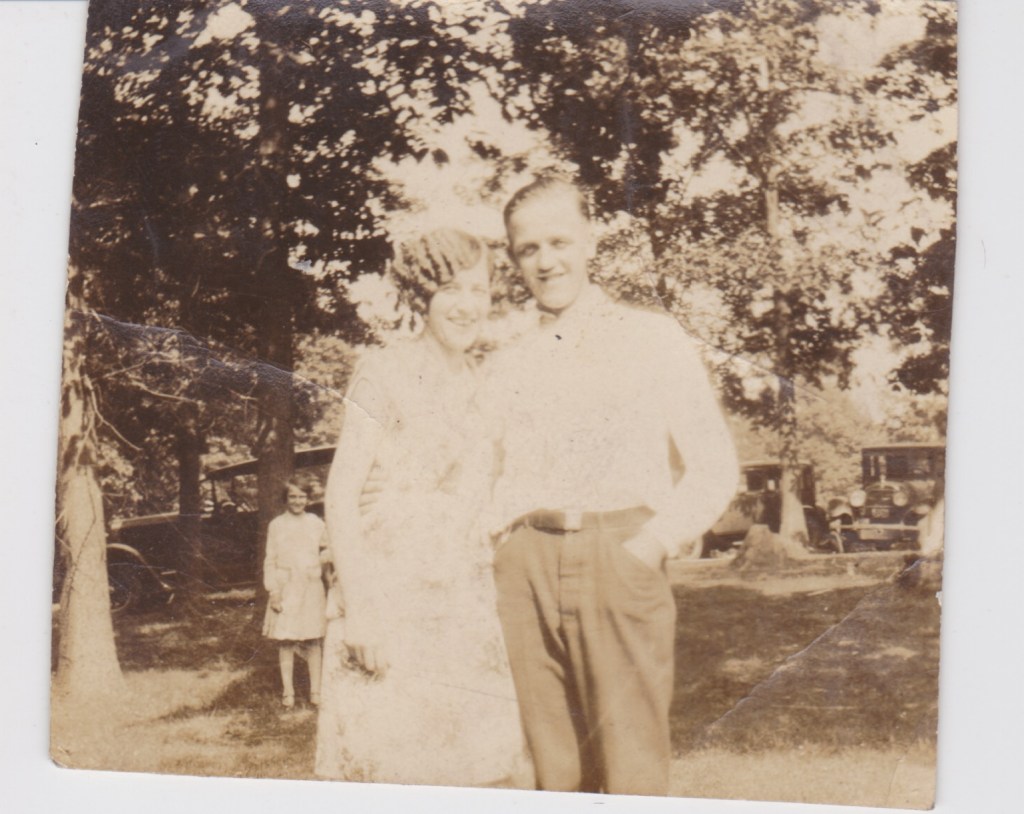
Stanley died at the VA Hospital in Rutland, Vermont, on January 19, 1964, at the age of 59. He had been confined there since September 1963. There is no record that he was a veteran of any war, so I’m not sure why he would have been there.
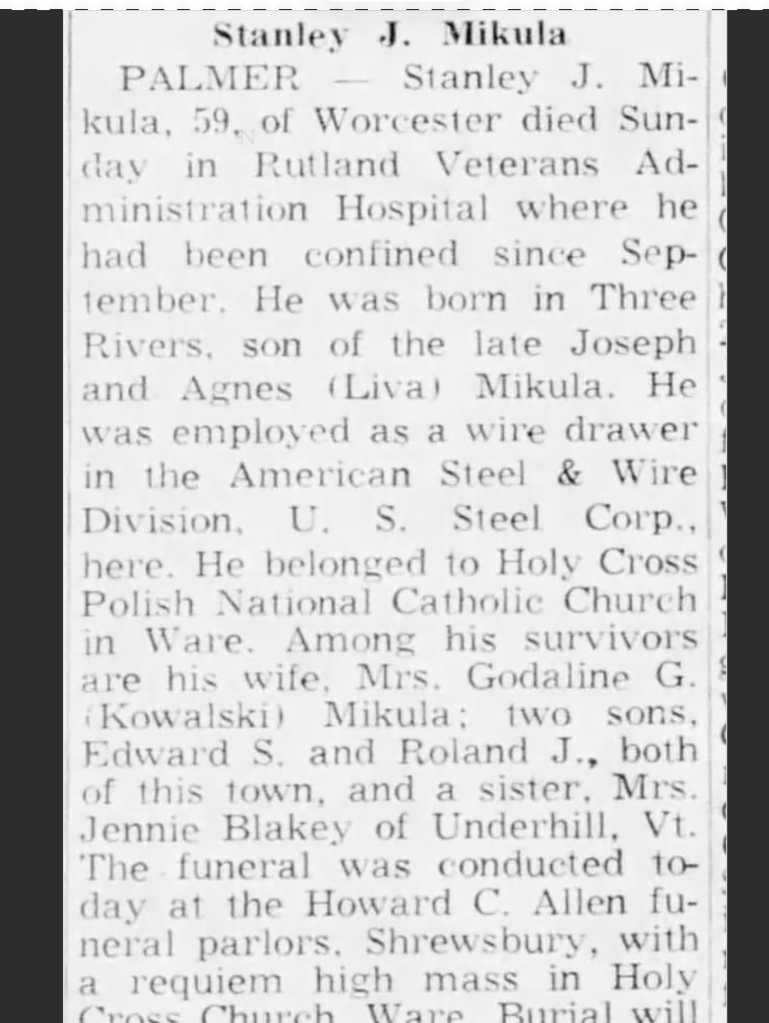
Stanley Mikula obituary

Early in my research journey, I sent out a lot of letters to names and addresses I found online. People, churches, cemeteries, anyone I could think of. I even dragged my sister and our kids up to the Palmer Library to go through their historical information.

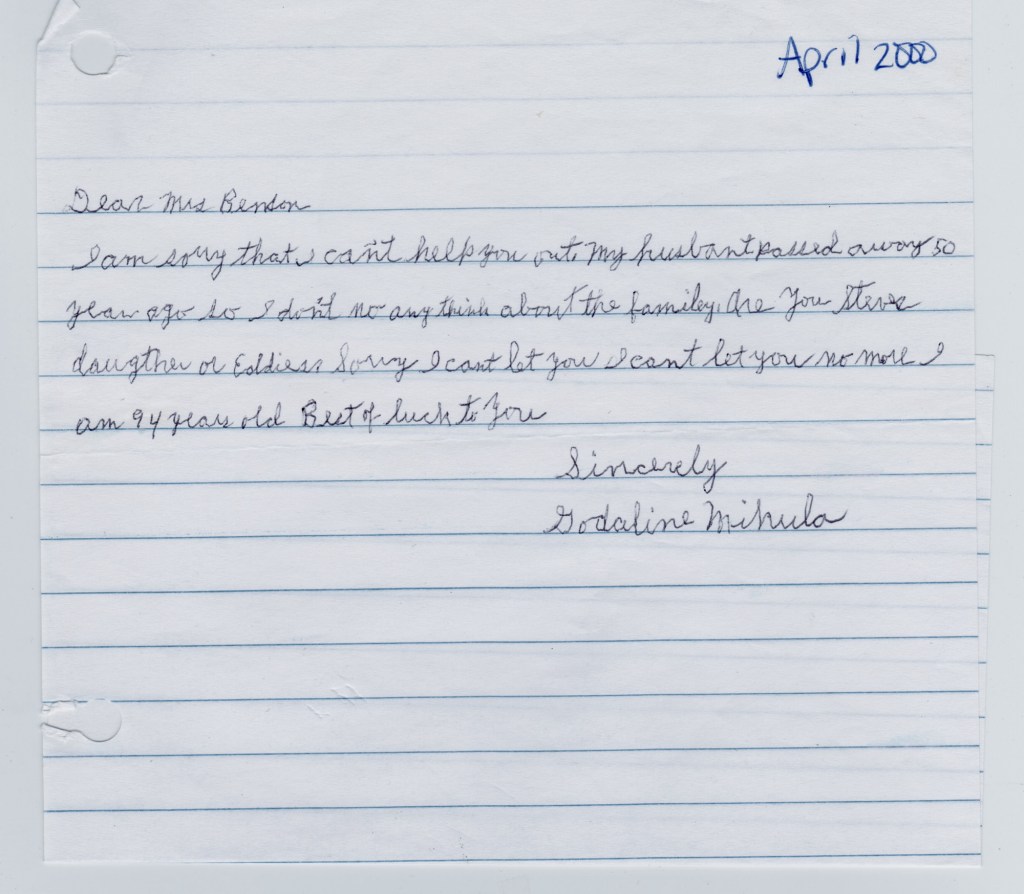
One letter in 2000 to Stanley Mikula somehow made it to Godaline who was now 94 and in a nursing home. She wrote back and we exchanged a few letters but unfortunately, I never went to visit her.
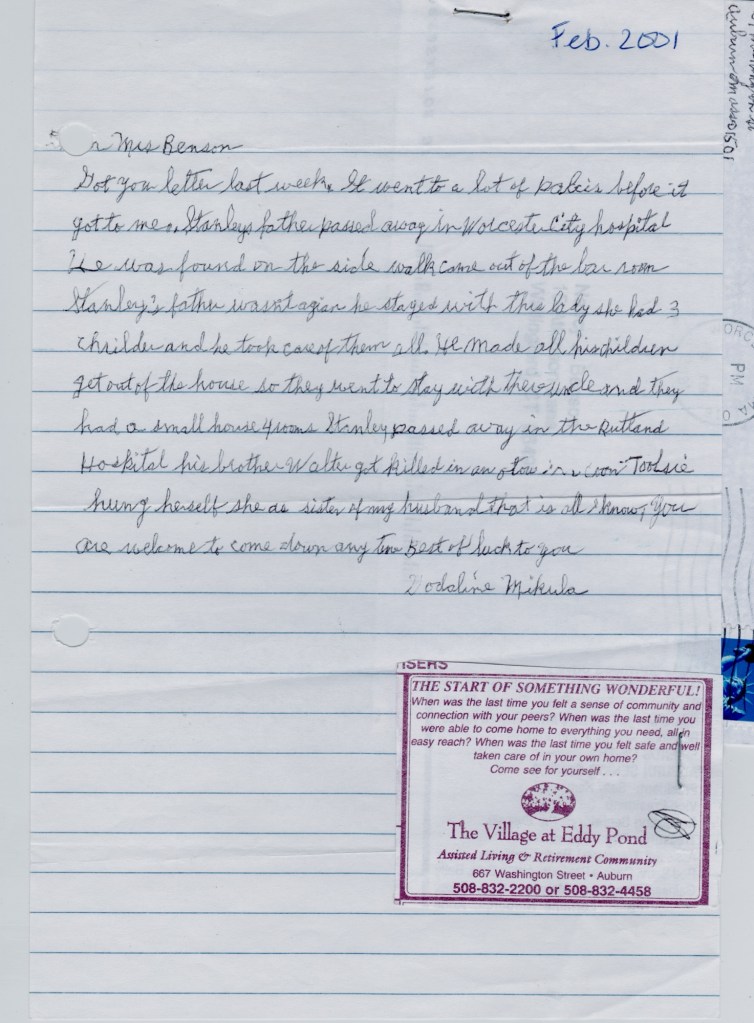
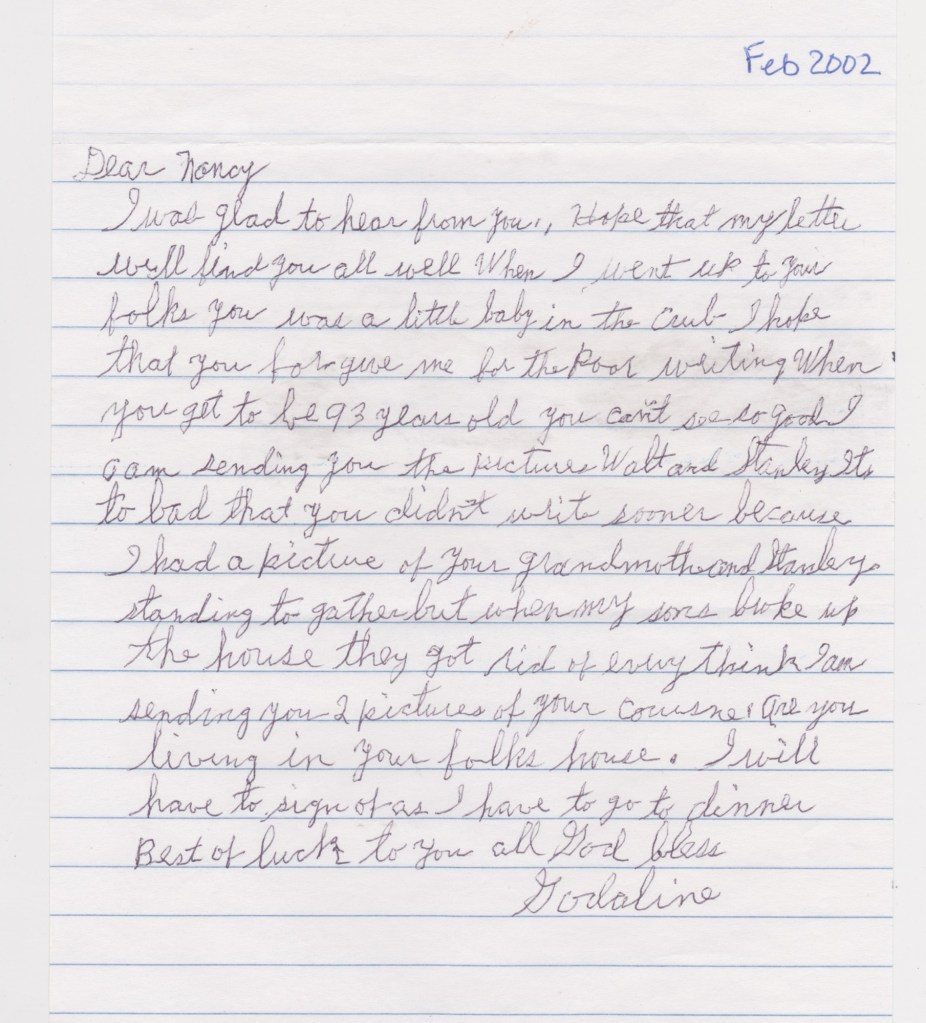
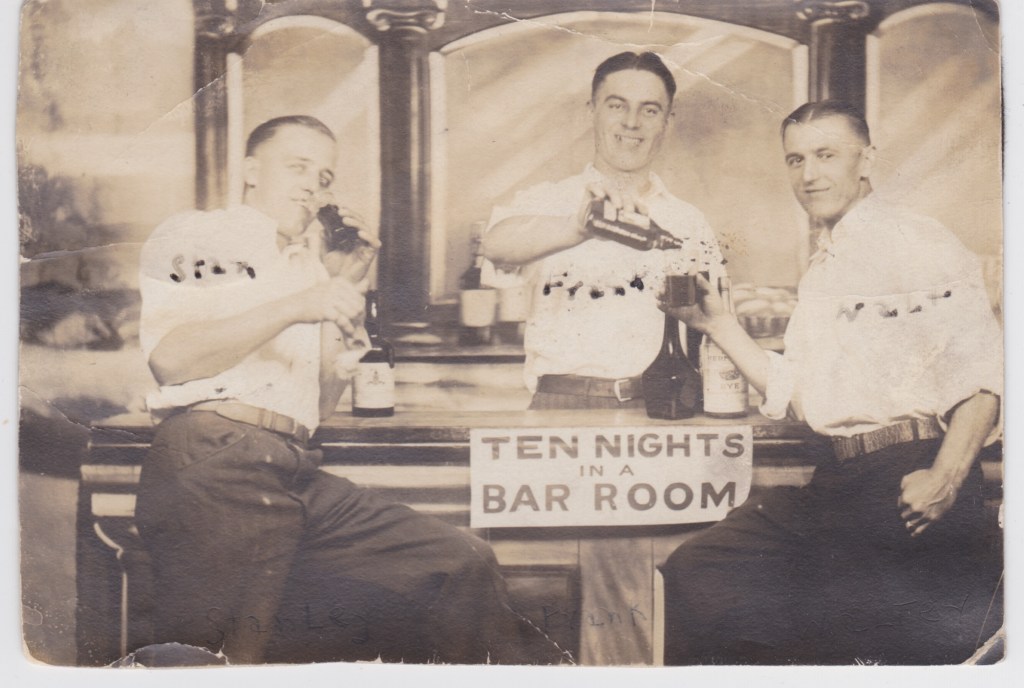
Stanley, Frank, Waltphoto from Godaline

Godaline passed away in 2006.

Godaline’s obituary

This is the end of the line for the family of Aniela and Joseph Mikula but I continue to try and connect to the DNA matches and will keep shaking those family trees!
More On The Mikula Family

Back in April of 2024, I wrote about the Mikula Family and my family’s connection to them. Aniela, the mother, was my grandmother Antonia Jakiela’s sister. Their maiden name was Liro.

I promised more about the sons, Walter and Stanley, but it’s taken a couple of years to get back to them. Which could be a good thing, because new search methods and new information continue to turn up. I’m going to share updates about the family members, but will still do a separate story on the sons.


Aniela, their mother, died in May of 1919 at the age of 48, from Tuberculosis of the bone, which caused gangrene of the spine. I didn’t give that much thought until I started on their story. Tuberculosis of the Bone is considered a serious extrapulmonary infection where the mycobacterium tuberculosis spreads from the lungs or lymph nodes to the bones and joints via the lymph nodes. The spine is the most frequent site and is called Pott’s Disease.


After Aniela died in 1919, Joseph married Anna Cerak, likely to help raise the younger children. My Auntie Helen remembers her as being very nice. Anna died in 1934. Joseph moved to Worcester and lived with Stanley and his wife until he died in 1945 at the age of 66.

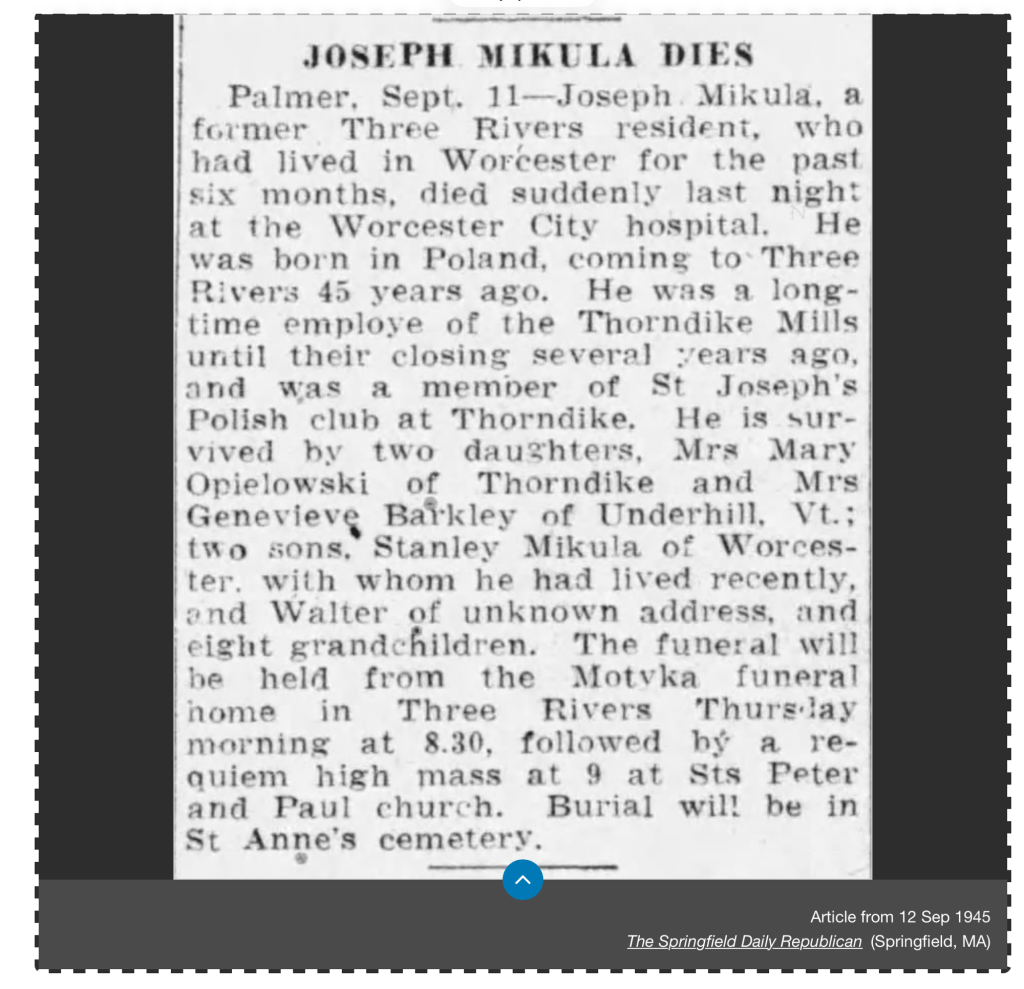
Joseph Mikula obituary 1945

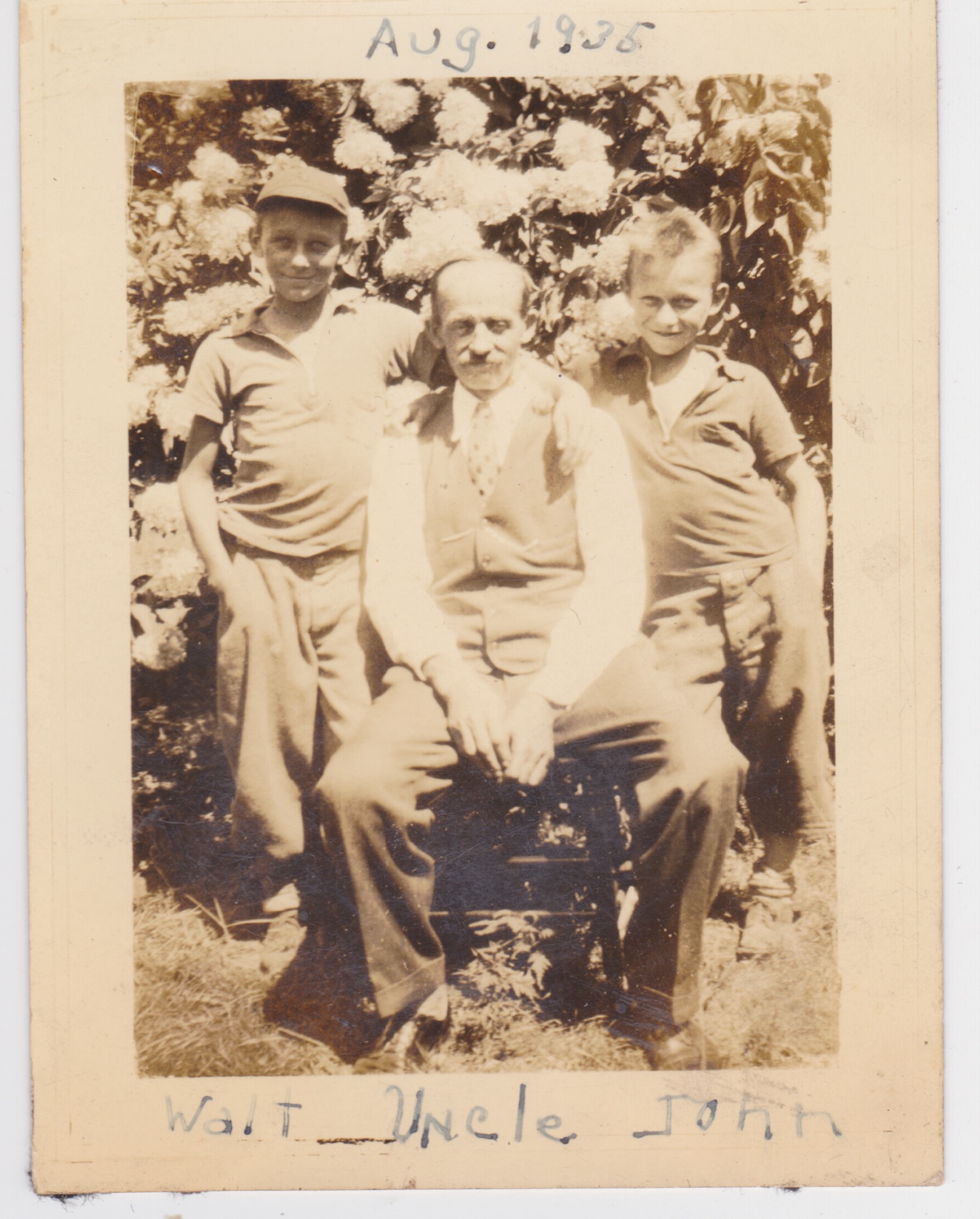
This is the only picture of Joseph Mikula I have. When my grandfather, Charles Jakiela, died in May of 1935, my dad John and my uncle Walt went to Thorndike for the summer. John had turned 11 and Walt was turning 13 that year.

Uncle Joe Mikula with Walt and John Jakiela

Catherine, born in 1907, third born, and first daughter, was hospitalized for at least four years at the Hampshire County Sanatorium with tuberculosis, where she died in September of 1934. She was an inmate there in the 1930 federal census. Her obituary listed her father and two sisters, Genevieve in Vermont and Kazimiera in Palmer, and two brothers, Walter and Stanley. My Auntie Helen remembered Catherine from the time she spent in Palmer after her mother, Antonina died in 1927. Catherine would have been 27 years old and they, my aunt and uncle Walt, who were 7 and 5 years old at time, called her Aunt Catherine because she was so much older than them.

Catherine Mikula obituary 1934

Bronislaw, born in 1909, the fourth born and third son, was listed in the 1910 federal census, but that was all I could find. Recently, I found a Palmer, Mass. death record for “Bronislaw M??l??R”, Father: Joseph, Mother: Allen Lera. It shows that Bronislaw died in July of 1910, at 18 months old, of gastroenteritis, which can be caused by contaminated food or water.


Genevieve, born in 1911, was the fifth born and second daughter and was the child with the longest life. She married George Blakey in 1930 and moved to Vermont, where he was a farmer. They had five children, 3 girls and 2 boys, between the ages of 12 and 14 months when he died at the age of 34 in 1943 after being in the hospital for 2 weeks “for treatment after a long period of ill health”. Genevieve continued to live in Underhill, Vermont, raising her children, and she died in 1983 at the age of 71 from breast cancer. Those five children produced 20 grandchildren.


Zofia, born in 1913, was the seventh born and third daughter. I have found Zofia in the Palmer birth records. I also have a copy of her baptism certificate. But that’s it. She’s not in the 1920 census, and there’s no mention of her in any family obituaries. I don’t know that I’ll ever find out what happened to her. She would have been about 14 years old when my aunt and uncle were living with them in 1927. My aunt said a daughter was called Tootie and she didn’t like her step mother at all. I wonder if Tootie was Zofia.


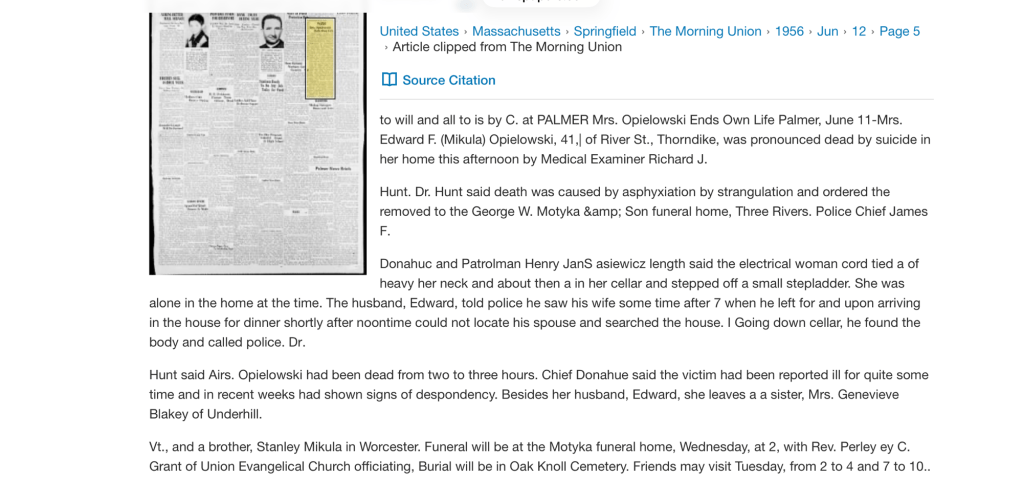
Kazimiera, born in 1915, was the eighth born and fourth daughter. I originally found Kazimiera in the 1920 census at 5 years old and in the 1930 census at 15, but nothing after that. When I found Joseph’s obituary online and saw the name “Mary Opielowski” I thought who else could it be but her? It was her.

Kazimiera and her husband, Edward, were married sometime in the early 1930s because the 1940 census says Edward, 26, and “Kay”, 24, were living in the same home as in 1935. I haven’t found any marriage records, but one might pop up. Kazimiera gave birth to a son, David, in 1941.

Kazimiera committed suicide in 1956, leaving behind her husband, son, sister Genevieve, and her brother Stanley. Walter was not listed in the obituary.

Kazimiera’s obituary (transcribed here)

Her husband Edward died in 1981, and their son David died in 2001; it appears he never married, but they both remained in Thorndike, Massachusetts.


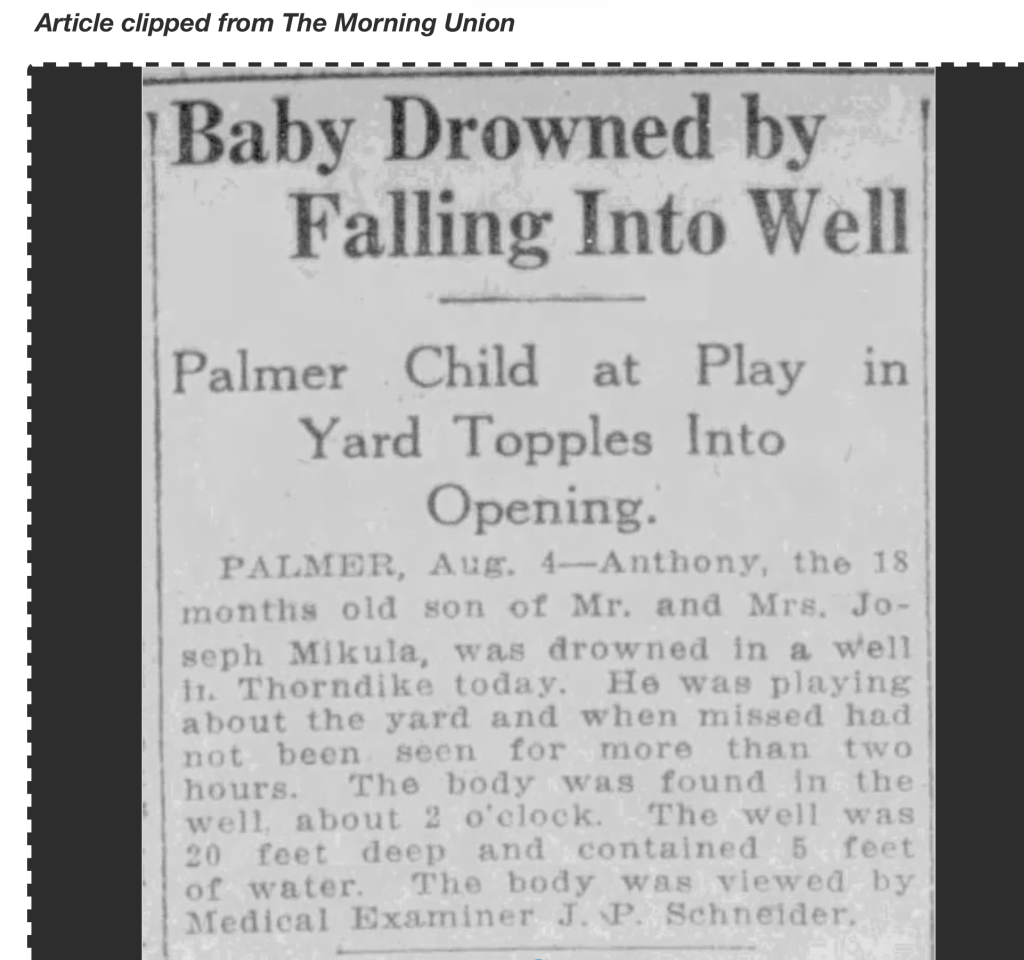
Antoni, born in 1917, the eighth born and fourth son, died in August of 1918 when he fell down a well. He was 18 months old.

Local newspaper article

This was not the only tragedy that summer. Mieczyslaw, born in 1918, the ninth born and fifth son, the baby of the family, died one month after Antoni from infant cholera when he was six months old. Cholera, “a disease of poverty”.

Next up – Walter and Stanley

Antoni Jakiela

My great uncle Antoni Jakiela was born in Lubatowa, Poland. Lubatowa is located in southeastern Poland, and from 1772 to 1918 was part of Austrian Galicia. Antoni is my grandfather Charles Jakiela’s younger brother.

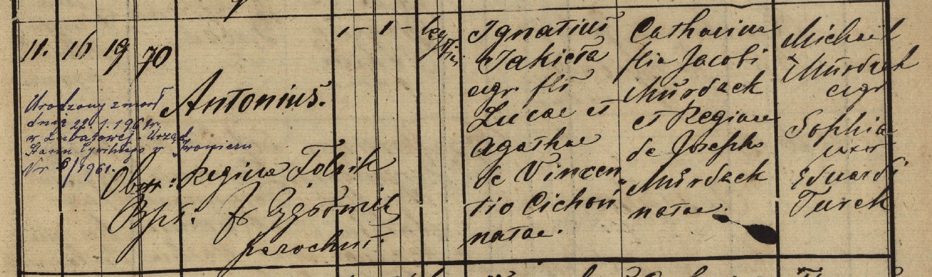
Antoni was born on January 17, 1893, to Ignacy and Catherine Murdzek. Charles was three years old when he was born. Their sister Agnieszka was born a year later.

Their mother died in June of 1894, the same year Agnieszka was born. Trying to raise three young children, Ignacy, at only 39, quickly remarried. On October 11, 1894, he married Victoria Borek. There is no record of any children from that marriage, but I continue to scour records.

When his brother Charles left for the United States in 1906 at the age of 16, Antoni was 13.

Both brothers served in World War 1. Charles served for the United States from Southington, Connecticut, through Camp Devens at Ayer, Massachusetts, as part of the 301 Trench Mortar Battery and the 302 Field Artillery.

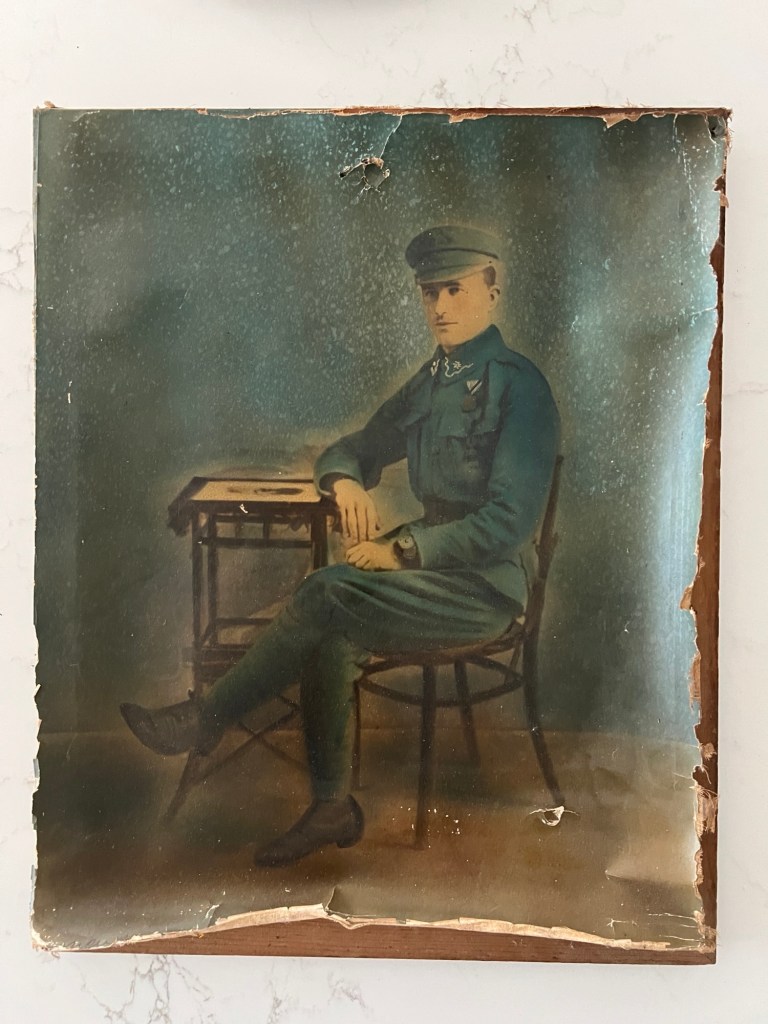
Antoni served in World War 1 with the Polish Legion based on this picture that has been in the family for many years. I shared the picture with a few Polish Heritage/Genealogy groups on Facebook and was told that it is a uniform for the Polish Legion based on the “maciejówka” cap and the zig-zag design on his collar. The one silver star on the collar is for the rank of lance corporal. The Polish Legion fought alongside Austria-Hungary troops against Russia. The cap was part of traditional folk attire in many regions of Poland and became part of the Polish Legion uniform. After Poland won its independence in 1918, the cap was thought to look too much like the German WW1 garrison hat, so the Polish army moved to a peaked 4 cornered cap.

Antoni Jakiela World War I

This is a 12×14 canvas portrait. Portions of the canvas are still attached to the wooden frame but one corner is secured with a nail. There is a piece of cardboard on the back attached to the frame, and two nails with a heavy string between them for hanging.

How and when was it sent to the United States? Was it received when Charles and his family were still living in Southington after the war? If so, where did it hang in their home? Charles died in May of 1935, and the children, ranging in age from 22 to 10, remained in their Wallingford home until Steve married Bertha Liedke in 1937. The family moved to Ward Street and finally to the Liedke family home. At some point, the portrait ended up in the back of the garage. When I began my ancestry work on the family, my cousin passed the portrait on to me.

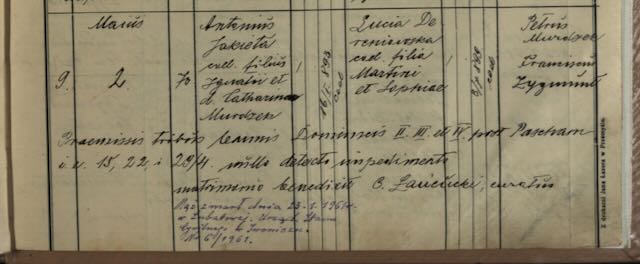
The next information I found for Antoni was his marriage to Lucia Dereniovoska (sp) on March 2, 1923. I haven’t been able to find any birth records for Lucia in the Lubatowa area with any similar spelling.

Antoni Jakiela and Lucia Dereniovoska marriage on March 2, 1923

This marriage record gives me both of their birth dates, and the #70 house number tells me Antoni is still living in the house his family lived in when he was born in 1893. The bottom of the form, in blue writing, says “husband died 23 January 1961, Lubatowa”. I don’t have any information on Lucia’s death.

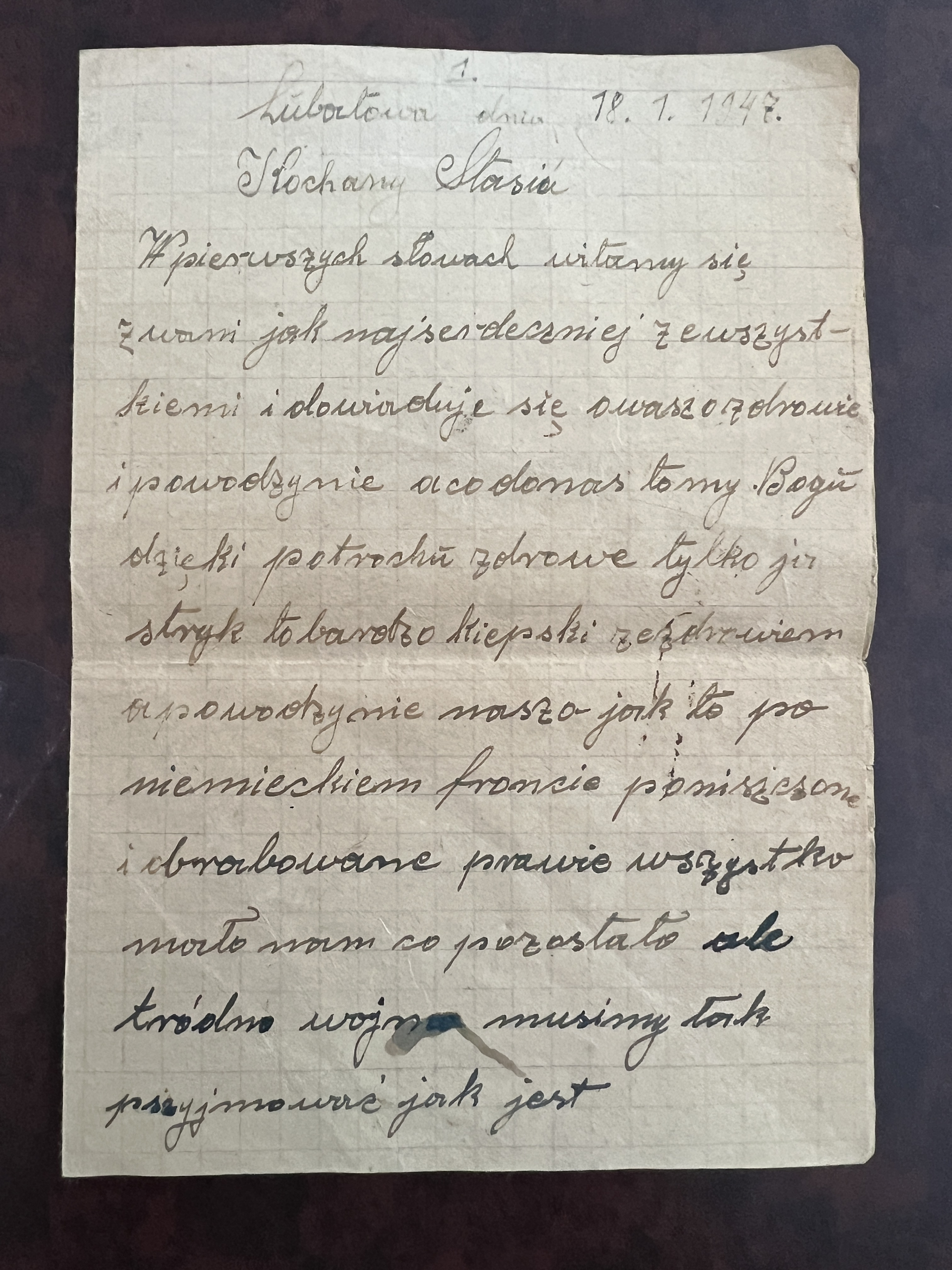
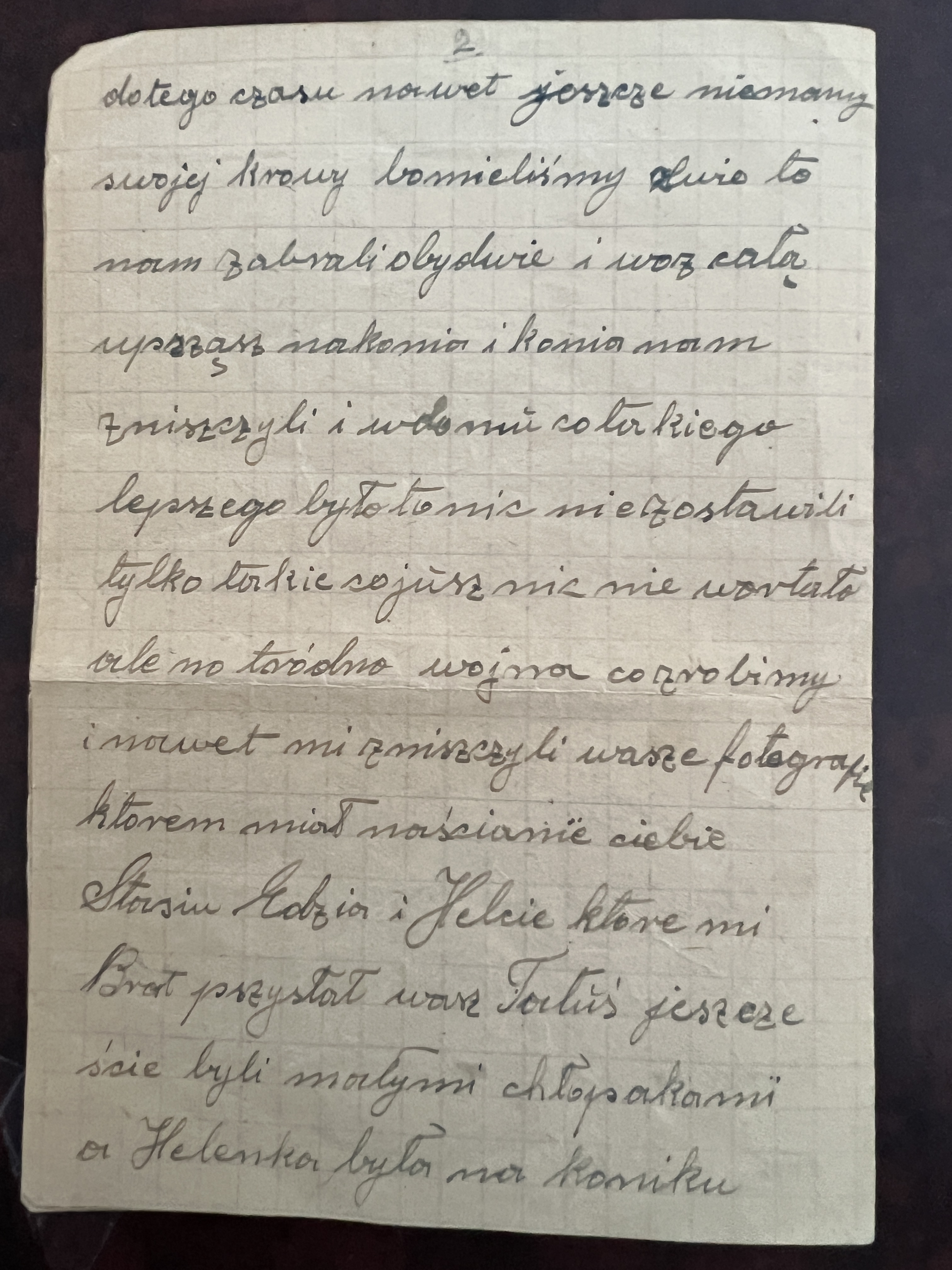
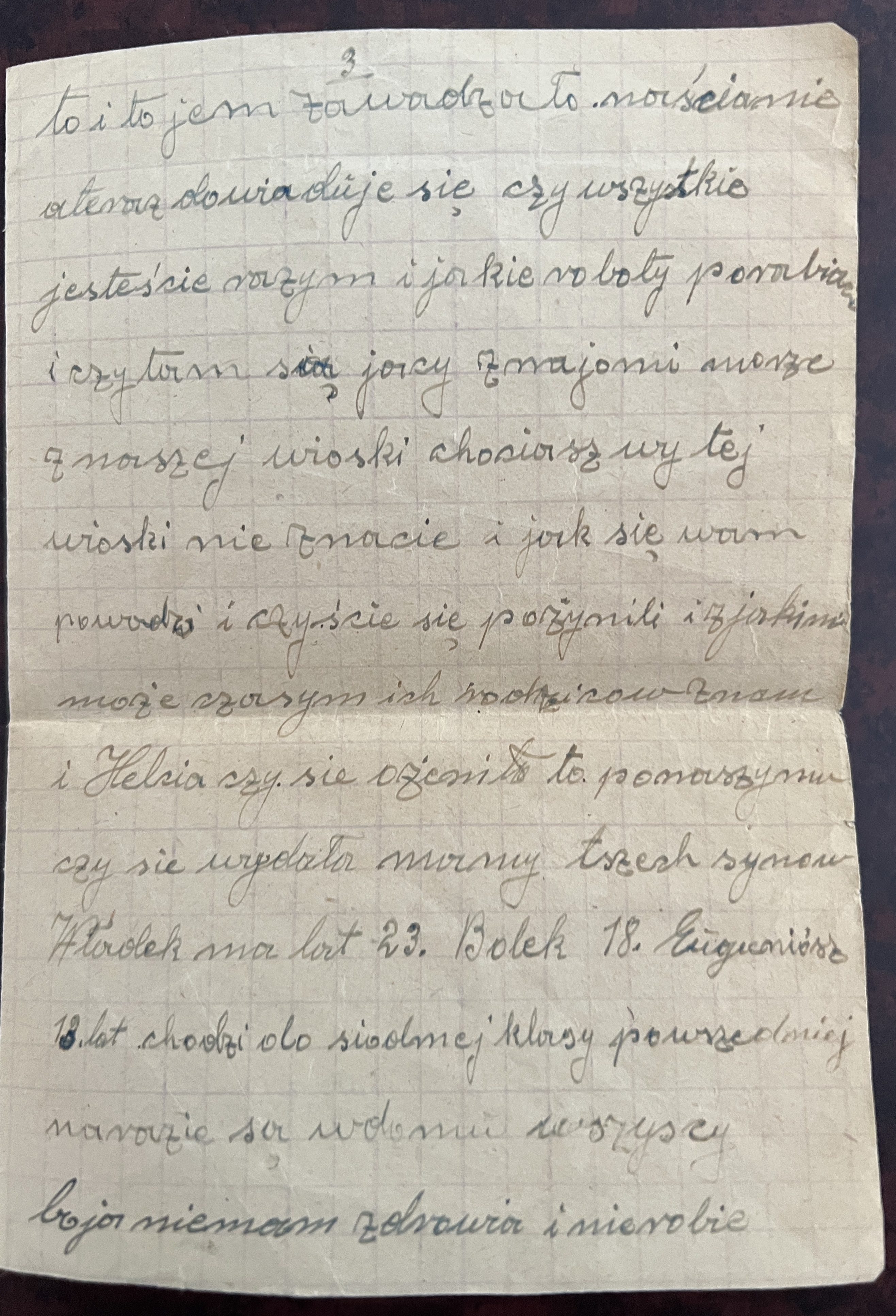
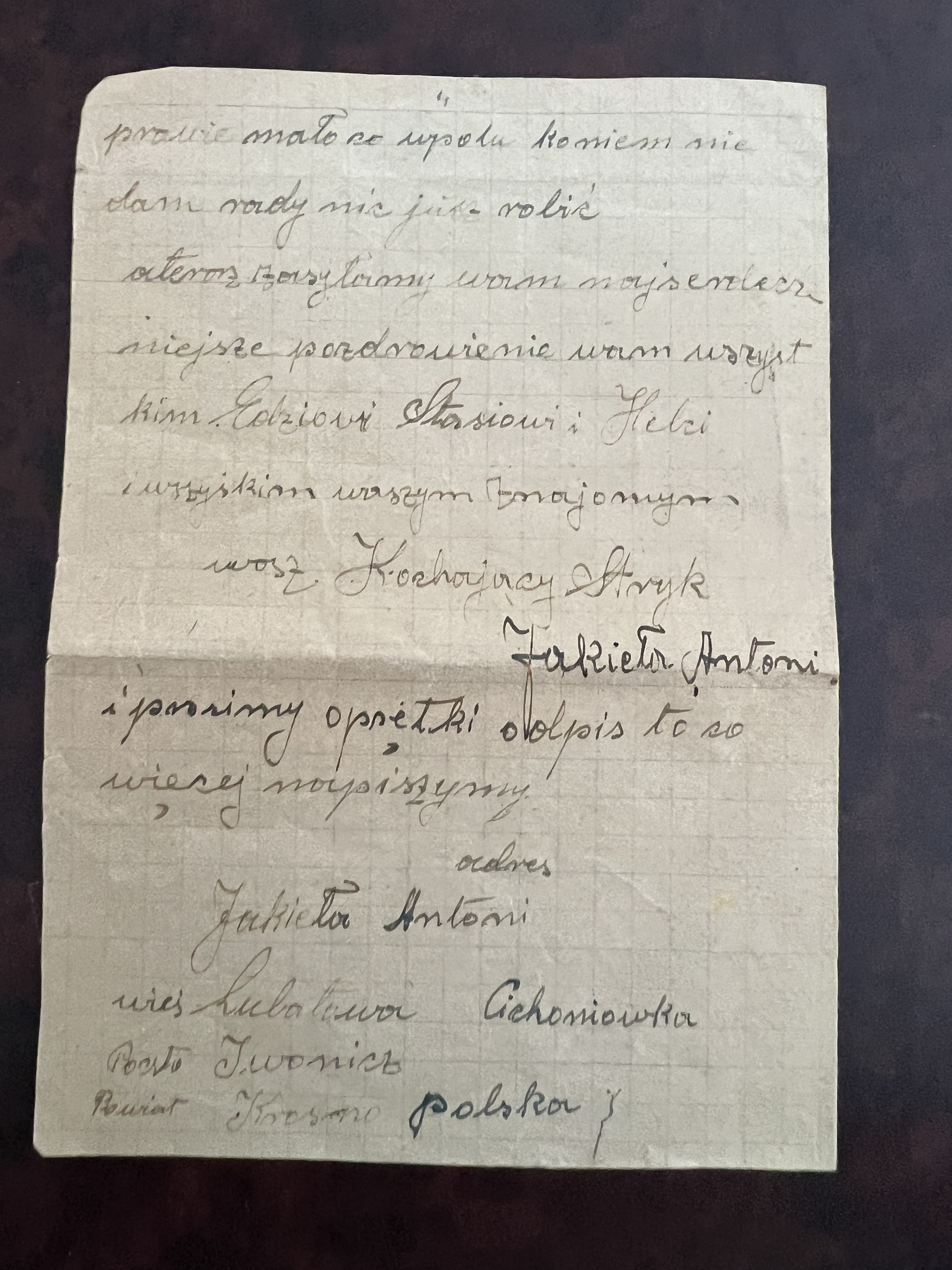
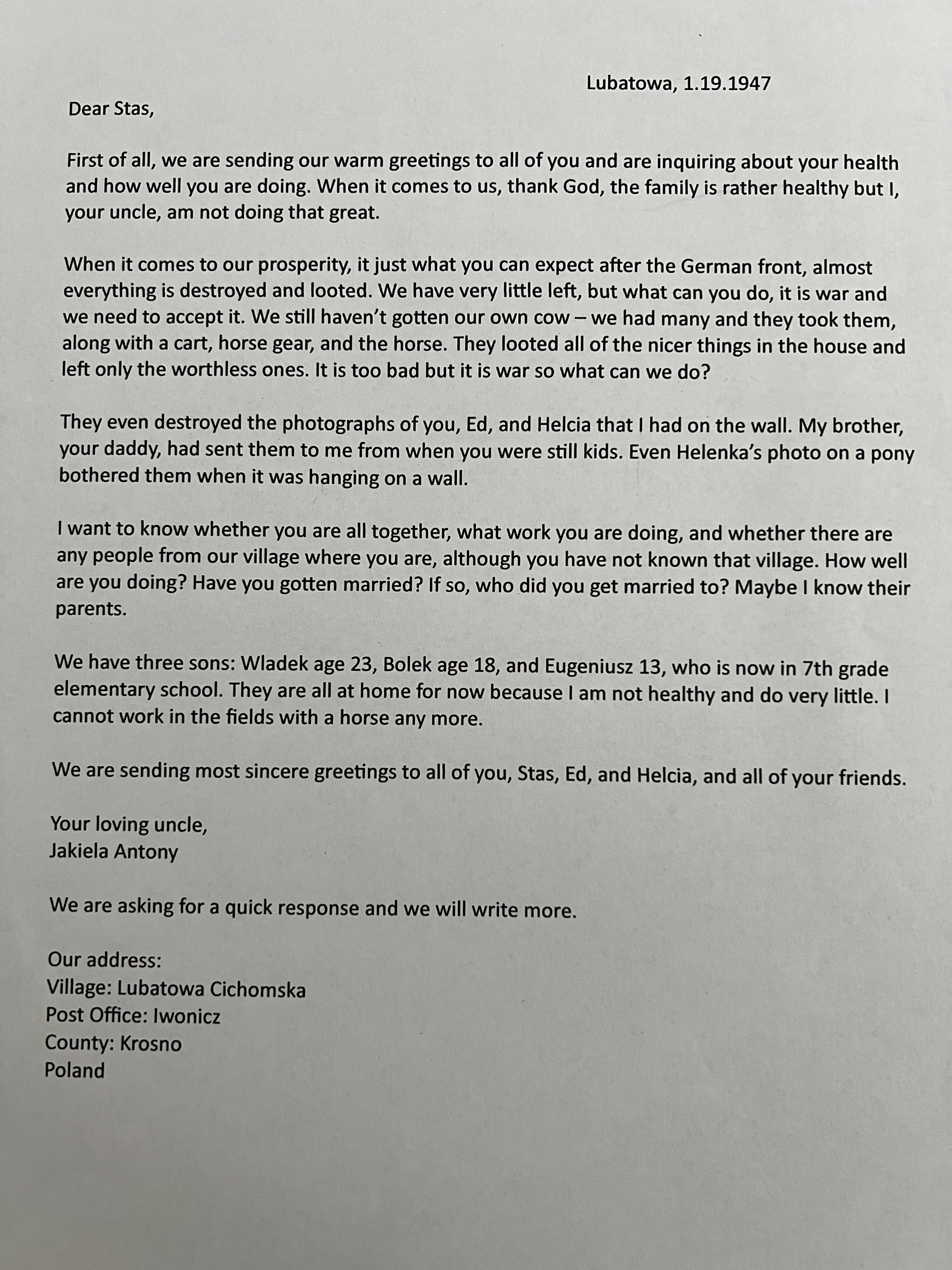
An amazing treasure that provided information on Antoni and his family was found while cleaning out my Auntie Helen’s apartment after she passed away in February of 2015. It was a letter from Antoni to Steve, Helen’s oldest brother. The information and questions in the letter indicate that there had been little communication between them. The letter was dated January 19, 1947, almost 12 years after their father and Antoni’s brother Charles had passed away. Of course, the letter was in Polish, and evidently, “old style” Polish, which was difficult for a fluent speaker to translate!

I don’t know if anyone ever responded to Antoni, but without this letter, I never would have known of their three children and their ages.

Antoni was 68 years old when he passed away in January 1961. I don’t know if life got any better in the town of Lubatowa. I hope so.

The Caregiver

The Week 2 topic for 52 Ancestors in 52 Weeks is “A Record That Adds Color”.

In 1912, my grandmother, Julianna Ingram Posluszny was 24 years old with a husband, a daughter Antoinette, born in January 1909, and a son, Conrad, born in November 1910.

Julianna, Konrad and Antoinette (late 1909)

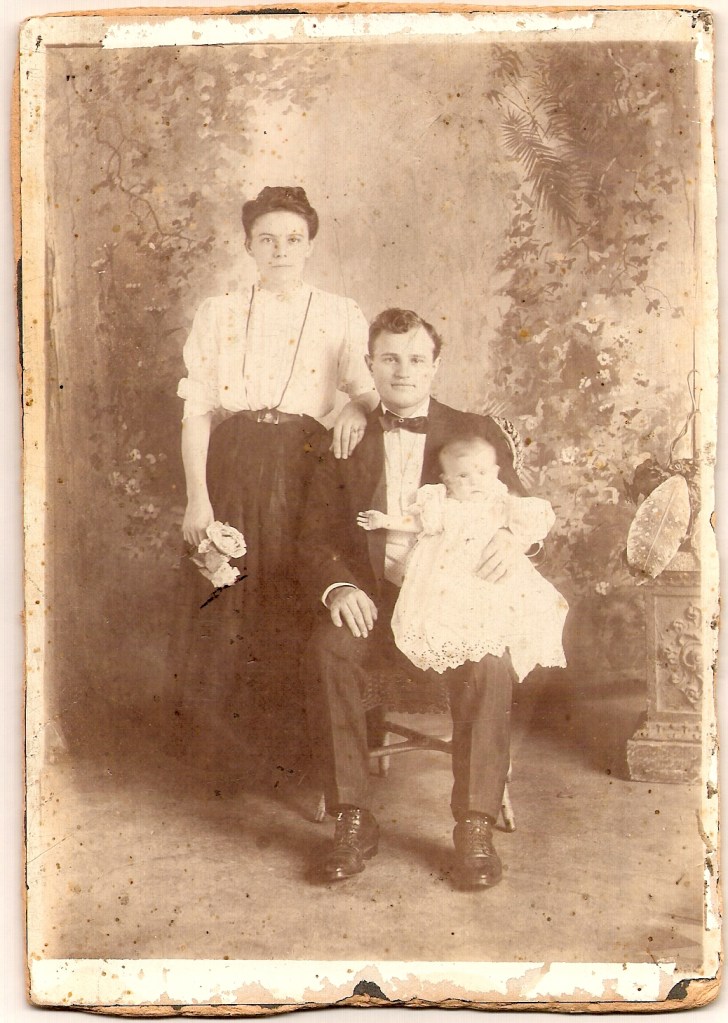
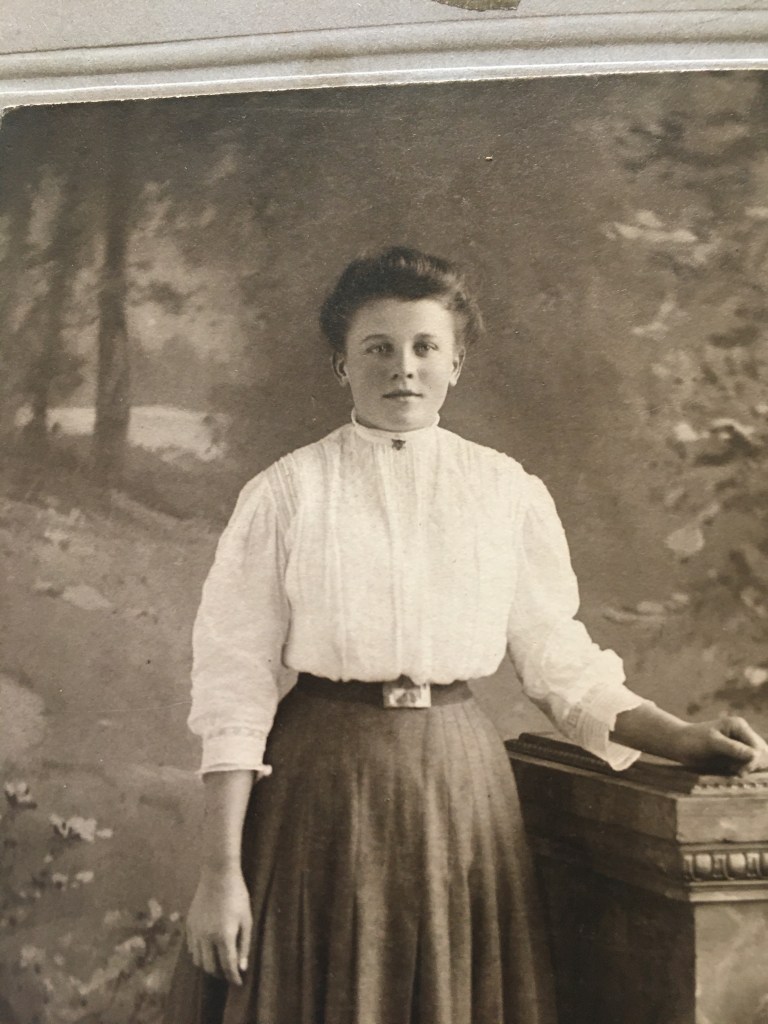
Her cousin, Mary Kukulska Juszczak came to the United States with Julianna’s sister, Marianna in 1907. Mary’s daughter Mary was born in 1910. Sadly, some time in the same year, Mary’s husband died in a work accident at the sugar refinery. But the following year she met and married Michael Zupko.

Mary Kukulska Jaszczak date unknown

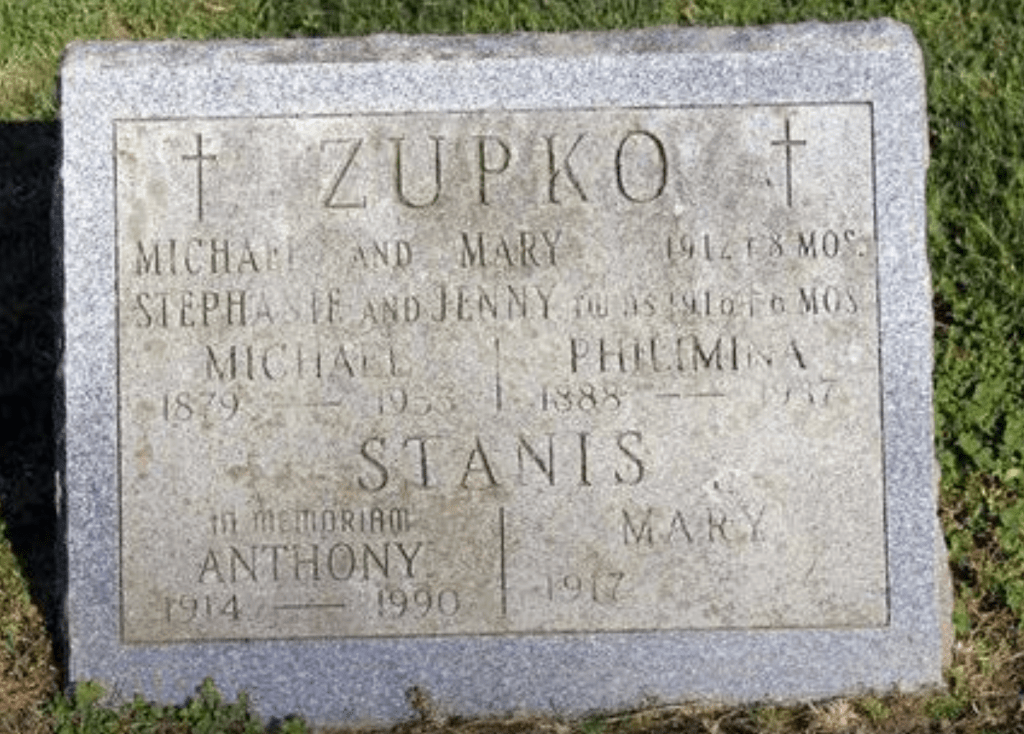
It was in April of 1912 that Mary gave birth to a son Michael Zupko. The only record to be found is their headstone with the year, 1912.

Mary and Michael Zupko 1912

Suddenly Julianna found herself as little Mary’s guardian. Her stepfather didn’t want to take care of her and asked my grandmother with a 3 year old, a 2 year old, and a baby on the way to take her. How could she refuse? She now had 3 children under the age of 4.

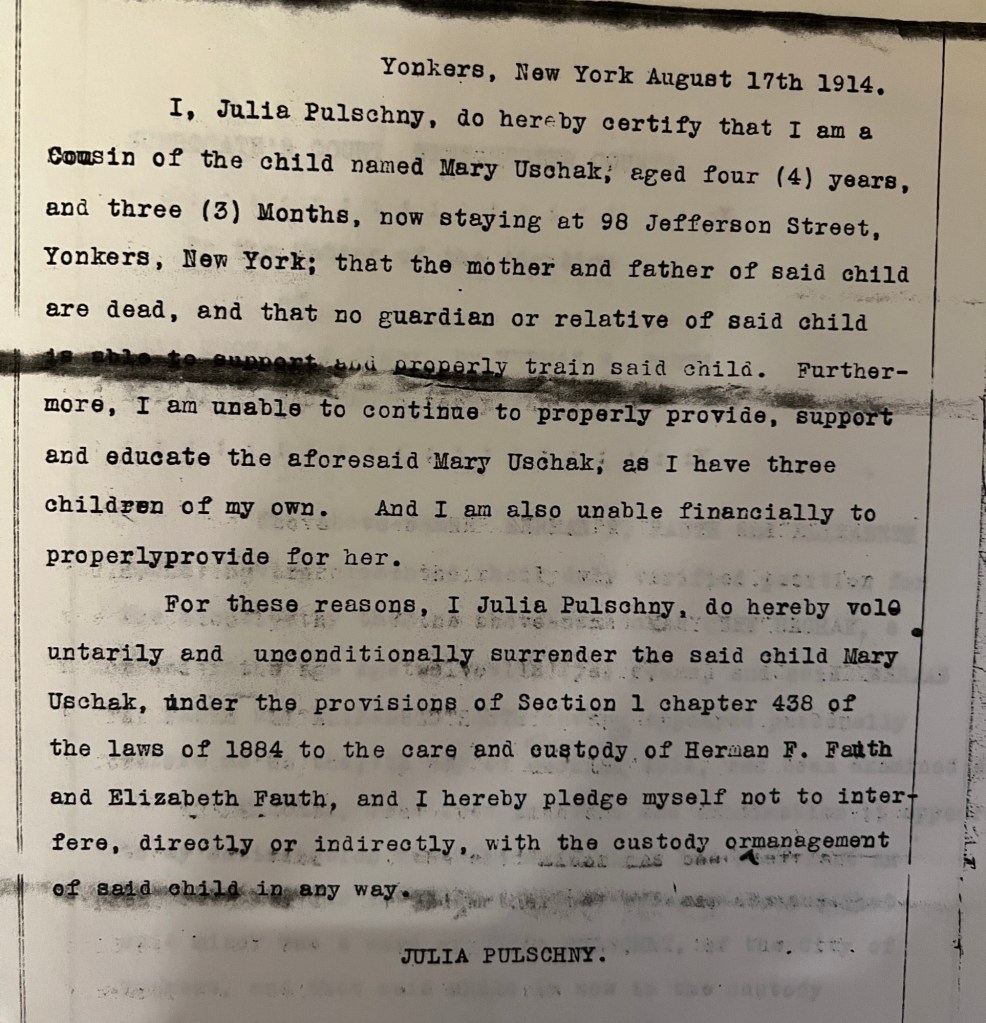
Her son, Louis, was born in February of 1913. She and her husband, Konrad, hung in there as long as they could but in 1914 they realized they had to give Mary up for adoption.

Julianna’s testimony August 1914

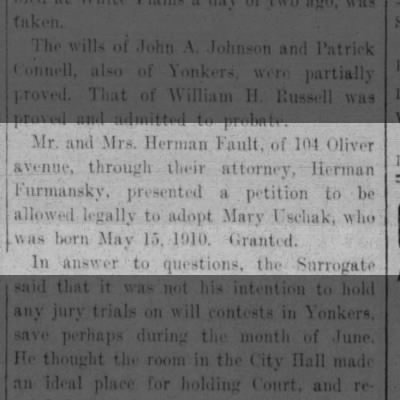
Fortunately, Herman and Elizabeth Fauth, German Methodists who had recently lost a daughter, heard of Mary through their church and petitioned to adopt her. Mary never had to go to an orphanage.

The adoption was final in October of 1914. My grandparents would go on to have a daughter Julia in 1917, and my mother Elizabeth in 1922.

Adoption notice October 1914

What a loving thing my grandmother did! Two children of her own and one on the way, and she takes in, I’m sure without hesitation, another 2 year old. She was always a very giving person but this information helped me see her in such a different light.

I wrote about this in January of 2020 when I was contacted by Mary’s granddaughter and 2 years later when “who died when” was determined by an ancestry relative.

Admirable Ancestor

The Week 1 topic for 52 Ancestors in 52 weeks for 2026 is “an ancestor I admire” and after looking at my family tree, I’ve decided that falls on my great grandmother Carolina Straub Posluszny Bonk. Although, technically, she is not my biological great grandmother, her son, Konrad and my grandmother Julianna Ingram were 2nd or 3rd cousins, so there is Carolina DNA in my body.

Carolina was born on April 12, 1855 in Wildenthal (what is now Dzikowiec) in the Galicia region of Poland. She was part of “an ethnic German population living in the Kingdom of Galicia and Lodomeria in the Austrian Empire established in 1772 as a result of the First Partition of Poland” (Wikipedia). This area was also known as Austrian Galicia or Austrian Poland for my family members asking are we Polish or Austrian or German? The answer would be “all of them”!

If her siblings list is accurate, Carolina was the 11th child born of 15 to her parents. Four of them born prior to her, died at birth or in their infancy. Carolina herself would give birth to 14 children with eight living past five years old.

She married Joseph Posluszny on May 31, 1876 in Wildenthal and she gave birth to her first child in March of 1879 when she was 24 years old.

Seven months following the birth of her daughter Elizabeth Eva in September of 1896, her husband and my great grandfather, Joseph Posluszny passed away. Carolina became a widow at the age of 41 with seven children ranging in age from 16 to 7 months old.

Last September, another of Carolina’s great-granddaughters through her son Joseph contacted me after finding this blog in google. She told me the following: “Pa’s father had been the village blacksmith. Pa’s father had an apprentice. His name was John Bonk. When Pa’s father died, John Bonk took over the blacksmith shop and apparently the family. Pa was not happy with this and it was about that time that he left Austria.”

Carolina and John Bonk were married on May 12, 1898. Carolina gave birth to a daughter who died at birth and in 1903 at the age of 48, gave birth to a son Walter John Bonk.

Her older sons did head to the United States shortly after her marriage to John. Her son John left in 1899, Konrad in 1900, and Joseph in 1901.

Carolina, John, daughters Mary and Elizabeth, and their son Walter immigrated in July of 1907 and resided in Perth Amboy New Jersey until their final destination of Wallingford Connecticut.

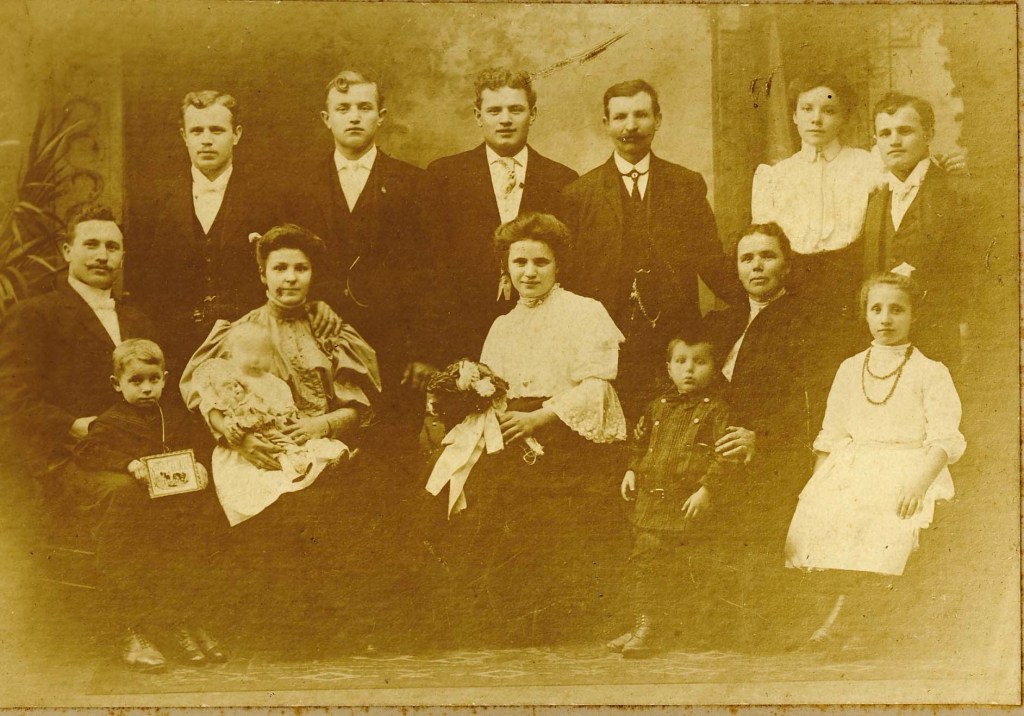
The Posluszny/Bonk Family about mid/late 1907

This photo ends up in nearly every Posluszny post. Carolina is seated on the right, with her son Walter in front of her. She is 52 years old at the time of this photo in 1907.

Frank and Josephine Posluszny wedding 8/1909 – Carolina front left, husband John Bonk behind her

She, along with her daughter Mary, was an active member in the local Polish National Catholic Church in Wallingford, St. Casimir’s Church.

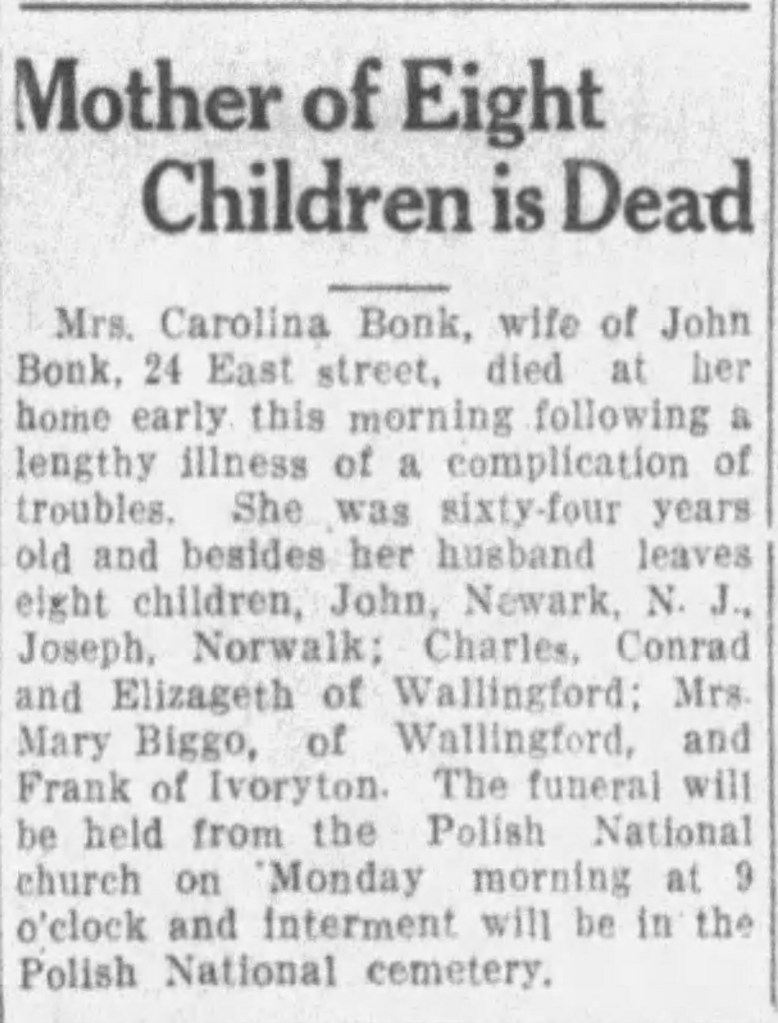
Carolina died at the age of 70 (not 64 as the newspaper article said) after suffering from stomach cancer. My Aunt Judy told me in a conversation years ago, that she and her mother, my grandmother Julianna, would go to Carolina’s house a few blocks away to take care of her when she was ill. Also, that my grandfather Konrad and Julianna were kind to her second husband. Carolina and John gave my grandparents the downpayment for their home in Wallingford on Clifton Street. I found it touching that my grandmother did the same for my parents when they purchased our home here on Atkinson Lane.

Carolina’s obituary 3/14/1925

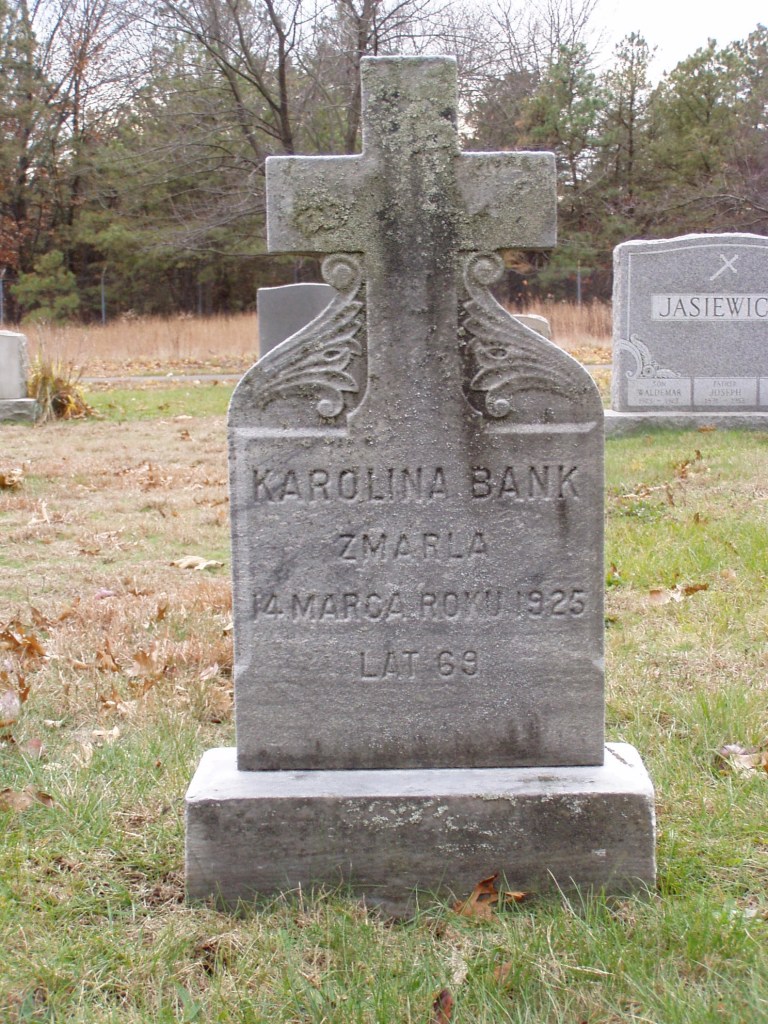
She is buried in the Polish National cemetery in Wallingford.

Carolina Bonk – St. Casimir’s cemetery

I can’t imagine a life with 14 siblings, or to give birth to 14 children only to have 3 die in the same year from smallpox. I don’t know the cause of her husband’s death at the age of 43, but with young children still at home and a business to run, the best option was to married the hired help. She did what she had to, to survive. She was well-respected in her church and community at their death and that makes me proud of her.

Looking Back at 2025

Yesterday, I took a trip down memory lane of the people I researched and wrote about this past year. I’m proud of the information I found, stories I wrote, and living relatives I uncovered during my search. Here’s a review month by month….

January

I started the year with a couple of posts from the 52 Ancestors in 52 Weeks Challenge by Amy Johnson Crow. The first topic was “In the Beginning,” and I chose to write about my parents’ courtship and wedding. I had fun going through old photos of them from their wedding and trips with my aunt and uncle. Ancestry provided the high school yearbook pages and my mom’s collection of postcards showed us the sweetness in their relationship.

The second post was “Favorite Photo.” My favorite photo will always be the Posluszny Family photo that started this crazy research journey! I think it is in every post I wrote about the family this year. It’s probably time to frame it and put it on a wall.

The third post in January told the story of my great-uncle John Posluszny. At the end of December 2024, I wrote about solving the “mystery” of his death in 1942, so I really wanted to start my Posluszny series with his story. I connected with his granddaughter, Janine, in 2012, and she shared the photos of her father, Stanley with me. I enjoyed finding and sharing the newspaper articles with her. I currently have a message out to a great-granddaughter of John and hope I hear from her to make another family connection.

February

On the 1st of February, I wrote about my mother’s diagnosis of brain cancer. Even 38 years later, memories were fresh.

Next up was a little break from family with a post about a sampler completed in 1817 and found by my father in the attic of his paint store in the early 1980s. He held on to it always curious about where it came from. Unfortunately, I didn’t think about researching it until after he passed away in 2010. I still haven’t delivered it to the Portland Historical Society!

Another great uncle, Joseph Posluszny, was my next subject. I can hear to this day my Aunt Judy saying, “Uncle Joe Post”. I’ve worked with his great granddaughter on Ancestry for many years and the majority of pictures I have came from her. In September, I was contacted by one of Joseph’s granddaughters who lives in Connecticut about 45 minutes away. I look forward to getting to know her better and hearing her stories!

This post was born during my Posluszny research when I noticed, after 15 years of research, that my great grandmother, Caroline Straub is listed on the 1910 census as having given birth to 14 children with 8 of them at the time still living! I headed over to the amazing Geneteka website, started searching, and managed to find the records for five children who died either at birth or a very young age.
March

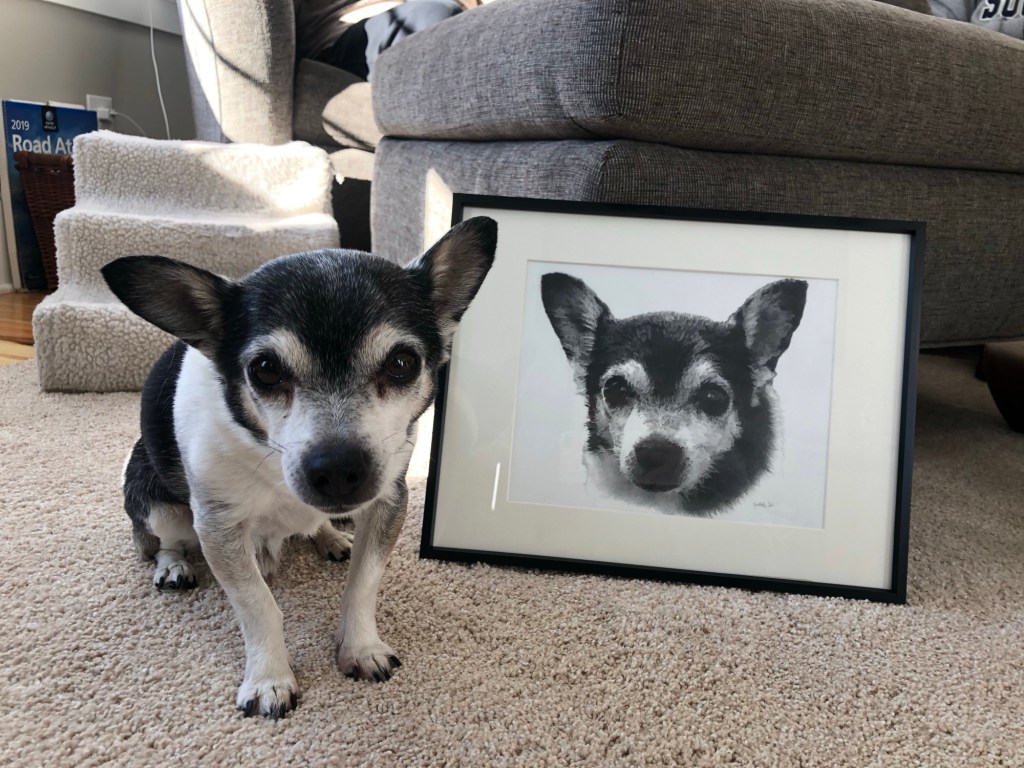
Early in March we said goodbye to our sweet chihuahua, Wally and late in March was the anniversary of my dad’s passing.

Wally with his portrait

April

The 98th anniversary of my grandmother’s passing was in early April and if you don’t know her story, you can read it here.

I wrote about my great uncle Frank Posluszny. He was a tough one over the years to find anything about because he was in a mental institution from the 1930 federal census to the 1940 census. I had very little information on the family and wasn’t sure where to look. But as the years go by, more information becomes available and I was able to find his great-granddaughter! We emailed back and forth and she actually knew him! She sent pictures which I included in his story.

Josephine, Frank, and Mildred Poslushny

May

I spent May working on my great uncle Charles Posluszny’s story. I posted once to check in to say I was working on him and at the end of the month, completed it. Once again, there are grandchildren and great grandchildren alive, but in this case, I don’t have a way to contact them.

June

June was busy with visiting relatives and a trip to Chicago so there were no posts in June.

July

In July I wrote about the sisters in the Posluszny family, Mary Posluszny Biega, and Elizabeth Posluszny Laçź. One who was well known and the other who disappeared without a trace.

August

I finally made it to the last of the Posluszny children, Walter Bonk, son of Caroline Straub and her second husband John Bonk. I knew all of his children and his grandchildren.

My second post was the result of a stranger’s request on Ancestry looking for “living relatives of Alfred Donroe”. He was my cousin in law’s father and he died in World War II. This person in France is working with citizens of Gouesnou France to create a permanent memorial to the soldiers and civilians who died there. I received a comment on there from my younger cousin, and we had a nice email conversation. He and his wife plan to go to France to see the monument.

September

The last quarter of the year I focused on my maternal grandfather and his family. Their lives were so entwined for many so years, that the first story takes you from Jacob and Katherine’s arrival in the United States through 1916. This was Part 1.

October

Engram Family Part 2 took place from 1916 through the 1930s. I became acquainted with a second cousin a few years ago and he sent a slew of family pictures. I also began searching on Newspapers(dot)com using family member’s names where I found Kitty and Louise playing basketball!

Later in the month, I wrote about Theresa, Katherine, and Louise from the 1930s through their lives. My half aunt Joanne shared photos with me as well as few letters Katherine wrote to Theresa’s daughter Irene. I’m grateful to Joanne for the information and the years of emails back and forth. I saved them all and finally printed them out and put them in order. I was overwhelmed by the amount of information that suddenly made sense!

November

Five posts in November! First up was the lives of Elizabeth and Hannah. Elizabeth had an interesting situation which deserved a post to explain it. It’s amazing what a person can find when they look hard enough, and have help from strangers on Ancestry! Thanks to Newspaper(dot)com again, I discovered a third cousin living about 20 minutes away!

Elizabeth, Hannah, and Louise 1940s

In time for Veterans Day, I shared a post from June 2024 called The Effects of War about my grandfathers in World War I, and uncles in World War II.

Then it was back to the Engram Family with Jacob Sr.’s story. I wish I knew more about him!

My cousin, Brian, messaged me pictures of a letter Jacob Jr. wrote to his sister Theresa. The war was over and he was waiting to go home. When Brian and I got together during Thanksgiving week, we sifted through all the Engram pictures and letters and there were more letters from Jacob to his sisters. They were very interesting to read.

December

I wrapped the year up with a re-post of December 7, 1941, the story of my Uncle Walt during the attack on Pearl Harbor.

I rounded out the Engram family with the final story of my grandfather Jacob Jr. I learned so much about him from my Aunt Joanne’s emails that again, didn’t make sense until it was time to write his story.

Jacob Jr. early 1940s

And here we are – the end of the year! I’ve signed up again for the 52 Ancestors in 52 Weeks challenge and I will be looking through my family tree for new ancestors to tell you about!

Happy New Year!

Engram Family Part 4 – Jacob Jr.

We are now at the end of the Engram Family stories, and I’ve saved my grandfather for last. His relationship with my grandmother is included here.

As I mentioned in my post about his father, Jacob Sr., Jacob Jr. made sure his father was cared for throughout his life. I think the same applies to his relationship with his sisters.

On December 16, 1934, Jacob, at the age of 39, married Anna Marie Winner of Vleigh Road, Queens, NY. She was the 24-year-old daughter of Henry and Joanna Winner. She had a brother who was six years older. They lived on a farm, which was close to Jacob’s farm in Queens in the 1930 census. Her father and brother were farmers, and in their household were three male boarders who worked on the farm, and a 44-year-old woman who was listed as a servant.

Jacob, Anna, Henry, and Joanna December 16, 1934

In the 1940 census, Jacob and Anna were renting at 136 Catskill Avenue in Yonkers, and Jacob was a partner with his childhood friend, Morris (Mo) Sherman, at Sherman Chevrolet, at 561 Central Park, Yonkers, NY.. In addition to the dealership, they owned a parking lot directly across from the main entrance to Yonkers Raceway, which now includes Empire City Casino. During racing season, they took turns working the lot with the help of a crew of his sister Elizabeth’s relatives.

Jacob Jr. early 1940s

Jacob and Anna’s daughter Joanne was born on March 11, 1945. She has the same birthday as my husband. This was 10 years into their marriage, and Jacob was approaching 50 years old.

When Joanne was 7, Jacob and Mo sold the dealership, but became partners in the business of second mortgages and, of course, the parking lot. Joanne says, “he was an ‘at-home’ Dad for most of my life…”

Jacob’s education ended at 7th grade, but he was born with a love for reading, history, and travel. Every day, he went out for the Daily News and the Daily Mirror, and the local Yonkers paper was delivered to the house. On weekends, he picked up the New York Times. Multiple magazines were delivered to the house each month. He loved reading biographies of famous men, plus subjects related to history.

The love of reading, the books, magazines, and newspapers are identical to my mother and to our house growing up!

He loved to travel. I found a ship manifest from his return passage to the United States from Havana, Cuba, in April of 1928. One of his favorite locations was Florida. Joanne says that when she was very young, they spent parts of winter in Miami, visiting Aunt Joan (formerly Hannah). When Joanne was nine, the family traveled on the Queen Mary out of New York and spent seven weeks traveling through France and into Germany to visit her mother’s relative in northern Germany. After she graduated from high school, they traveled back to Europe, visiting England and the northern countries.

Travel didn’t have to be something grand, though. Jacob found enjoyment in “going for a ride”. It could be an evening ride through the back roads of Westchester, or weekend trips “out on the island” (Long Island), sometimes to New Jersey or up the coast to Connecticut and beyond.

Unfortunately, drinking was a problem in their home, on a “cyclical basis”. He drank, and her mother would join him. He would go from very quiet to loud and angry. This was something Joanne talked about in our correspondence: of her being the sober one in the house and seeing and hearing a lot of “not for children” content growing up. Perhaps his drinking led to his estrangement from his sister Kitty in the early 1950s.

But because it was cyclical, for most of the year she was able to see another side of Jacob. She saw what a generous, quiet man he was, who loved to read the papers, tend to his flowers, and visit historical sites. A man who was as comfortable with bums in the Bowery as he was in First Class on the Queen Mary.

Jacob suffered a heart attack in 1966 when he was 71 years old and became ill in late 1973. Joanne was living in Pennsylvania, and by the time she came home, he was in the hospital, where he died on January 24, 1974.

Twenty-seven years later, my cousin Judy received an email from Joanne in response to a card Judy sent to Joanne’s (now deceased) mother informing her that our Aunt Tootsie was in a nursing home. Ann Engram must have been on Aunt Tootsie’s Christmas Card list. As they say, “the rest is history!”

Thoughts From France

While I work on the final post for the Engram Family which will be my grandfather, Jacob Jr., I wanted to share something I received from my new second cousin, Brian.

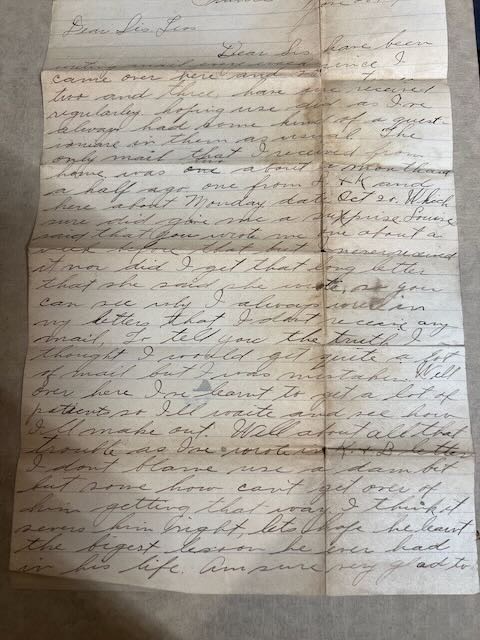
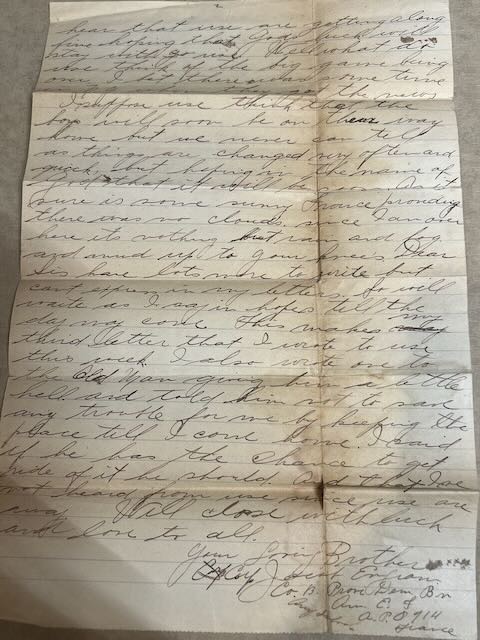
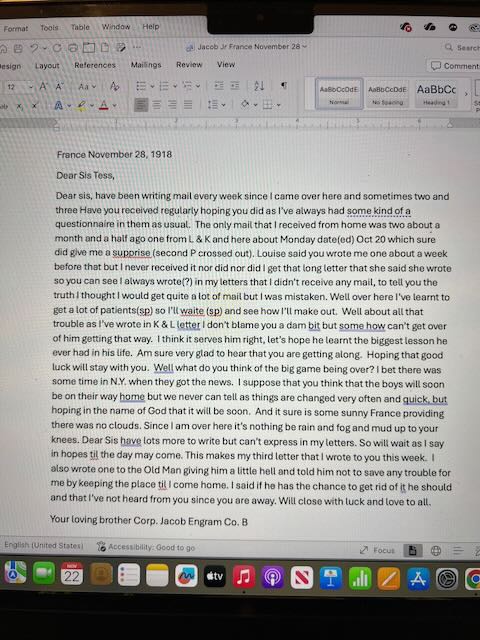
This is a letter from my grandfather Jacob, Jr to his sister, Brian’s grandmother, Tess. He is in France at the end of World War I. The war ended on November 11, 1918 and now he is writing on November 18, 1918. He talks of writing letters every week, sometimes two and three, but not receiving any letters. He thought he’d receive more. He says they’re told they’ll be home soon, but things keep changing, and he hopes it will be soon. I’ve roughly transcribed the letter but it’s fun reading the original.

Brian is the grandson of Barbara Theresa Engram Murphy, oldest child of Jacob Sr, and Katherine (Duy) Engram. Since his mother, Irene, was also the oldest of her family and cousins and lived in the same home for many years, she was the keeper of the family memories.

A few years ago, Brian shared many photos with my Aunt Joanne and me. A lot of them are from the Murphy side, but there were also many Engram family photos and newspaper clippings.

Brian is visiting Connecticut from his home in Florida is going through the family photo bin and I am planning on meeting with him to sort through it and help put names to faces if I can!

My Veterans

In honor of Veterans Day, I’m sharing the story I wrote in June of 2024 for the 52 Ancestors in 52 Weeks challenge. It’s called, The Effects of War. There are links within that story that share the details of their time served.

Beginning with World War I, there was my biological maternal grandfather, Jacob Engram and my paternal grandfather, Charles Jakiela.

My Great Uncle Bronislaw Liro went back to Poland before World War I broke out, fought for the Austrian Army, was captured, and escaped from Siberia.

World War II saw my Uncle Connie and my dad enlist in the Army Air Force and my Uncle Walt and Uncle Mal in the Navy. My Uncle Walt lived through the horror of Pearl Harbor 3 weeks fresh out of Navy radio school.

While cleaning out my aunt’s home, I found a letter from my Great Uncle Antoni written in 1947 describing the aftermath of World War II.

My father in law Harold served in the Korean War as a cook, his brother Ronald as an infantry tank driver, and my step father in law Paul was in the motor pool.

It’s an honor to have these brave men in my family.

The Mishkind-Engram Annullment

In my last post, I told you about the short marriage of Elizabeth Engram to Barney Mishkind. It lasted less than a year and then she went on to marry Alfred Klein, except she didn’t marry him until they were approaching their “25th wedding anniversary”.

Someone with Barney in his family tree alerted me to court documents under Elizabeth Mishkind. I was surprised to see that the information matched court documents under her father’s name. Because they are over 100 years old, I was able to download them through the Bronx Court Records website.

Court documents

They were the court proceedings for Elizabeth to receive an annulment from her marriage to Barney and contained interesting information.

Her grounds for an annulment were that she was not yet 18 when she got married, that she didn’t voluntarily cohabitate with him after she turned 18 years old, and she married without the knowledge of her parents.

The first step was on April 8, 1918, her father, Jacob Engram was appointed her legal guardian, because she was not 21. (I continue to go back and forth with “Ingram or Engram” because the documents and even their own signatures use both!).

Elizabeth’s sister, Kathryn, served Barney with the summons and complaint on April 9, 1918 when she met him at 25 Lenox Avenue in New York. Although he had 30 days to respond, he never did.

Exhibits in the online file included:

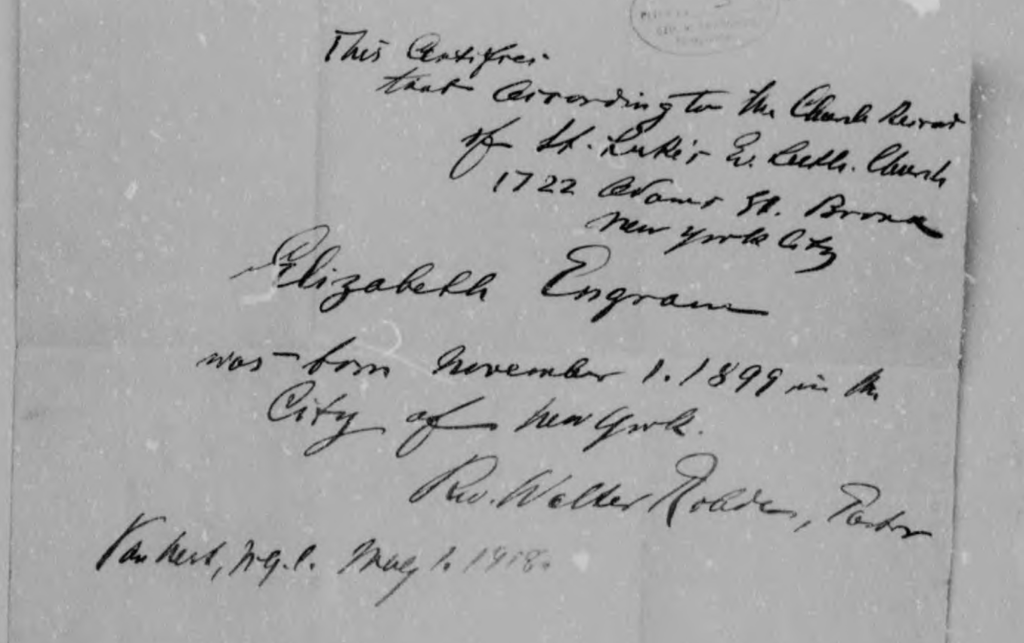
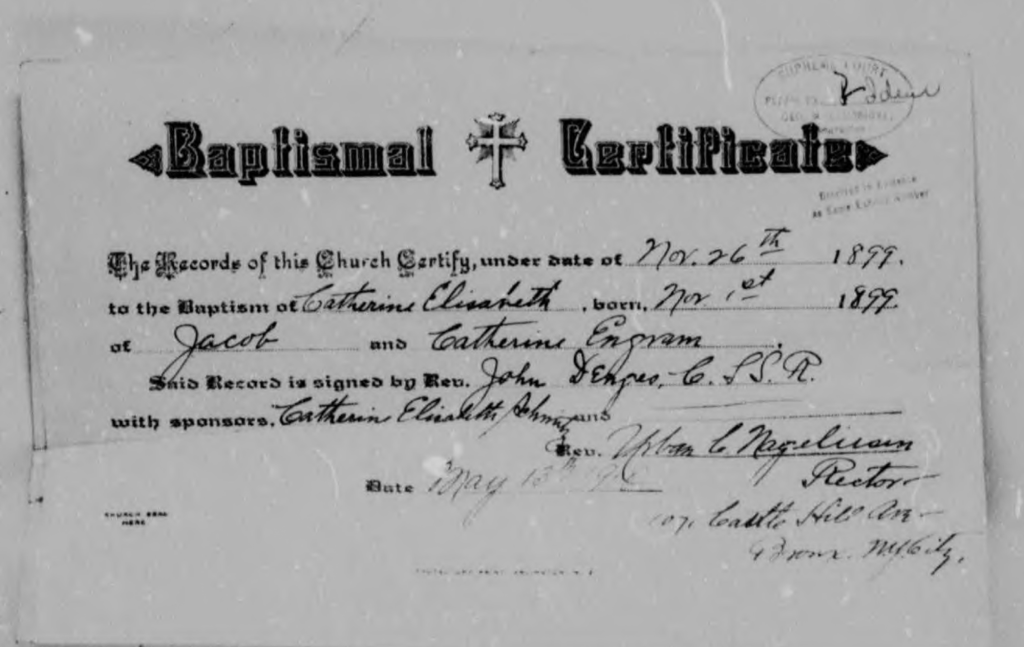
  • a note from the reverend of St. Luke’s Evangelical Lutheran Church in the Bronx confirming that Elizabeth was born on November 1, 1899 in New York. This lists her name as Catherine Elizabeth Engram.
  • Her baptism certificate from Holy Family Church in the Bronx
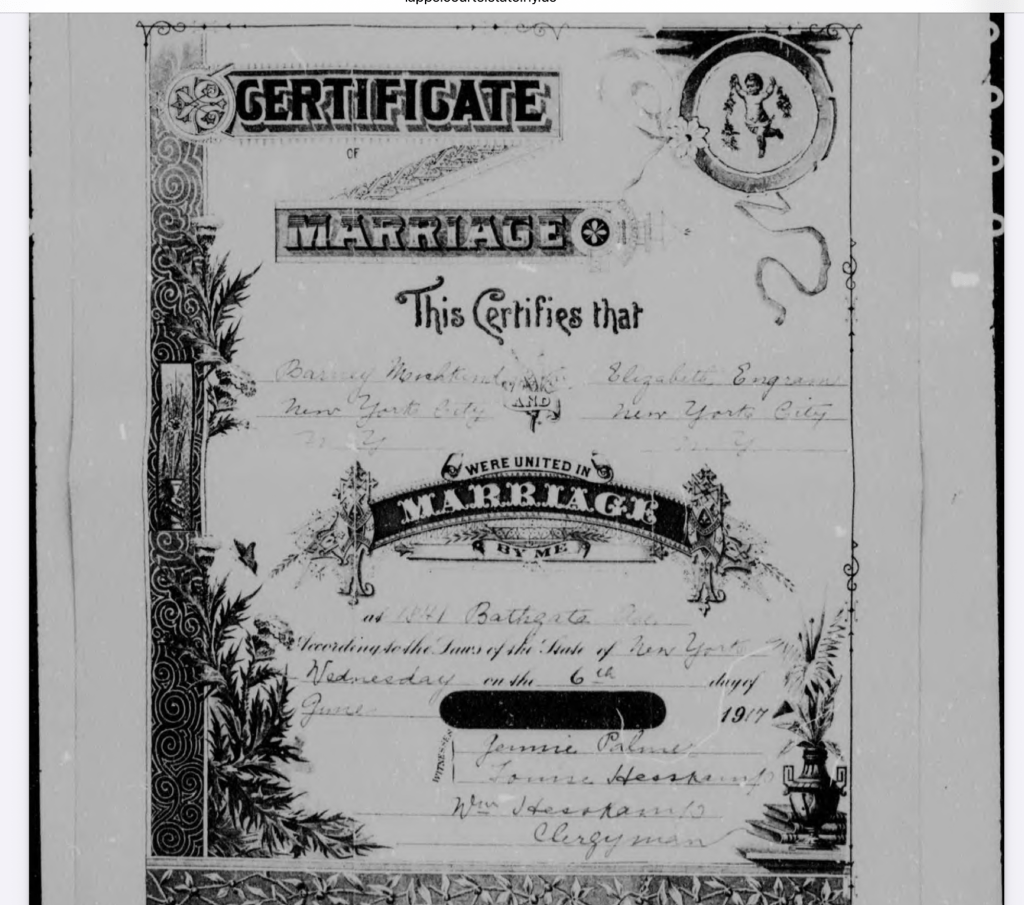
  • The marriage license from Wednesday, June 6, 1917 for a service performed by rev. William Hesskamp of the Methodist Episcopal Church in New York

In late June of 1918, Elizabeth sat for testimony in court. She said after they were married, he brought her back to the hospital where she worked and lived, and he went home to his people. Whenever he came back to New York, they hired a furnished room. But, she claimed, after she turned 18, she didn’t “voluntarily cohabitate” with him. “He treated me brutally”, she said. Q: what did he do? A: Why he beat me.

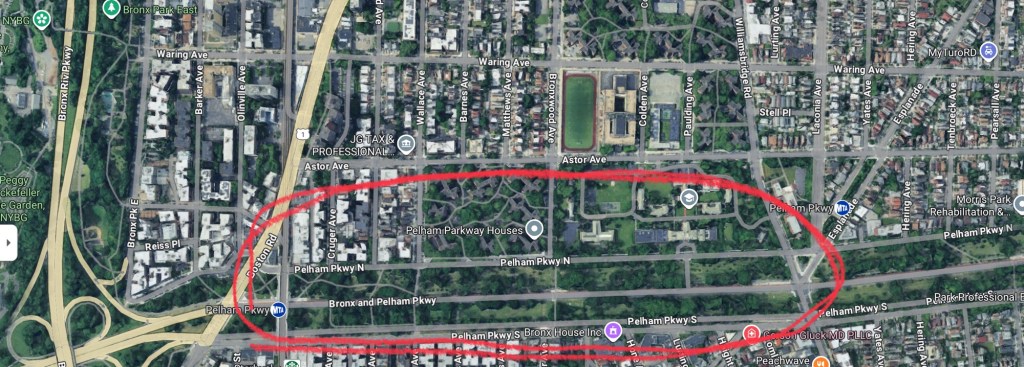
Next on the stand was her father Jacob. He lists his residence as Pelham Parkway between White Plains and Williamsbridge Road, which is more defined than at any other information I’ve found. His testimony was limited to her date of birth and when he found out she was married, which he said was March of 1918.

Engram Farm in 1918 somewhere within this area between White Plains Road and Williamsbridge Road

Kathryn had the most information. She said she knew Barney for a little over a year and met him a week or two before he and Elizabeth were married. They met when the three of them went to the cemetery to Kathryn and Elizabeth’s mother’s grave. The conversation of marriage must have come up because Elizabeth said they had no intention of marrying, but later Barney told Kathryn he did have the intention of it. When Kathryn found out a week of two later that they were married, she didn’t tell her father because her mother had only been gone five months and “it would only make him feel very bad at the time”. (Don’t forget, Kathryn was the sister who stayed home and took care of Elizabeth, Louise, and Hannah under unbearable, alcoholic conditions).

She continued her testimony telling the court that she told Jacob in March of 1918 because Barney was treating Elizabeth “brutally” and “I could not stand for it anymore.” At the time, Barney was back in New York and they were living in a furnished room on Corlear Avenue. Kathryn said Elizabeth was there against her will. “He compelled her by death”, “he said he would kill her if she didn’t go with him”.

Elizabeth got back on the stand and said while Barney was in New York for 2 weeks, she gave up her employment at the hospital (never named) and he threatened her. The court asked her in a variety of ways whether, after her 18th birthday, they lived “as husband and wife”. She claimed no, and that she was there because he said he’d beat her, and he did during that time.

I just have to interject here that she grew up in a family with an alcoholic father who beat her mother and here she is in the same situation. It’s no wonder Kathryn and Louise never got married and Hannah had two short marriages.

At the end of this, Elizabeth’s lawyer states that Barney has never responded to the summons and complaint and so an attorney is appointed to represent him.

The files include a deposition from Elizabeth’s attorney Barney Levy, who says he was informed that Barney is in the military as a private in the 105th field Artillery and is stationed at Camp Stewart in Newport News Virginia and he does not intent to object or contest and is willing for the marriage to be annulled.

Barney’s military record – furloughed February 19 to March 1, 1918 (the 2 weeks he was in New York forcing Elizabeth to live with him)

Back in court, the lawyer assigned to Barney is deposed and says he mailed him a letter asking for information as to whether he objected but received no response. The lawyer spoke with Barney’s mother who said both she and her son had no objection to the annulment. The lawyer spoke with Barney’s father on July 21, 1918, who said “the facts alleged are perfectly true” and he had a serious conversation with his son and know there are no objections and in fact, Barney though the annulment was already done.

The lawyer presents a letter he was handed from Barney’s father, allegedly from Barney that acknowledges the facts and has no objection whatsoever to the granting of the decree for annulment. Probably because Elizabeth has been receiving his service pay as his wife!

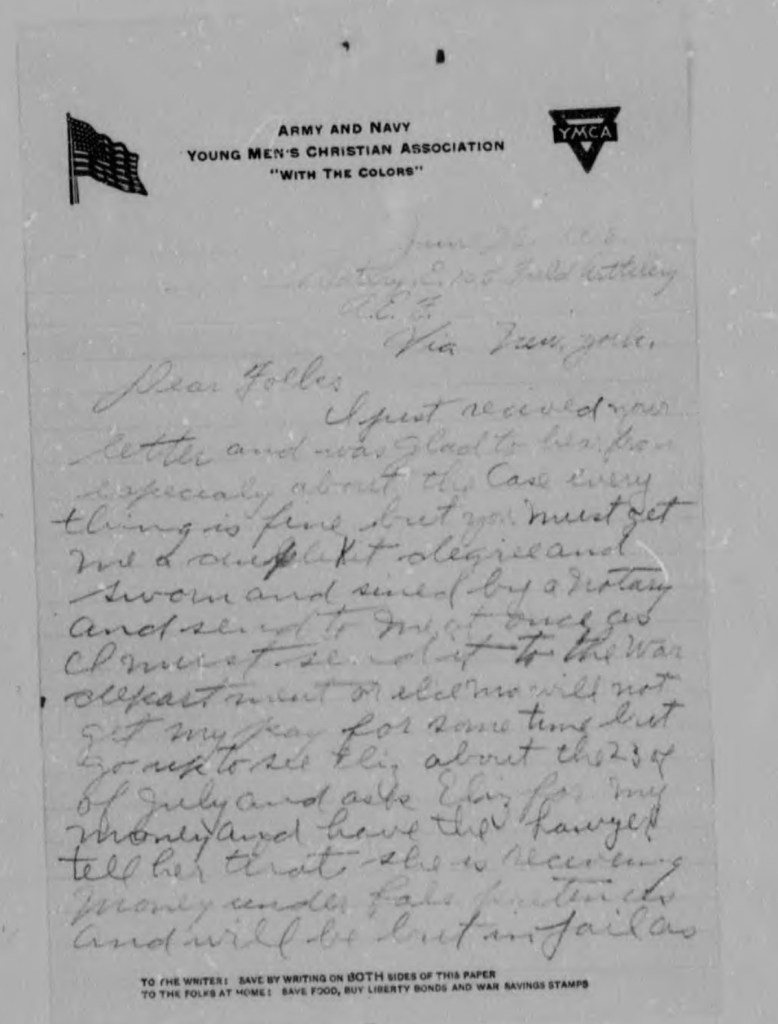
The letter says:
Dear Folks,
I just received your letter and was glad to hear from you especially about the case. Everything is fine, but you must get me a duplicate degree (decree) and sworn and signed by a notary and send to me at once as I must send it to the War Department or else Ma will not get my pay for some time. But go up to see Eliz about the 23 of July and ask Eliz for my money and have the lawyer tell her that she is receiving money under false pretenses and will be put (?) in Jail (?) as…
that is the extent of the letter copied.

On July 26, 1918 the judge rules that Elizabeth is entitled to a judgement of annulment and “after three months a final judgement may be entered”.

November 12, 1918, the final judgement is granted and Elizabeth Mishkind is once again Elizabeth Engram.

Annulment finalized November 12, 1918