Week 7 of 52 Ancestors in 52 Weeks is all about Immigration.
It’s impossible to focus on just one ancestor because they all left the same region between the ages of 4 and 51 between 1899 and 1912.
My maternal grandmother, Julianna Ingram in 1903 at 16 years old followed by one sister 4 years later and another sister 8 years after that.
My paternal grandfather Charles Jakiela in 1905 at 15 years old without any siblings ever following him. Traveling to Southington Connecticut and shortly after to Palmer Massachusetts to work in the textile mills.
Imagine sending your child, first on a (present day) 14 hour overland trip to get to the port of Bremen Germany. From there, they would board a steam ship to travel to New York and start a new life – without you. Neither Julianna or Charles ever returned.
You couldn’t just pick up a phone a find out how their trip was or are they getting enough sleep, and have they found a job yet?
My maternal grandfather Konrad Posluszny immigrated in 1900 at 16 years old. He had the benefit of uncles already in Yonkers, New York and all his brothers arrives in the next five years. His mother, step father, 2 sisters, and a half brother, arrive 7 years after he did. They were lucky to all be together in the “new country”.
My grandmother Julianna left behind her parents, and 2 sisters and a brother, one or two were born after she left. I wonder how affect they were by the first and second word wars because we do know how Charles’s family fared.
The topic for Week 6 of 52 Ancestors in 52 Weeks is – Earning a Living so I am turning this week to the Posluszny side of the family to tell you about my grandfather and his brothers.
My grandfather, Konrad Posluszny, and his four brothers were hatters. The occupations on their ship manifests say “laborer” so it’s likely they picked up the trade when they immigrated to the United States.
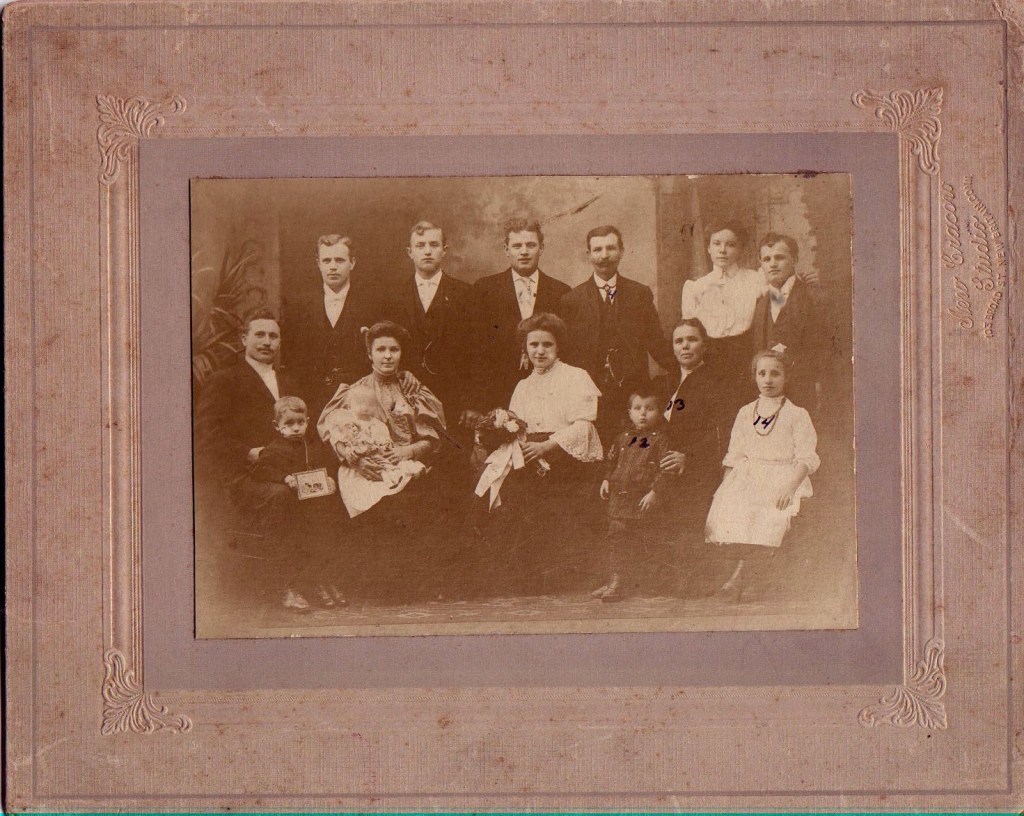
The Posluszny Family abt. 1909. Men from left – John, Joseph, Frank, Charles, stepfather Jon, and Konrad
In the early 1900s, hat making was booming and during that time period, Konrad and his brother Charles lived in Yonkers New York. They held jobs as finishers at the Waring Hat Manufacturing Company. The factory was on the corner of Riverdale Avenue and Vark Street which was only a block and a half from their home on Jefferson Street.
Waring Hat Manufacturing Company, Yonkers NY
His other three brothers John, Joseph, and Frank all lived in Newark New Jersey. I don’t know which company they worked in but there were 34 hat companies in Essex County making it the hat capital of the world! They would have had their pick of any and they also worked as finishers.
The 1920 census showed all five brothers still in the hat making industry. Konrad and his family were still in Yonkers, John and Frank in New Jersey, Joseph and Charles with their families in Norwalk Connecticut.
The 1920s brought about a slowdown in the hat making industry and many companies merged. John left hat making and because a proprietor of a restaurant/saloon in Newark.
Unfortunately Frank turns up in the 1930 and 1940 federal census as an inmate in the Essex County Hospital for the Insane. We know the old saying “mad as a hatter” but in this case it was hereditary rather than occupational.
Charles worked for the American Hat Company and Joseph for the Hat Corporation of America, both in Norwalk. They worked has hatters until they retired.
But, the more interesting story is that of my grandfather. I’ve told the story of the family’s move to Easthampton Massachusetts where they lived very briefly before they moved to New Britain and lived in a two family house with my grandmother’s relatives where my mother was born in 1922.
In New Britain, my grandfather opened up a hat store called the Conrad Hat Company and in 1923 it was at 43-45 Broad Street before moving to 317 Main Street.
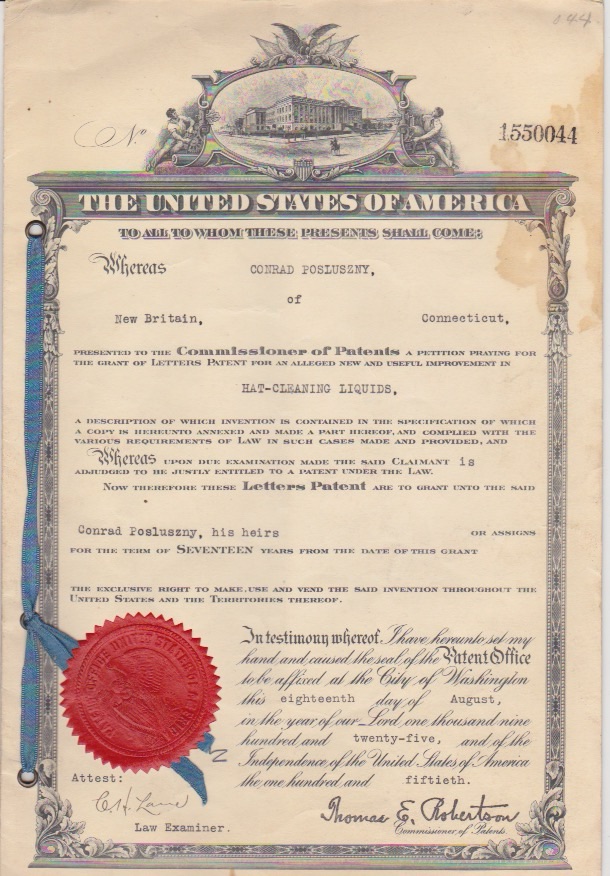
In 1924, he applied for a patent for a cleaning solution for straw hats and was awarded with the patent on 1925. I don’t know if he ever made any money from it but he still holds the patent to it.
Patent certificatePatent information
Unfortunately, in the summer of 1924, in the span of two weeks there were fires in his store.
Fire in August of 1924fire in July of 1924
I found these news clippings while researching this story and I wonder if it plays into what my Aunt Judy said in her recorded conversations about not being a business-type guy but he would have been successful if he was. She said he was too soft hearted and the politicians in New Britain would come in, have a hat made and say they’d pay him later but they never would. He couldn’t pay his insurance, had those two (suspicious!) fires a few weeks apart and had to go out of business.
The family moved to Wallingford and he went to work at the Steel Mill until his death in 1944.
The theme for week 5 of 52 Ancestors in 52 Weeks is “Influencer”.
The definition of Influencer is “a person or thing that influences another”. That person could be none other than my mother, Elizabeth Posluszny Jakiela.
She was born in 1922, the youngest of five children with an age gap of five years between her and her sister.
After high school she went to a business school and learned bookkeeping and worked at one of the several silver factories in the area. She got married while working there and continued to work until pregnant with my older sister. Eighteen months later, she had me and my twin sister.
When I started fourth grade, she went back to work, first for a temp agency and then a permanent job so she juggled family and work.
When my dad purchased the paint store he had worked at for years, she jumped right in to take care of the bookkeeping, heading to the store after her day was done at her paying job.
Even with this, she found time to volunteer at school events, participated in women’s church groups, school groups, and was an assistant troop leader for our Girl Scout troops.
When our church began running a carnival in the early 1970s, she jumped right in to volunteer wherever she was needed. Only a few years went by before she was selected to be the chairman of the event. She never backed down from a challenge and she loved being a part of it and continued to volunteer up until she passed away.
My sisters and I all got married and raised our children, found the time to volunteer in their schools and in our community.
Personally, I went to school to be an administrative assistant and have worked with my husband for 25 years in his remodeling business as his bookkeeper and office manager. I definitely inherited that from her!
My mother will be gone 37 years on April 4th and I know she would be proud of the influence she had on her three girls, and her grandchildren in turn.
The topic for week 4 of 52 Ancestors in 52 Weeks, is “Witness to History” and for this there was no other story to tell but this one.
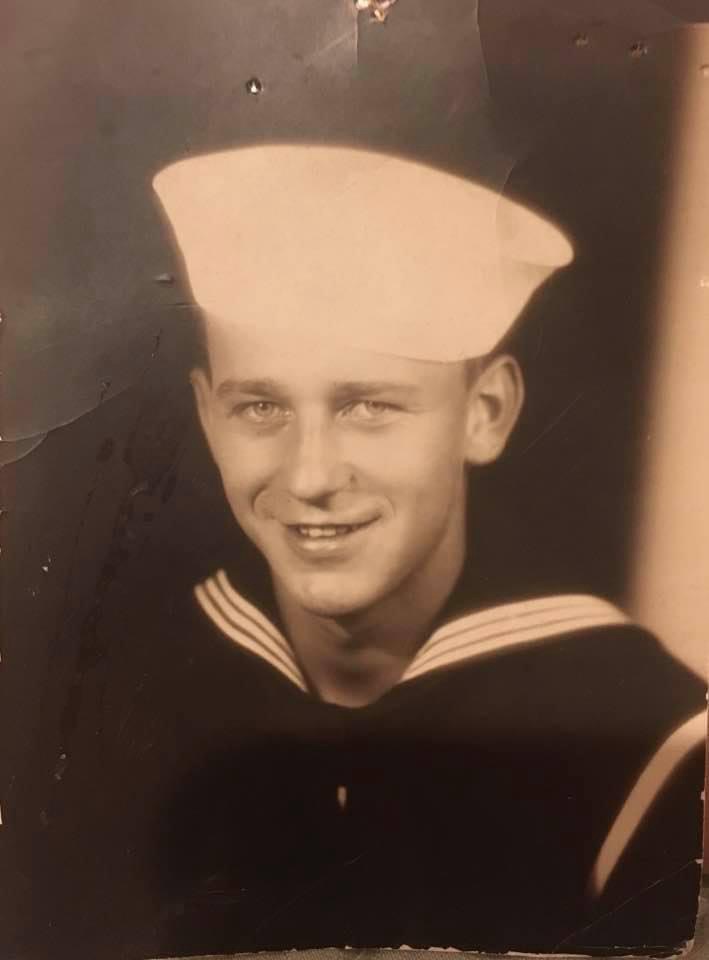
My uncle, Walt Jakiela was 19 years old, fresh out of Navy radio school as a seaman second class, and in Hawaii for only three weeks on the morning of December 7, 1941.
Walter Edward Jakiela 1941
As Walt walked out of the barracks, he noticed smoke billowing from burning sugar cane fields. He didn’t think much of it, and headed into the hanger.
Not long after that, the hanger began to shake and there were muffled sounds of exploding bombs as the Japanese bombers struck the ships in the harbor. He and his mates rushed out of the hanger to see the bombs and torpedoes dropping on the ships, which were like sitting ducks on the water. Fighters strafed the decks of the ships, and sailors were mowed down from above. At first, he thought the planes were Russian and then he saw the rising sun emblem of Japan.
There was a lull in the attack and he said that’s when he really became scared.
When the second wave hit, some of the soldiers had the presence of mind to set up machine gun batteries to shoot at the planes. Walt shot at quite a few but he didn’t think he shot any down.
He said the second wave was more like a clean up and the Japanese were picking off the targets that weren’t destroyed with the first wave. Planes which never got off the ground, barracks, ships, boats, and servicemen were shot at by planes flying through the thick smoke which Walt said made it feel like a tunnel, not knowing which way was which. All around were bodies of his fellow servicemen, injured or killed in the attack.
After the second attack, Walt helped with the treatment of the injured soldiers. He went along and marked the boots of the soldiers who had been given morphine injections. He and the rest of the survivors were asked to volunteer for mortuary duty but he chose instead to volunteer for the dangerous duty of flying out in search of Japanese planes. He just couldn’t handle seeing all the death.
“It changed my whole life” he said when speaking about his experience 50 years later.
When he spoke about the attack, he said it wasn’t exactly a surprise to the higher ups. They knew something was coming, they just didn’t know when.
He was a radio/gunner for U.S. Navy Patrol Squadron 23, which was made up of 12 patrol bomber seaplanes called “Catalinas”. They were used primarily for attacking submarines. His squadron was assigned to 12 hour daily search missions for over a week, but the men were never informed what they were searching for and the missions ended on December 6th.
Walt had joined the Navy in February of 1941 rather than be drafted into the Army and he stayed in the Navy for another 20 years. He saw the entirety of World War II as well as the Korean Conflict from various bases around the world.
Pearl Harbor wasn’t the only time he was a witness to history. In 1945, he was stationed at Saipan air base when the Enola Gay delivered the first atomic bomb on Hiroshima on August 6th. He said when the crew of the Enola Gay landed, its crew members said, “you can go home now.”
He earned two air medals with gold stars for his 50-plus missions throughout World War II, as well as the rank of chief petty officer, before his retirement in 1960.
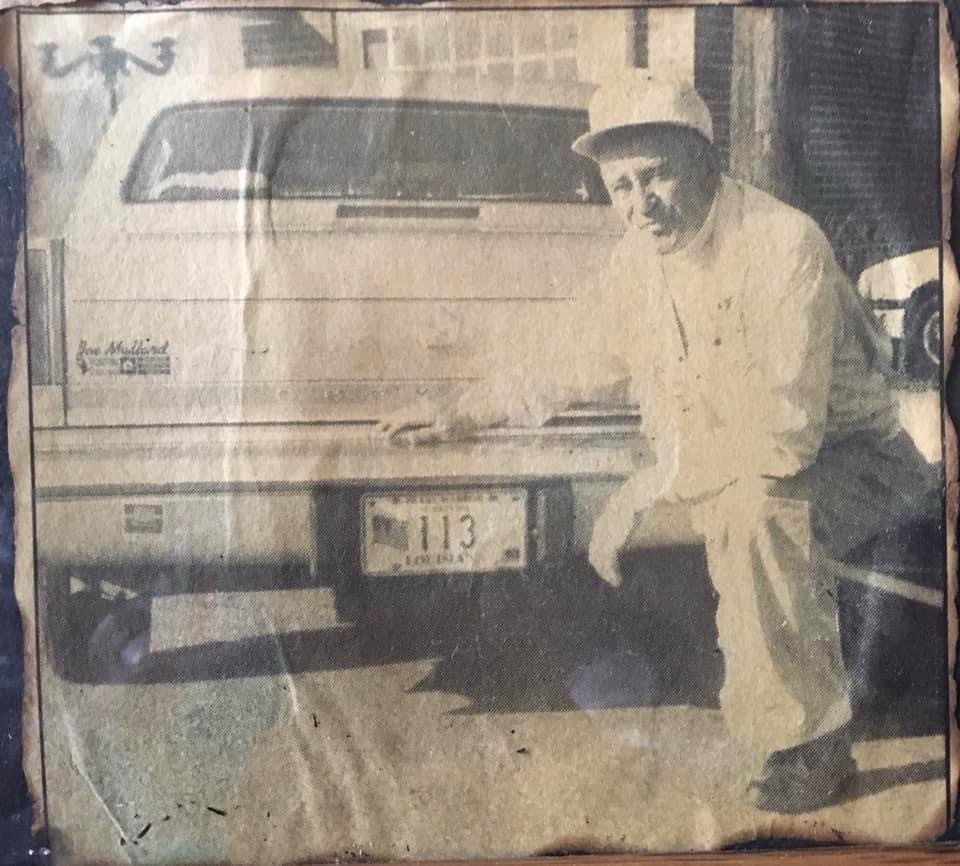
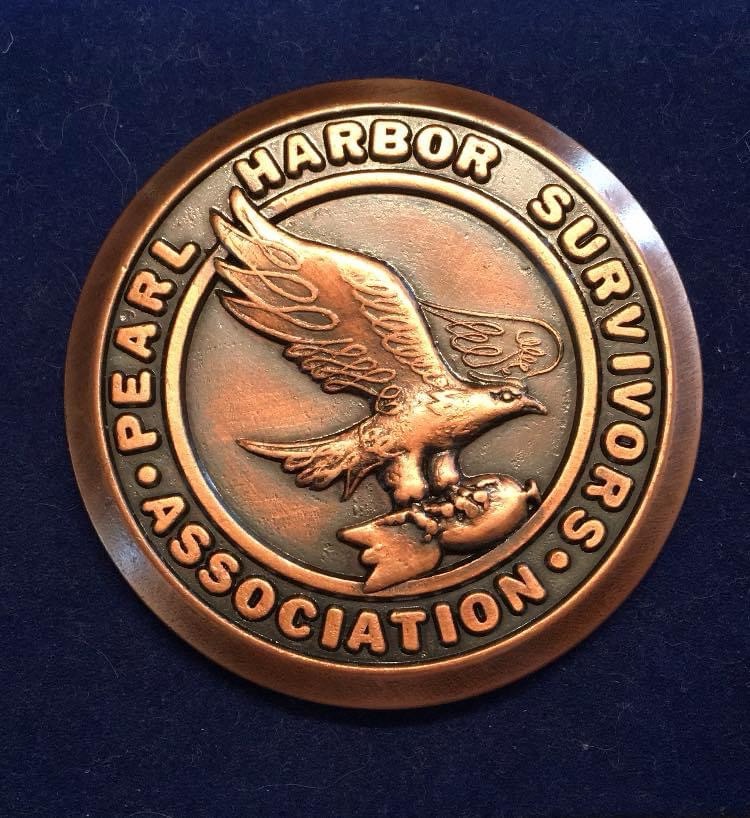
Walt and his survivor license plateA special group of people
After he retired from the Navy, he went to work for Grumman Aircraft company. He started as a field service representative, then a worker with the space program, and then a part of the program which developed the F-14 Tomcat fighter jet.
This information came from a newspaper article he sat for in 1991.
My Uncle Walt retired from Grumman in 1980 and he and my Aunt Eleanor moved to Ruston Louisiana to be near his older son. He died in 1997 at the age of 75.
I likely only met him a few times, but I wish I had known him. He was so young to experience what he did and I’m sure it did change his whole life. He’s a hero to me.
This subject is number 3 on the list of “52 Ancestors in 52 weeks for 2024” created by Amy Johnson Crow. Week wise, I’m a little late to the party, but who cares – as long as I show up!
So my favorite photo is this one:
John and Steve at Baldwin Pond
This is a photo of my dad, John, and his oldest brother, Steve. It was taken approximately 1936 when my dad was 12 and Steve was 23. Look at the smiles, look at Steve’s arms over my dad’s shoulders holding him close, and look at my dad’s hands reaching back to hold his brother’s legs.
If my timing is correct, this was about a year after their father was killed in a hit and run accident not far from home. Eight years previous to that, in 1927, their mother died from pregnancy complications when my dad was not quite 3.
That hit and run left 5 children, ages 23, 21, 15, 14, and 12 orphans. Life was definitely not easy for them before their father died, but it got worse the night the policeman banged on their door to tell them their father was dead.
Steve, at 23, became their guardian. Family stories say the priest at the church they attended, St. Peter and Paul’s Catholic Church, offered to be their guardian (in name) in the event there was an attempt to break them up. John and his brother Walt were alter boys and Helen cleaned the alter during the week so he knew them well. I don’t think it ever came to that.
They continued to live in the little brown house on Prince Street in Wallingford and Steve had a job as a meat cutter nearby. In 1937, Steve married Florence whose family lived on the corner and he brought them into the marriage.
Steve was a father to all of them and I’m sure it was difficult as a newly married couple to have teenagers in the house so soon! Life wasn’t always easy but he and Florence made a home for them.
I see such true affection in their expressions and that’s what makes this my favorite photo.




 It's All About Family