The Week 10 topic for 52 Ancestors in 52 Weeks is “Language”.
I’m on my 80th consecutive day of learning Spanish through Duolingo and trying to remember the possessives, the verbs, the subject pronouns, the “el”s and “la”s – whooo boy – I break out in a sweat as I get toward the end of the lesson and I know I’m going to have to type out the answer myself instead of picking words from a list!
I begin to imagine what my ancestors felt, coming to the United States, likely not knowing any English and hoping to find a job quickly. There were no ESL classes for them!
My maternal grandmother spoke German, Polish, and Russian and my paternal grandparents Polish. My Uncle Eddie spoke to me of being laughed at in school because he and his brother spoke only Polish (likely in the early grades, hopefully soon enough he learned English!). My paternal grandfather went off to World War I speaking little to no English.
I admire anyone who can speak a language other than their own. I’m hoping that someday what I’m learning will come in handy!
The week 9 topic for 52 Ancestors in 52 Weeks is Changing Names.
You may have a story or two in your family about how “their last name was changed/shortened by the Ellis Island worker that couldn’t understand what they were saying”. Although that probably happened to some people, many times it didn’t happen that way! Most likely it was done by the immigrants themselves trying to fit in, or tired of spelling their name or hearing people mispronounce it!
My maternal family last name was Posłuszny. That little line through the “ł” sounds like “whoosh”. The majority of misspellings I see is “Poslushney”.
Two of the five Posłuszny brothers, Joseph and Charles, changed their name to Post some time during the 1920s. John used Post for business purposes as a restaurant owner, but used Posłuszny in his personal life.
Frank, poor Frank, who spent decades in an insane asylum, remained Posłuszny for his lifetime as did my grandfather Konrad’s family. I recall hearing that my Aunt Judy wished her dad had changed their name because she got so tired of spelling her last name to people!
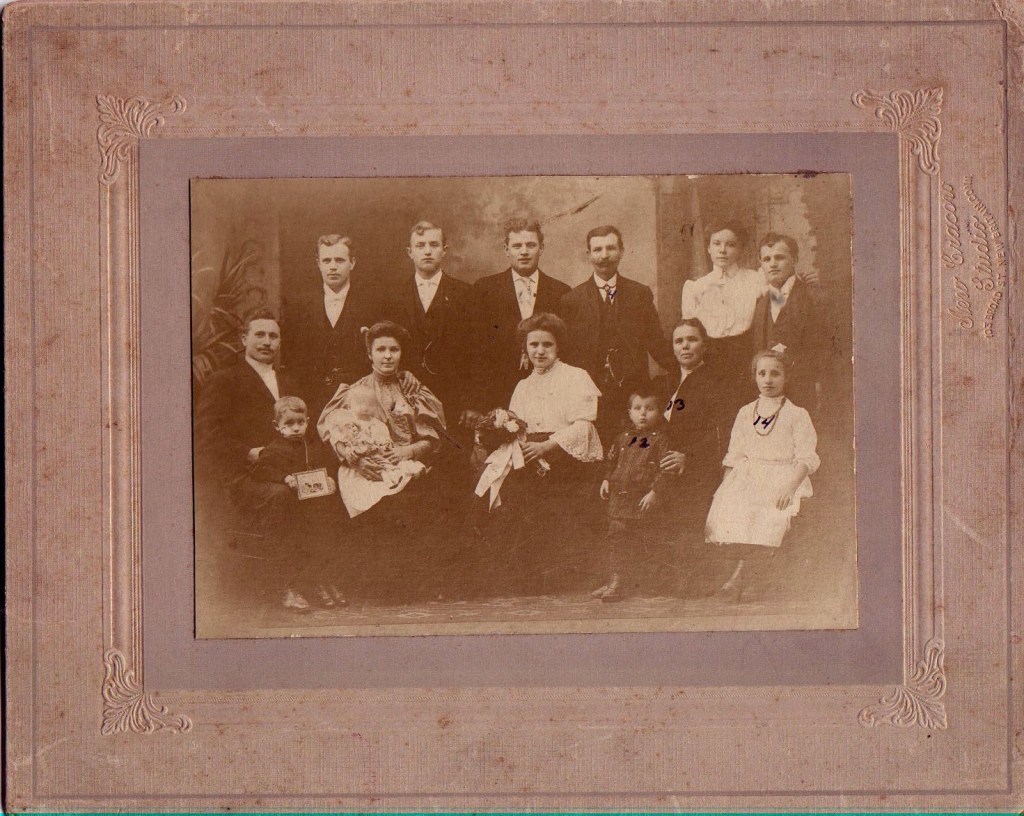
Left to right John, Joseph, Frank, Charles, (far right) Konrad
The topic for week 8 of 52 Ancestors in 52 Weeks is – Heirlooms.
The definition of a Heirloom is a valuable object that has belonged to a family for several generations. Since my great-grandmother was the farthest back generation to immigrate in the early 1900s, I’ll have to go with what I have, but I still think they are pretty important!
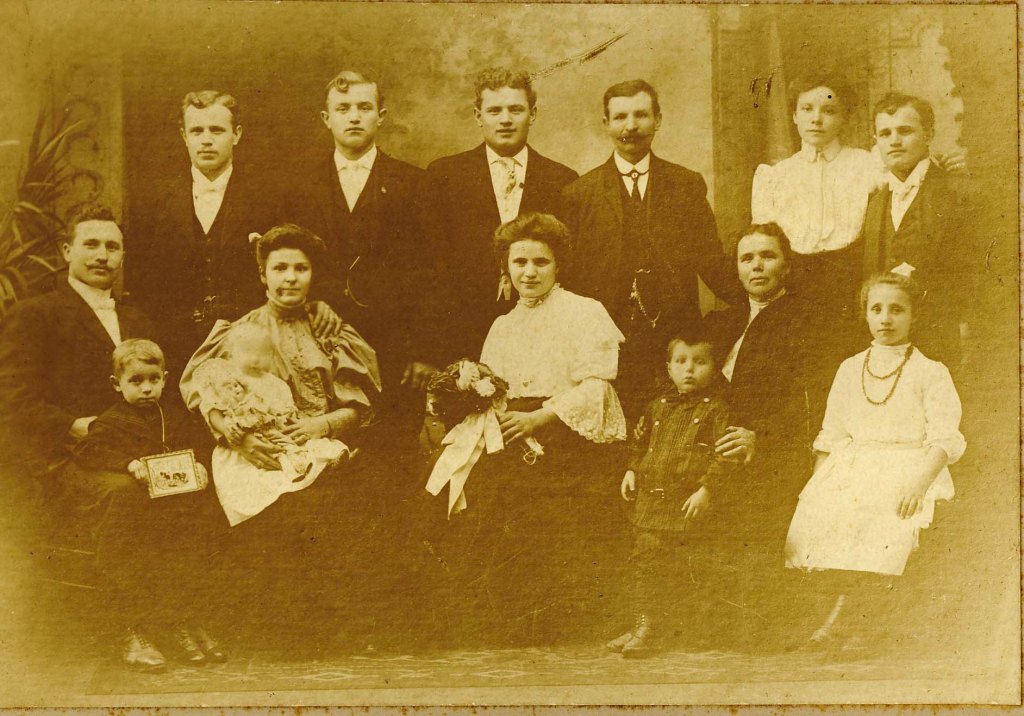
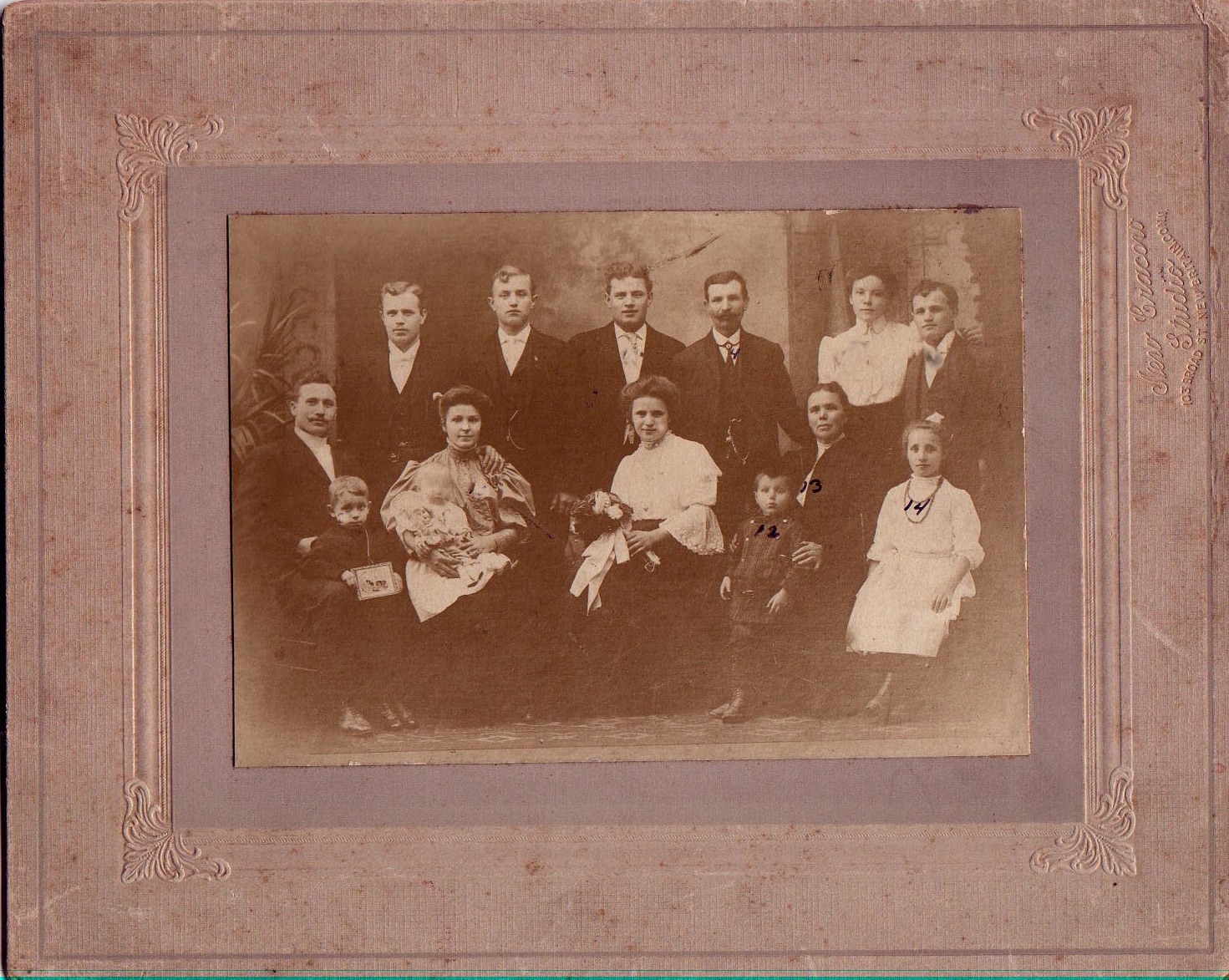
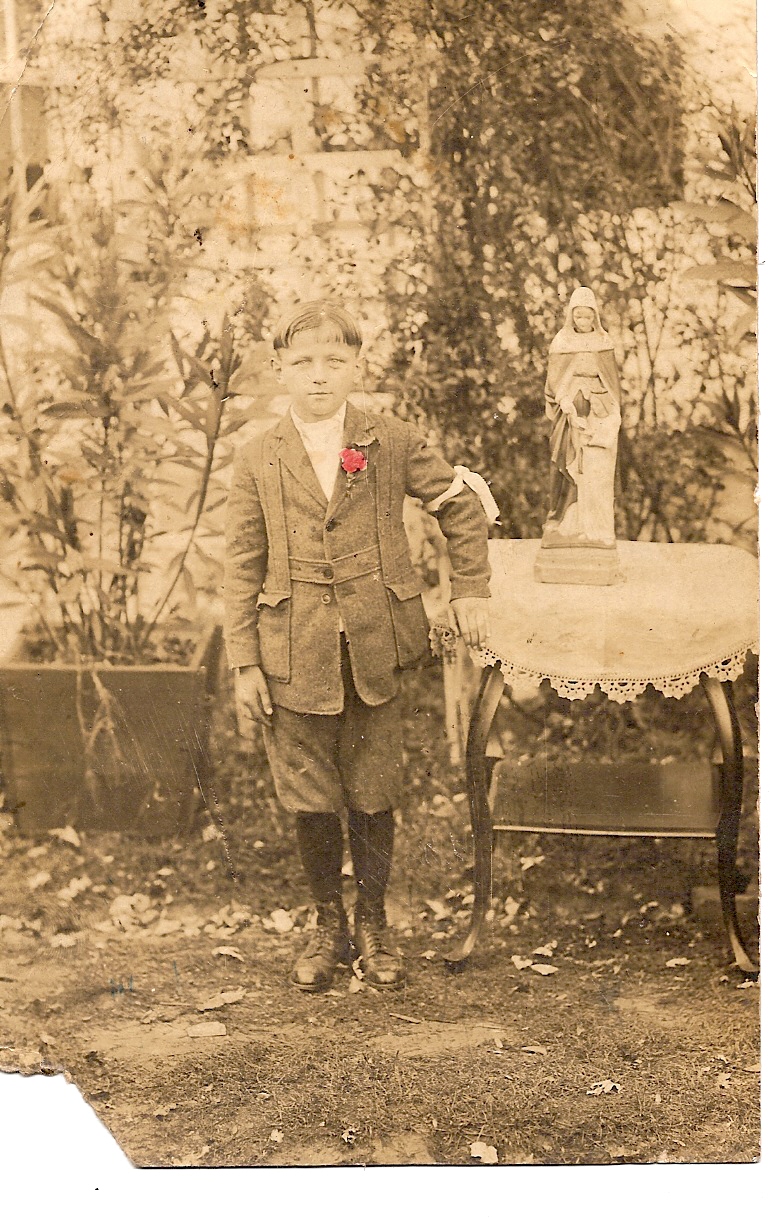
Pictures. I have a lot of pictures! Professionally taken including family groupings from the early 1910s, first communions from the early 1920s, weddings, and family photos collected in multiple albums by my mother growing up in the mid-1920s and early 1930s, and beyond. In addition to those, I have videos from the early 1930s through the 1970s which I wrote about in an earlier post here.
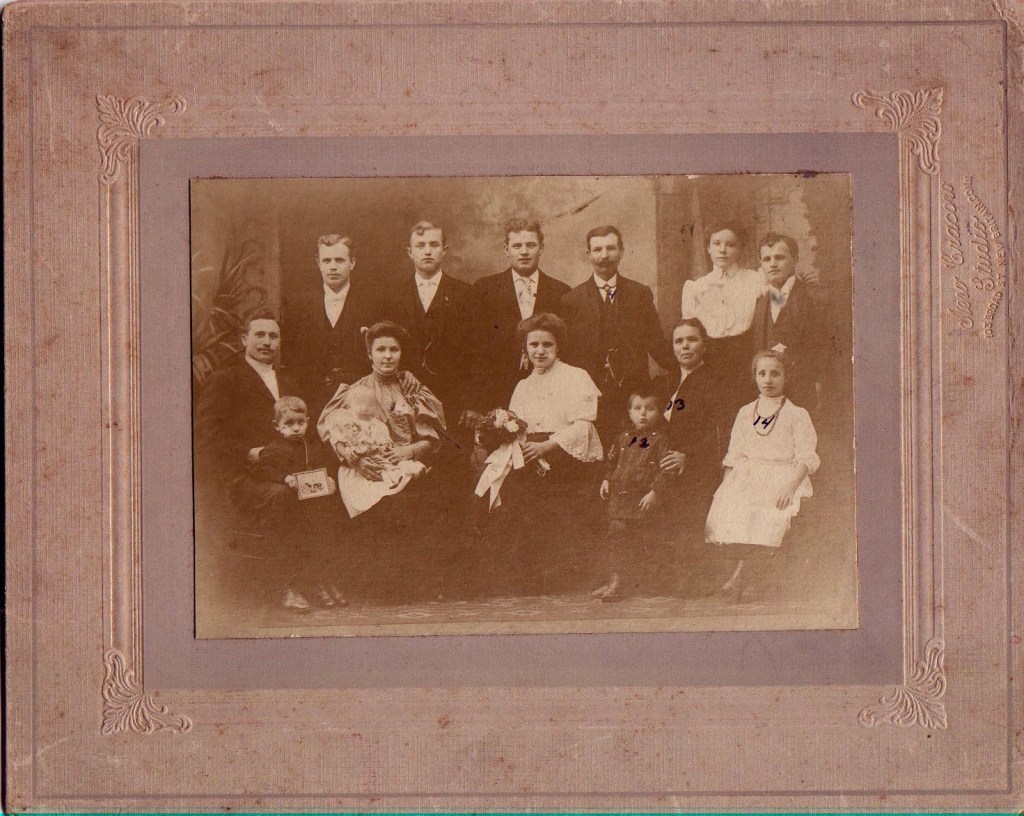
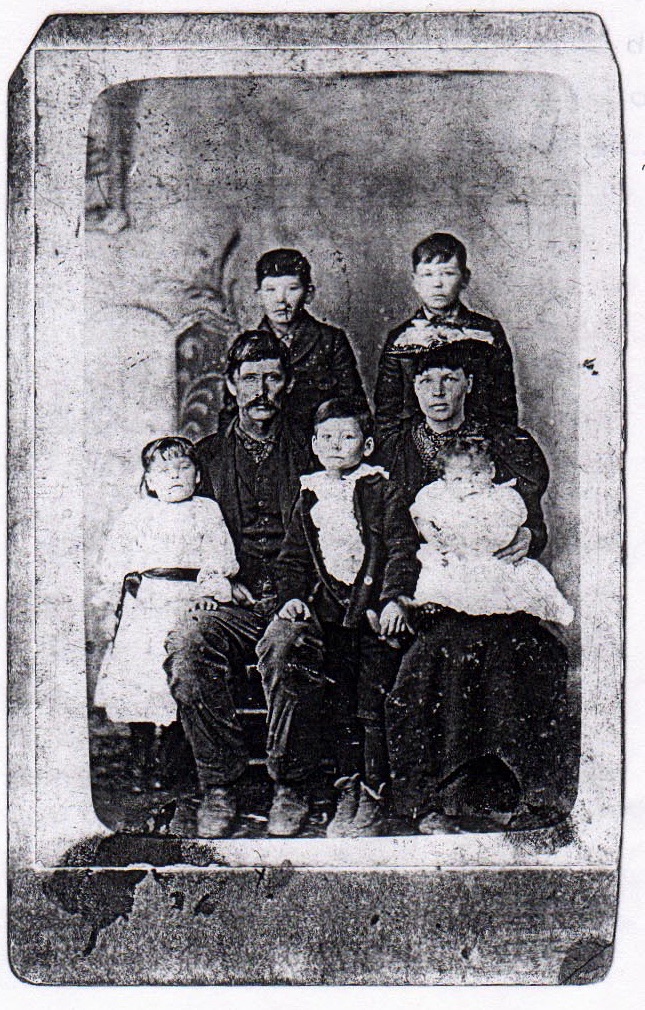
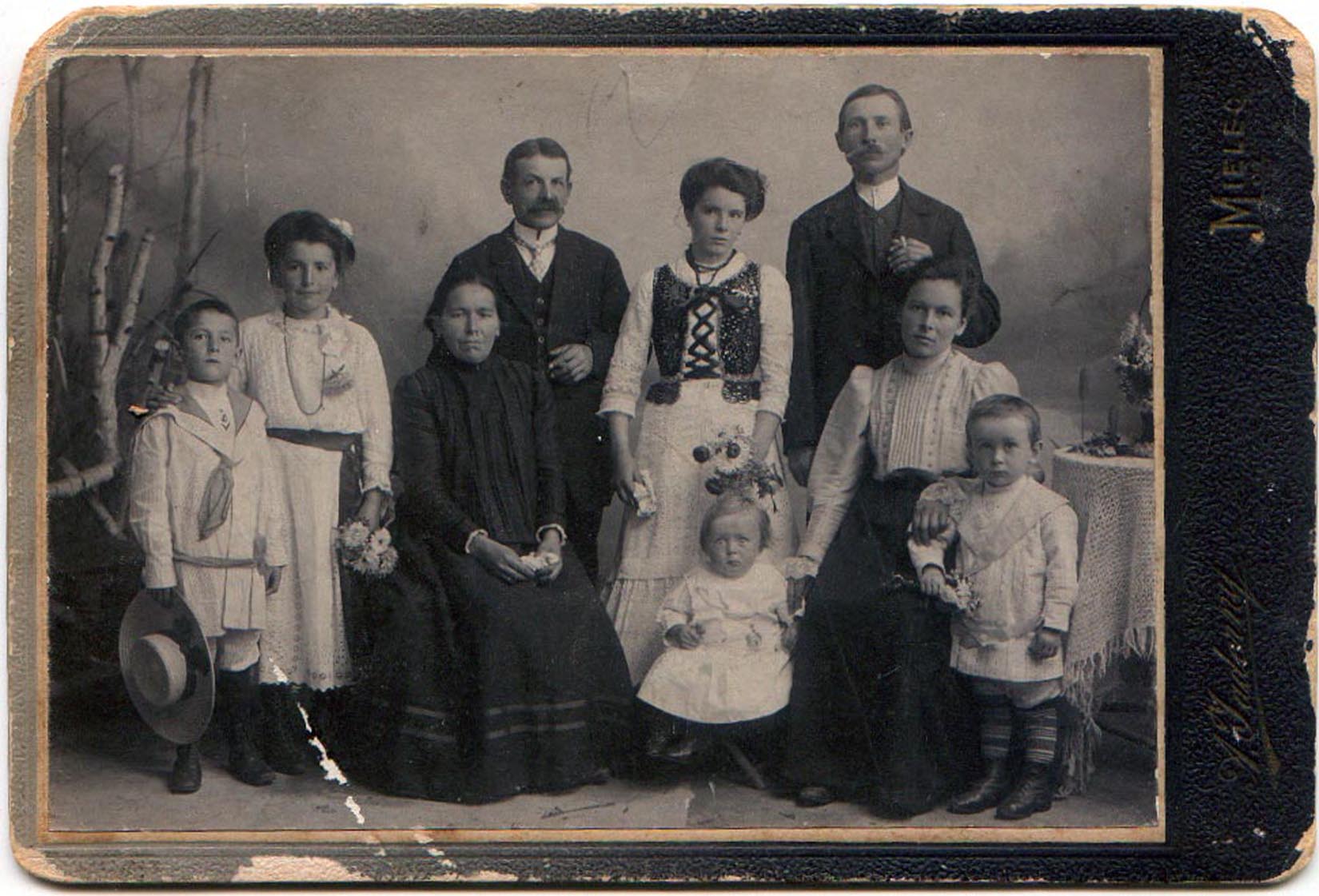
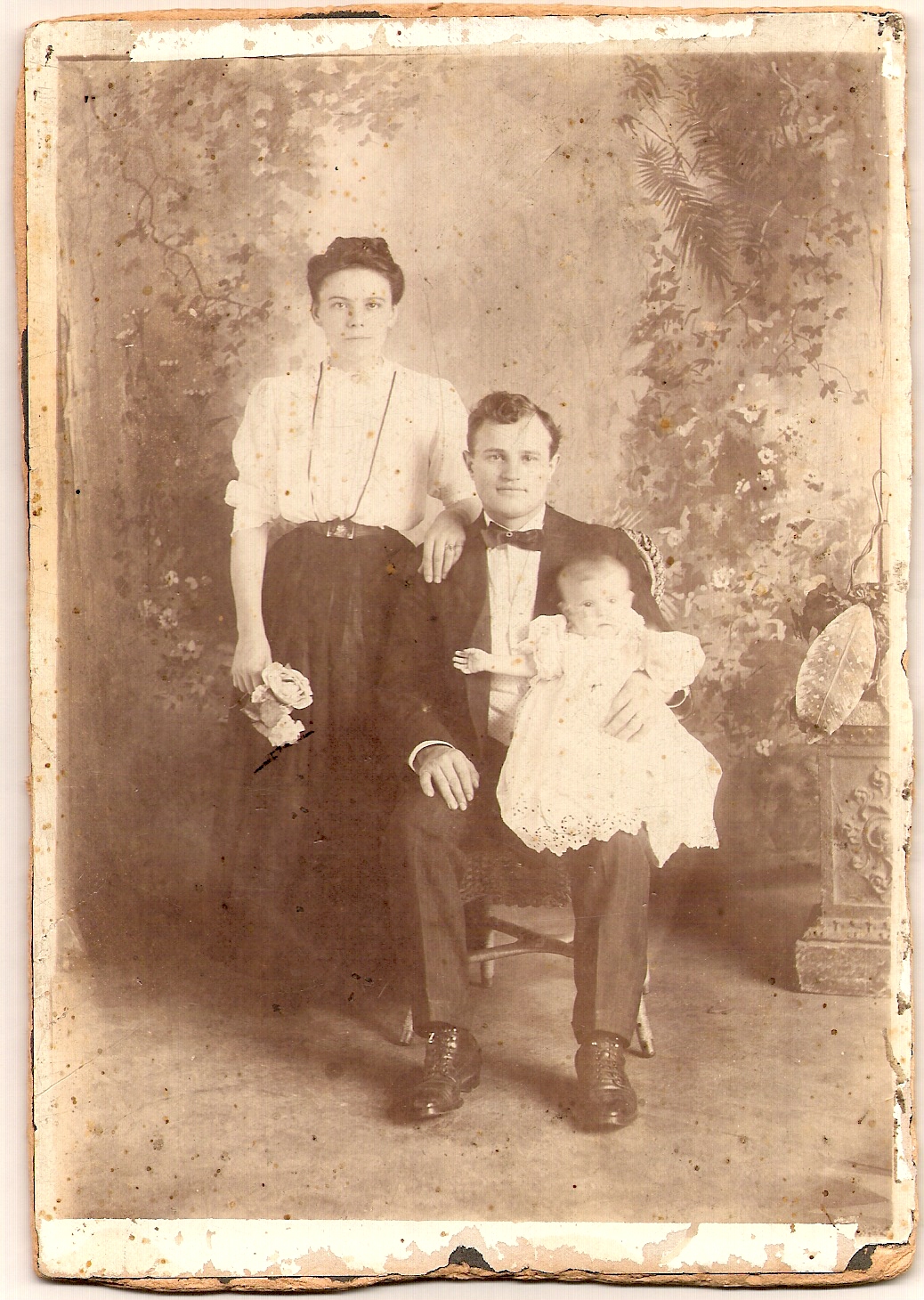
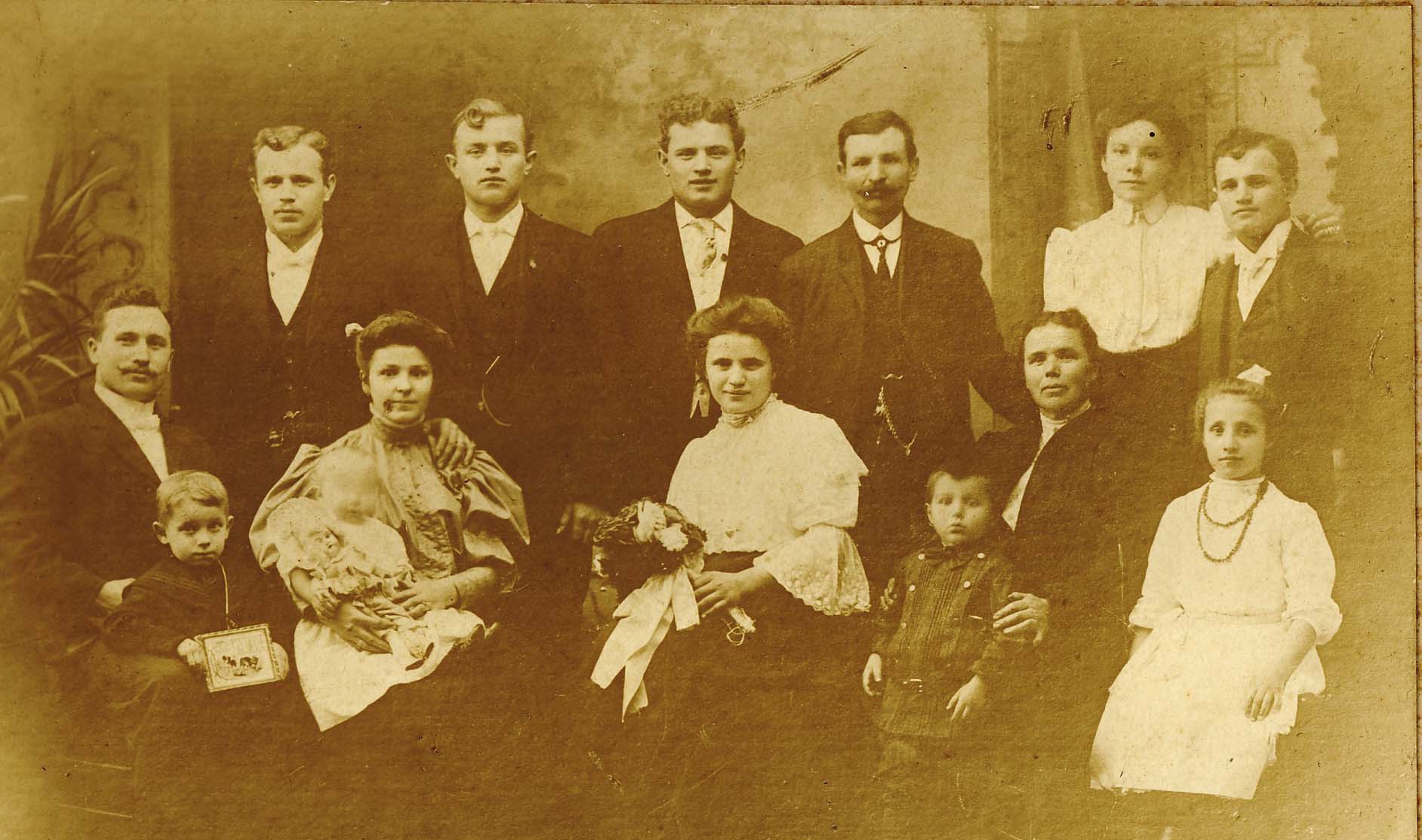
Posluszny Family abt.1910Connie and Betty abt. 1927Eddie Jakiela abt. 1920Ingram Family date unknownJulianna, Konrad, Antoinette abt. 1910
When I started research in 2000, my Aunt Tootsie (Antoinette) was the Family Historian. She was the oldest Posluszny sibling and lived in the family home on Clifton Street from the purchase in 1925 until she moved to a Judd Square apartment in 1989. I often sat with her to discuss the family and the people in the pictures. Dates and seeing how far your lineage stretches back are fun, but my interest has always been the stories and photos. Who they were as people and as a family. Who we most resemble. I try to imagine what life was like in Yonkers and Connecticut in that time frame. I guess that’s why I love where I live so much because this is where they lived their lives.
I’m grateful over the years to acquire more photos from my Jakiela cousins, through my ancestry contacts, and through unexpected DNA matches! I’ll continue to share more pictures and stories as I create some order to my accumulated files and notebooks.
Week 7 of 52 Ancestors in 52 Weeks is all about Immigration.
It’s impossible to focus on just one ancestor because they all left the same region between the ages of 4 and 51 between 1899 and 1912.
My maternal grandmother, Julianna Ingram in 1903 at 16 years old followed by one sister 4 years later and another sister 8 years after that.
My paternal grandfather Charles Jakiela in 1905 at 15 years old without any siblings ever following him. Traveling to Southington Connecticut and shortly after to Palmer Massachusetts to work in the textile mills.
Imagine sending your child, first on a (present day) 14 hour overland trip to get to the port of Bremen Germany. From there, they would board a steam ship to travel to New York and start a new life – without you. Neither Julianna or Charles ever returned.
You couldn’t just pick up a phone a find out how their trip was or are they getting enough sleep, and have they found a job yet?
My maternal grandfather Konrad Posluszny immigrated in 1900 at 16 years old. He had the benefit of uncles already in Yonkers, New York and all his brothers arrives in the next five years. His mother, step father, 2 sisters, and a half brother, arrive 7 years after he did. They were lucky to all be together in the “new country”.
My grandmother Julianna left behind her parents, and 2 sisters and a brother, one or two were born after she left. I wonder how affect they were by the first and second word wars because we do know how Charles’s family fared.
The topic for Week 6 of 52 Ancestors in 52 Weeks is – Earning a Living so I am turning this week to the Posluszny side of the family to tell you about my grandfather and his brothers.
My grandfather, Konrad Posluszny, and his four brothers were hatters. The occupations on their ship manifests say “laborer” so it’s likely they picked up the trade when they immigrated to the United States.
The Posluszny Family abt. 1909. Men from left – John, Joseph, Frank, Charles, stepfather Jon, and Konrad
In the early 1900s, hat making was booming and during that time period, Konrad and his brother Charles lived in Yonkers New York. They held jobs as finishers at the Waring Hat Manufacturing Company. The factory was on the corner of Riverdale Avenue and Vark Street which was only a block and a half from their home on Jefferson Street.
Waring Hat Manufacturing Company, Yonkers NY
His other three brothers John, Joseph, and Frank all lived in Newark New Jersey. I don’t know which company they worked in but there were 34 hat companies in Essex County making it the hat capital of the world! They would have had their pick of any and they also worked as finishers.
The 1920 census showed all five brothers still in the hat making industry. Konrad and his family were still in Yonkers, John and Frank in New Jersey, Joseph and Charles with their families in Norwalk Connecticut.
The 1920s brought about a slowdown in the hat making industry and many companies merged. John left hat making and because a proprietor of a restaurant/saloon in Newark.
Unfortunately Frank turns up in the 1930 and 1940 federal census as an inmate in the Essex County Hospital for the Insane. We know the old saying “mad as a hatter” but in this case it was hereditary rather than occupational.
Charles worked for the American Hat Company and Joseph for the Hat Corporation of America, both in Norwalk. They worked has hatters until they retired.
But, the more interesting story is that of my grandfather. I’ve told the story of the family’s move to Easthampton Massachusetts where they lived very briefly before they moved to New Britain and lived in a two family house with my grandmother’s relatives where my mother was born in 1922.
In New Britain, my grandfather opened up a hat store called the Conrad Hat Company and in 1923 it was at 43-45 Broad Street before moving to 317 Main Street.
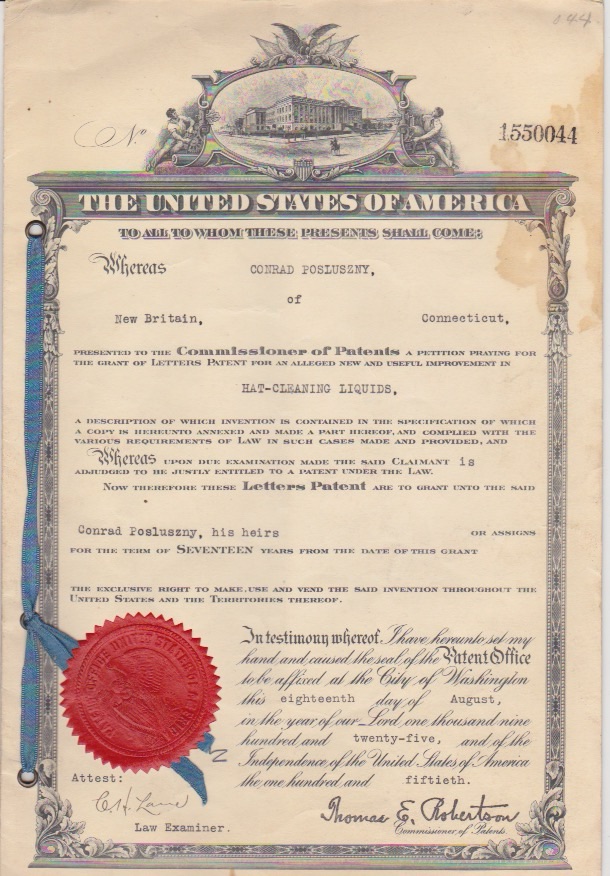
In 1924, he applied for a patent for a cleaning solution for straw hats and was awarded with the patent on 1925. I don’t know if he ever made any money from it but he still holds the patent to it.
Patent certificatePatent information
Unfortunately, in the summer of 1924, in the span of two weeks there were fires in his store.
Fire in August of 1924fire in July of 1924
I found these news clippings while researching this story and I wonder if it plays into what my Aunt Judy said in her recorded conversations about not being a business-type guy but he would have been successful if he was. She said he was too soft hearted and the politicians in New Britain would come in, have a hat made and say they’d pay him later but they never would. He couldn’t pay his insurance, had those two (suspicious!) fires a few weeks apart and had to go out of business.
The family moved to Wallingford and he went to work at the Steel Mill until his death in 1944.
The theme for week 5 of 52 Ancestors in 52 Weeks is “Influencer”.
The definition of Influencer is “a person or thing that influences another”. That person could be none other than my mother, Elizabeth Posluszny Jakiela.
She was born in 1922, the youngest of five children with an age gap of five years between her and her sister.
After high school she went to a business school and learned bookkeeping and worked at one of the several silver factories in the area. She got married while working there and continued to work until pregnant with my older sister. Eighteen months later, she had me and my twin sister.
When I started fourth grade, she went back to work, first for a temp agency and then a permanent job so she juggled family and work.
When my dad purchased the paint store he had worked at for years, she jumped right in to take care of the bookkeeping, heading to the store after her day was done at her paying job.
Even with this, she found time to volunteer at school events, participated in women’s church groups, school groups, and was an assistant troop leader for our Girl Scout troops.
When our church began running a carnival in the early 1970s, she jumped right in to volunteer wherever she was needed. Only a few years went by before she was selected to be the chairman of the event. She never backed down from a challenge and she loved being a part of it and continued to volunteer up until she passed away.
My sisters and I all got married and raised our children, found the time to volunteer in their schools and in our community.
Personally, I went to school to be an administrative assistant and have worked with my husband for 25 years in his remodeling business as his bookkeeper and office manager. I definitely inherited that from her!
My mother will be gone 37 years on April 4th and I know she would be proud of the influence she had on her three girls, and her grandchildren in turn.
Week 2 of the 52 Ancestors challenge is about Origins.
I didn’t know a lot of my family’s origins growing up. I knew my maternal side was German and my paternal side was Polish. My mom’s mom spoke German, and my dad took us to the local PNA for polish lessons for a few years. It wasn’t until I started my ancestry work that I realized how convoluted it all was!
My paternal side was definitely Polish, but it was in the Galicia region which was like the shifting sands of time. Were they Polish? Maybe Austrian? If they were Austrian isn’t that sort of German? Evidently, who ever conquered them at the time, that’s what they were.
My maternal side was “German”, but they were also in the Galicia region. And why did my Aunt Tootsie say “dumb Polaks” if they lived in the same area?
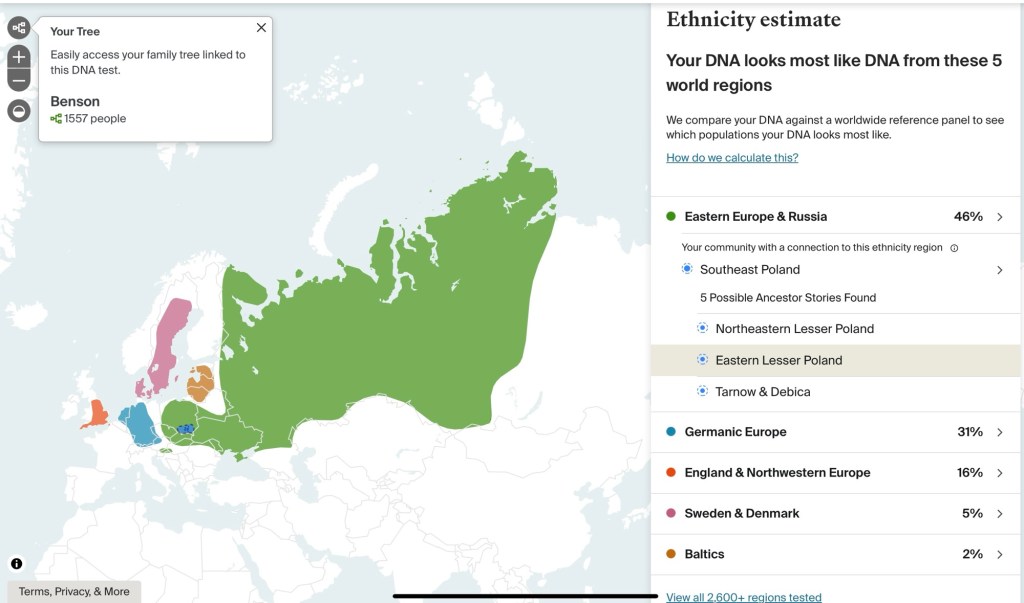
I had my DNA tested and here are the results:
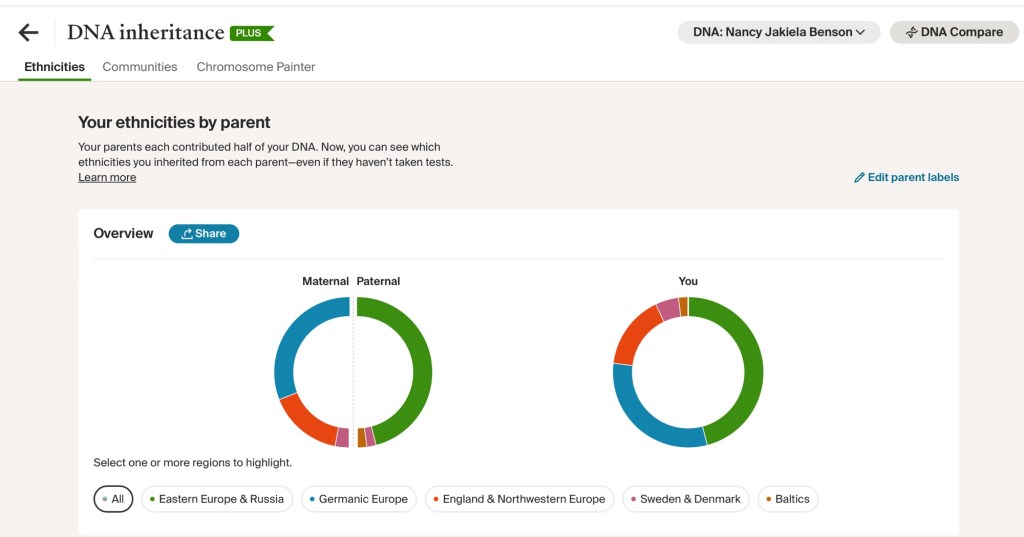
Ancestry DNA ResultsMy ethnicities per parent
I was fascinated to see that my material side had NO Eastern European, so yes, my material side was mostly Germanic Europe. Both sides had a bit of Sweden and Denmark which makes me think of the Danes and Vikings!
Possibly the stories I’ve read of German being paid to go to the Galicia region “to teach” the Polish how to farm has some weight behind it. After all, my maternal side were farmers.
Something interesting on my maternal side was the England and Northwestern Europe. Mostly the England because as you might remember, and if you don’t, I talked about the discovery of my biological grandfather here .
With new family, there is always new information to share and what this cousin shared was quite a shock – my 35th great grandfather is King Alfred the Great! He was the most famous of the Anglo-Saxon kings. He prevented England from falling to the Danes and he promoted literacy and learning. Fierce and educated – it certainly carried down the line!
It’s fun to take a dive into the DNA results looking the results and thinking about my origins.
I’m starting, and hopefully I will complete, a “challenge” called 52 Ancestors in 52 Weeks #52Ancestors.
I’ve been spending more time on my other site Thoughts From the Passenger Seat writing about thoughts that pop into my head, or answering the daily prompts. It’s easier! I don’t have to dig through the paperwork or get frustrated searching on Ancestry.
But I miss it….and I bet you do too!
Starting this week I’ll be writing one story a week based on the prompt provided. It won’t always be dates and facts and it could be about any one in my family – maybe even you!
Posluzny family c. 1909Joe Mikula with Walt and John JakielaGalloway Family c. 1910Katherine Duy EngramJulia, Konrad, and Antoinette Posluszny c. 1909John, Walt, Steve, Ed Jakiela
I hope you’ve enjoyed the stories of my Aunt Judy I’ve shared so far. The explanation of how they came to be is here and the second part about her family growing up is here. Catch up and then join in!
So this part of the conversation between Aunt Judy, her niece “Little Judy” and her nephew, Jack involves Aunt Judy growing up and her marriage and life with Uncle Mal – Malcolm Bellafronto.
What was the hardest thing you ever did? My Hair. No one has any idea of the life I had.
I lost my hair when I was a year old! 1917 during the war, everyone was getting typhoid, so when I lost my hair they figured I’d get it back, but I never did. My mother was taking me down to Yale-New Haven clinic for observation, by then I was 8 or 9 years old. I had eyebrows and eyelashes and I had to sit there with all the doctors standing around trying to figure out what was wrong. They couldn’t find any reason except alopecia, yet they said, it was not really, because I had eyebrows and eyelashes! When I hit puberty, I got pubic hair and hair under my arms but as I got older, everything left. They said I would get it when I hit puberty, which wasn’t true, but I’m glad they did because I always had the hope that when I was a teenager, I’d get that hair so at least I wasn’t in despair.
Judy and Betty
My mother made a white hat for me but they’d pull it off my head and call me Baldy and everything – and they were my peers. Then when I got older, cripes, I wore that kooky wig. I got hit in the forehead playing basketball and it got knocked off and there were all the boys in the stands. One time the wind caught it while I was walking up Center Street and I had to go chasing it!
Aunt Judy 20 years old
When I see them getting these wigs for these kids, I tell you, I am so glad. I told my kids once they could understand, I swear if I ever hear you make fun of anyone with an infirmity, you will get beat until you are black and blue. I told them why. You have no idea how tough it is on a kid, especially a girl. When I see these things about stuff like that being funny, I think, You have no idea. That is not funny at all. But like I said, I had so many other blessings.
What are some of the fun times? The best thing that ever happened to me was Mal. I think if I had not found someone who loved me so deeply…once we were horsing around and it (the wig) fell off, and of course, I went into tears. he said “What’s the matter with you? Don’t you think I know?” Well, knowing and seeing are 2 different things. But to have him love me and think I was so wonderful was really the best thing to happen to me. Had I not married him, I probably would have wound up a crabby old maid! I never can complain about my life.
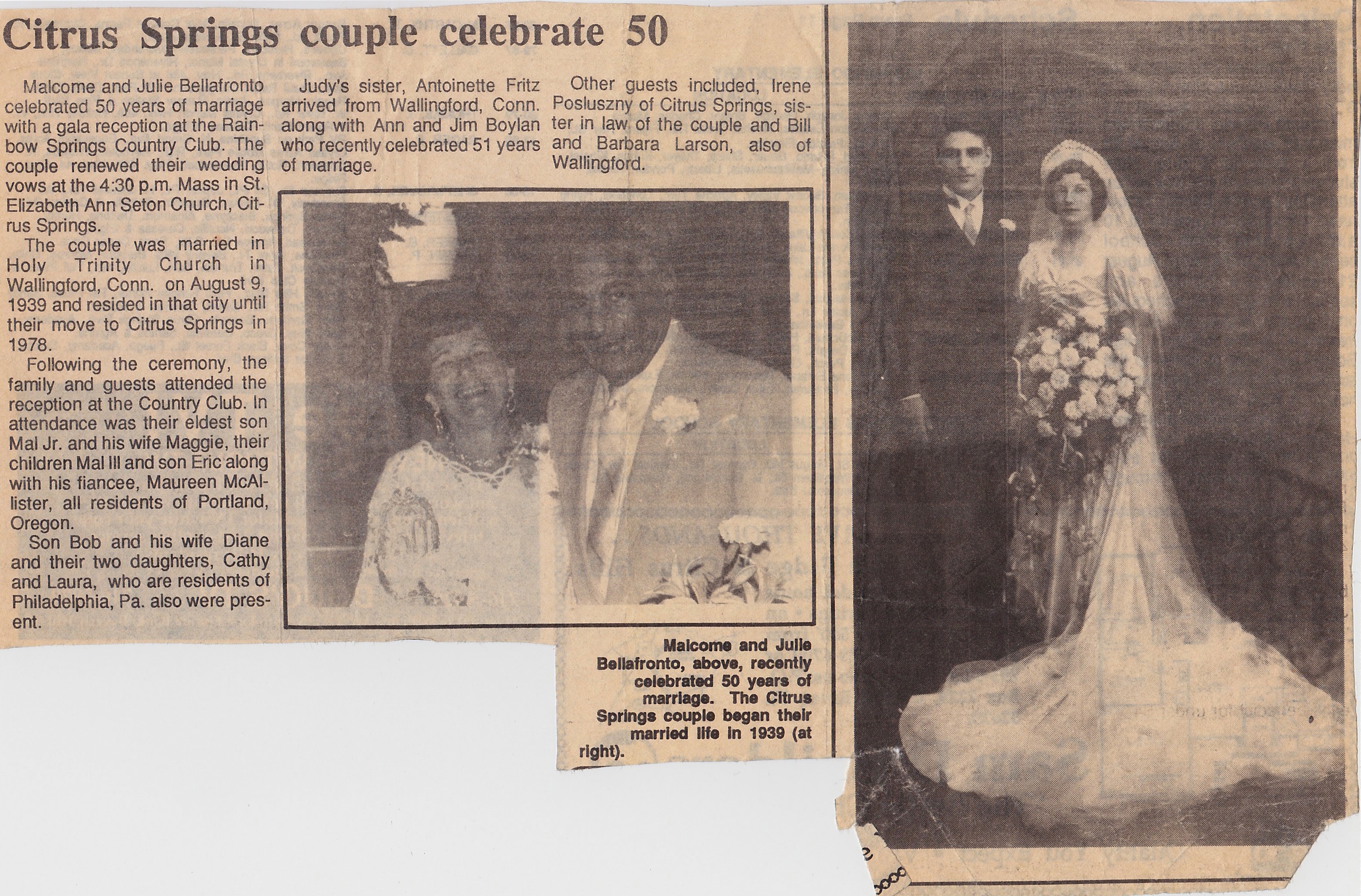
50th Wedding Anniversary 1939 / 1989 tap for full picture!
Aunt Judy and Uncle Mal were very close with her brother Lou and his wife Irene. They traveled together, had summer cottages next door to each other, and all retired to the same location in Florida.
How did Lou and Mal meet? They both played football. Lou was quarterback, and Mal was center. Connie (her oldest brother) also played.
How did you and Uncle Mal meet? When I was drunk! It wasn’t love at first sight. The next time I saw him he said “I owe you something”. When I asked what, he said, “You said you’d give me a kiss if I scored a touchdown, and I didn’t so I have to give it back”. We grew on each other and I never thought I’d marry an Italian! When I went to New York to go shopping with my cousins over Easter he came to the house 2 or 3 times a day to see if I was home yet! We started going steady after that.
How did he propose? I don’t remember anything big. Once you started going steady that was usually it and the first gift you received was a cedar chest. He was carrying around a ring for awhile and I finally asked him when the heck he was going to give it to me because I wanted to wear it before the wedding!
What do you think your family thought of Uncle Mal? He was concerned about what my family thought of him. I asked him why and he said, “well, you know, Polish and Italians don’t get along”. I told him well, we’re also German! Finally I called out, “Hey Ma – I got a problem”, Mom said “What’s your problem?”. I said, “Mal wants to know what you think of him”. She said, “what do you mean what do I think of him?” “Well, he’s Italian!” Mom said, “So?”. Mom loved Mal.
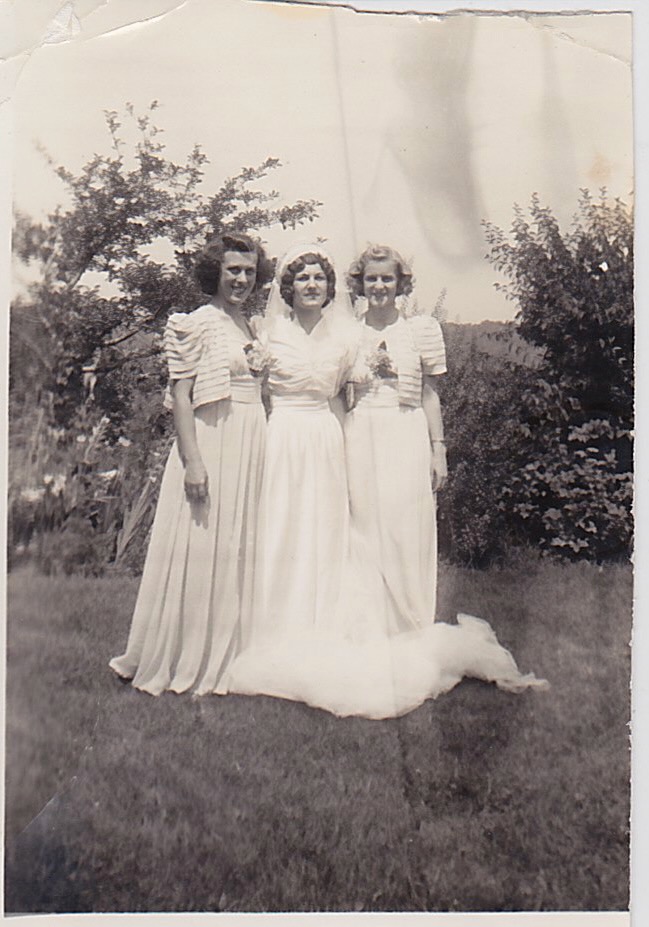
Helen Evon, Judy, Betty (her sister) August 9, 1939
My mom was like that. Very liberated for her time. If someone said you couldn’t go to another church, she’d say, “that’s a lot of nonsense. God is in every church, not just in our church!”
What did the Bellafronto family think of you? They tolerated me and they had to because…No, I think my mother in law liked me but she was very domineering. She was born in the United States and went to Italy on a visit and met Mal’s dad, and they got married. Mal loved his dad dearly and was the only one in the family who did. For years and years we would go to their house for a meal and he’d come downstairs, eat and go back up! We were shocked that he came to our wedding. When his mother was dying, she took my hand and said you’re the best thing that every happened to my son. The family was different. You had to know them. They didn’t know how to mix. They were good to me though.
Mal, Judy, and Stephano (Augustine) Bellafronto May 1939
Uncle Mal was in World War II? Yes, he enlisted in the Navy in July of 1943 and went right away. We lived with my Mom, Dad, and Betty while he was gone. He was on a sub-chaser and spent 2-1/2 years in the Caribbean. The ship came back to California and was in dry dock so young Mal and I went out there to stay with him. We planned on staying with Tante Lizzie and Uncle Ben when he went back out. But shortly after the ship pulled out of the port, the Navy said Mal had enough points to go home! So we all came back to Connecticut.
Milly Bellafronto, Judy with Young Mal 1944
Mal, Judy, and young Mal returned to Wallingford to live after he got out of the Navy. They built a house on Lincoln Avenue in Wallingford around the corner from where my family would eventually live. In June of 1946 their son Robert Louis was born. They lived there until the mid-1970s when they retired to Florida with my Uncle Lou and Auntie Irene. My parents remained close to them after they moved and took a few trips down to Florida to visit with them.
What are you most proud of? My marriage. It was the best thing that every happened to me.
September 1985June 2013 (age 96)
Aunt Judy was sassy. In hindsight, she was very similar to how my grandmother has been described! She told you how it was and didn’t hesitate to swear, and then laugh! She had a very infectious laugh and it was fun to listen to her stories.
I hope you’ve enjoyed these Conversations with Aunt Judy!
Through the questions asked by Little Judy and her brother Jack, I’m going to share Aunt Judy’s answers and give a little background to her responses. If you missed the beginning, you can find it here. Let’s start with the early years.
There was a lot of conversation about Gram. She was quite a woman who had quite a secret! This is what she had to share about her mother.
What do you know about your mother’s early life?: She was quite a lady. She was not the person that people knew in the end. She was one of the lucky ones. She came here with no one. I don’t even know how she got here without a sponsor. She was lucky to be taken in by a rich woman – I don’t know her nationality or her name, but she immediately enrolled her in night school. That’s why she could speak English and learned at the niceties (Gram was this woman’s maid). That’s why she had so much poise. She was very fortunate.
How did she meet Grandpa? They both lived in Yonkers which was considered Germantown because that’s where all the Germans immigrated to. They were 3rd cousins and has to get dispensation. *This would mean they shared great great grandparents and in the early 1900s even 2nd cousins didn’t need dispensation so that might have been a family tale. Commonality appears to be with the Straub last name.
Julianna and FamilyJulianna, Konrad and Antoinette (late 1909)Posluszny Family – Julianna and Konrad back right
How many languages did she speak? She could speak German, Russian, and Polish, and she could understand “Jewish”. I bet out of all of us my mother had the highest IQ. She then followed that up with – I don’t know if my mother was any smarter than my dad but she had more balls than my father, yes she did!
Where did you learn to cook and sew? My mother! She could look at a piece of crochet and she could do it. She and Toots (the oldest daughter) would walk and window shop and if they saw a dress that Toots liked, she could just look at it then they’d go to Horowitz’s and buy the material and make a paper pattern and then the dress would be done the next day. I’m a good sewer but I could never do that! Gram didn’t need a pattern. There was nothing she couldn’t do and that’s why when we’d get shy about something she’d get so impatient with us! She’d say, “American boy got an education, and you can’t open your mouth?” She would open hers!
What else did Gram enjoy? She was an actress! She was in plays at the Polish (national) church a couple of times a year. I can still picture watching them! My mother and Aunt Mary (Gram’s sister-in-law). Aunt Mary was the boss – producer. Everyone would go to the church on Sunday night to watch. I don’t know what the hell they were saying but whatever she said, I guess it was the right thing because they’d all clap!”
What was Gram and Grandpa’s relationship like? She had a tough row to hoe. My father had a drinking problem. Fortunately, when he’d get drunk, he’d go up to bed and go to sleep. But he never lost a day’s work in his life. My mother got the paycheck. But just the same, to us, we knew Christmas would come, he was going to have too much to drink and then go to bed. It bothered us! Now we realize it wasn’t all that bad.
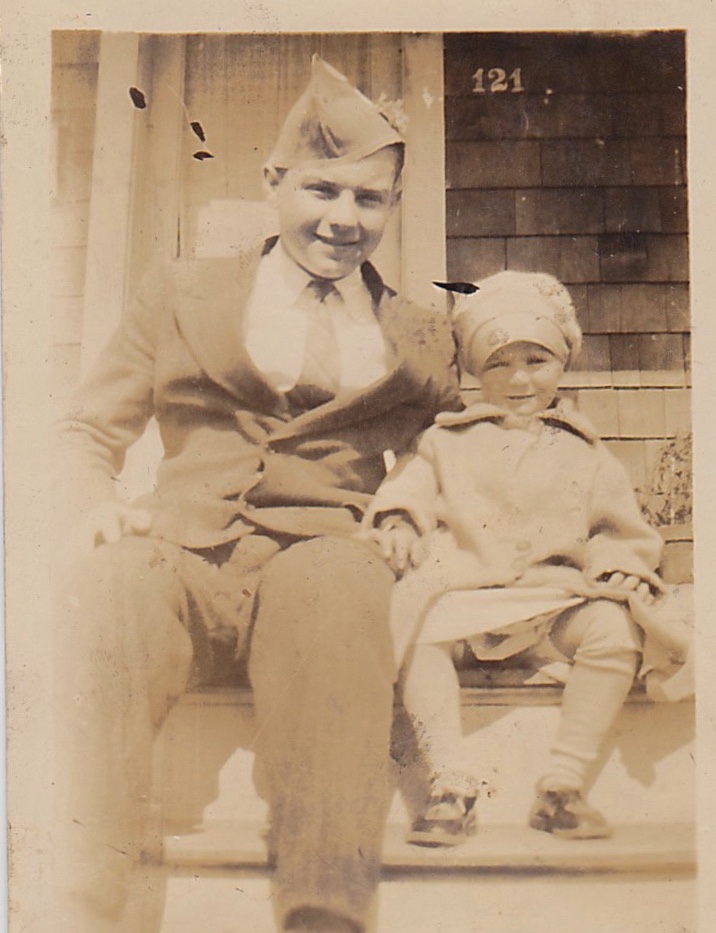
Tell us about your dad My dad and his brothers were hatters. When we moved to New Britain, he owned a hat company (The Conrad Hat Company). Dad was not a business-type guy but he would have been very successful if he was. He was a soft-hearted guy and the politicians in New Britain would come in and take advantage of him, having a hat made and saying they’d pay him later and they never did. He couldn’t pay his insurance, had a fire, and went out of business. They moved to Wallingford so he could find a job. He did get a job in the steel mill and his mother and stepfather gave them $500 to put a deposit on the house at 121 Clifton Street.
Who graduated from High School and when did everyone start working? Tootsie (15), Connie (14), and Lou (11) didn’t attend any school once they moved to Wallingford. Tootsie did housework until she could get into the factory. Connie grew up to be a fabulous baker but I don’t know if he started working for one right away. Lou went to the farm (Wallingford was filled with farms in the 1920s) and pretty much lived there. Judy graduated high school, and Betty graduated high school and went to business school. She was asked why did everyone start working. “Because there was no money!” Think about it – 5 kids, dad with no job, moving to a new town – everyone had to pitch in.
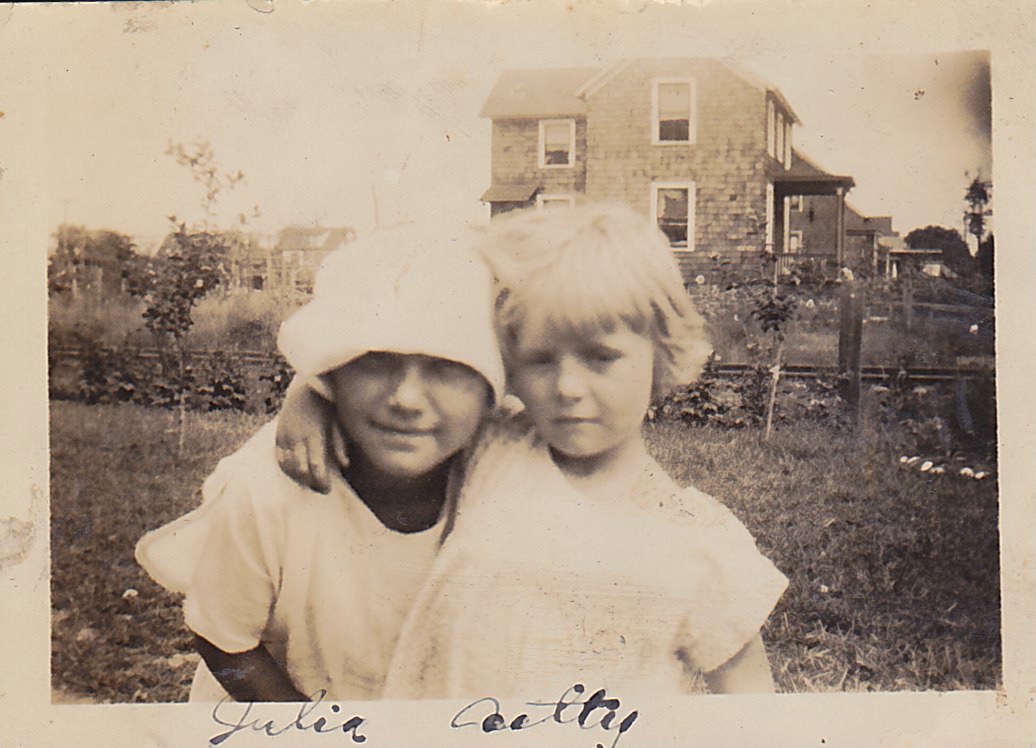
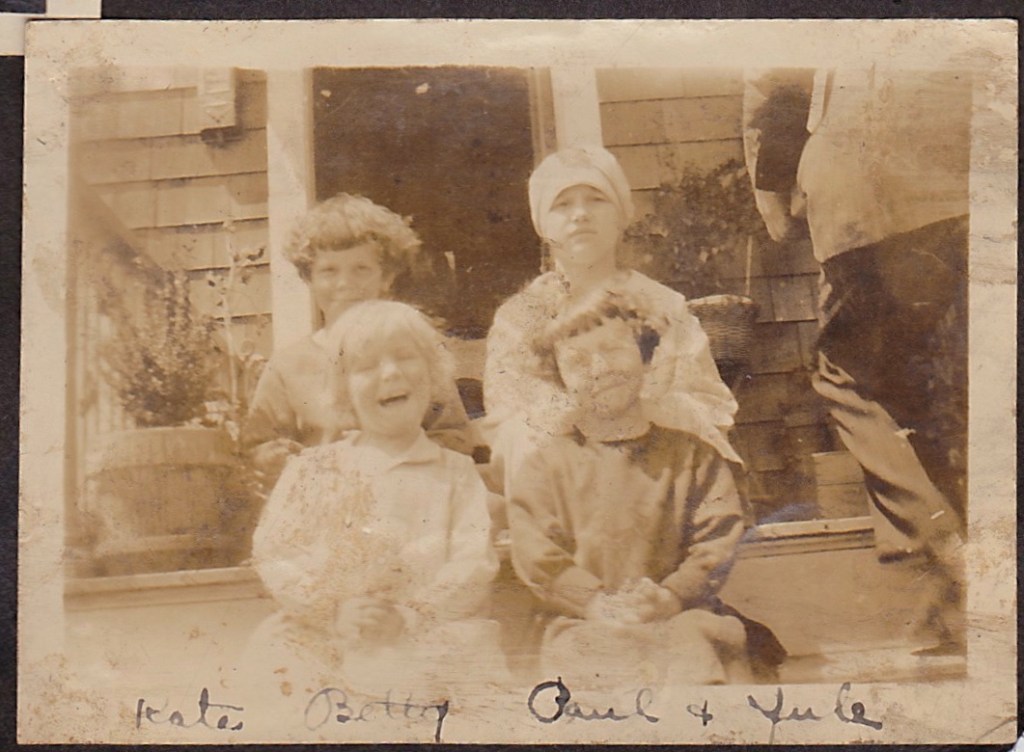
My mom, Betty front left, cousin Pauline right. Back cousin Katherine and Judy in capConnie and BettyJudy and Betty
I’m going to end here and next, we’ll hear from Aunt Judy about her life growing up, meeting Uncle Mal, and their life together!












 It's All About Family