The week 9 topic for 52 Ancestors in 52 Weeks is Changing Names.
You may have a story or two in your family about how “their last name was changed/shortened by the Ellis Island worker that couldn’t understand what they were saying”. Although that probably happened to some people, many times it didn’t happen that way! Most likely it was done by the immigrants themselves trying to fit in, or tired of spelling their name or hearing people mispronounce it!
My maternal family last name was Posłuszny. That little line through the “ł” sounds like “whoosh”. The majority of misspellings I see is “Poslushney”.
Two of the five Posłuszny brothers, Joseph and Charles, changed their name to Post some time during the 1920s. John used Post for business purposes as a restaurant owner, but used Posłuszny in his personal life.
Frank, poor Frank, who spent decades in an insane asylum, remained Posłuszny for his lifetime as did my grandfather Konrad’s family. I recall hearing that my Aunt Judy wished her dad had changed their name because she got so tired of spelling her last name to people!
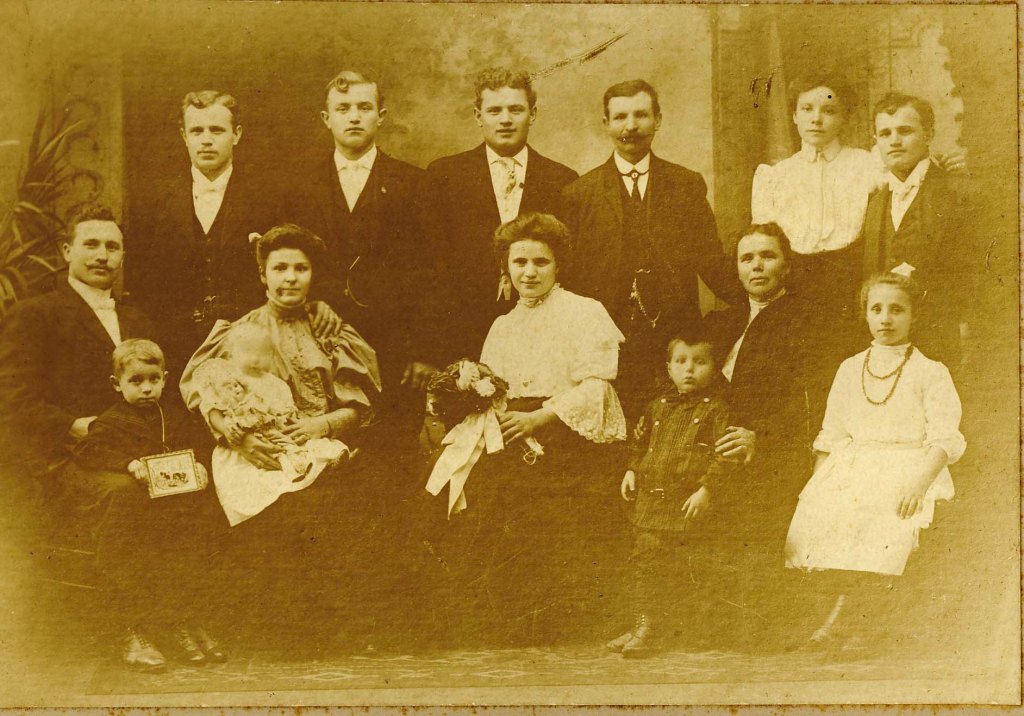
Left to right John, Joseph, Frank, Charles, (far right) Konrad
The topic for Week 6 of 52 Ancestors in 52 Weeks is – Earning a Living so I am turning this week to the Posluszny side of the family to tell you about my grandfather and his brothers.
My grandfather, Konrad Posluszny, and his four brothers were hatters. The occupations on their ship manifests say “laborer” so it’s likely they picked up the trade when they immigrated to the United States.
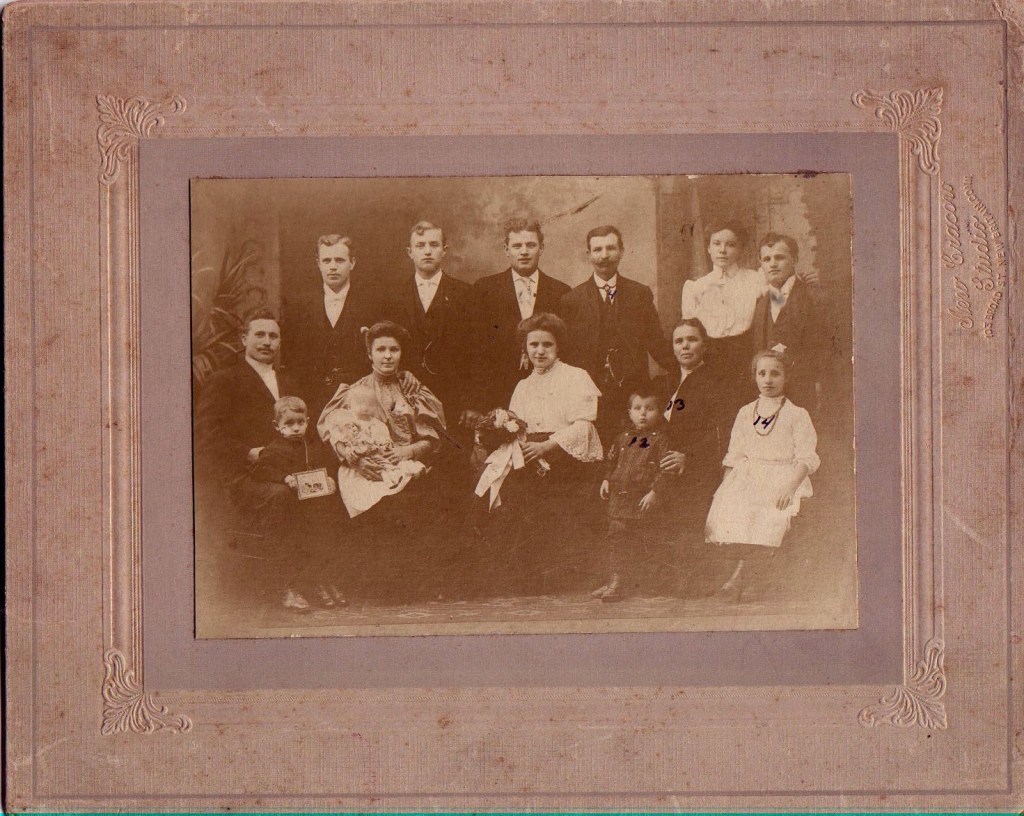
The Posluszny Family abt. 1909. Men from left – John, Joseph, Frank, Charles, stepfather Jon, and Konrad
In the early 1900s, hat making was booming and during that time period, Konrad and his brother Charles lived in Yonkers New York. They held jobs as finishers at the Waring Hat Manufacturing Company. The factory was on the corner of Riverdale Avenue and Vark Street which was only a block and a half from their home on Jefferson Street.
Waring Hat Manufacturing Company, Yonkers NY
His other three brothers John, Joseph, and Frank all lived in Newark New Jersey. I don’t know which company they worked in but there were 34 hat companies in Essex County making it the hat capital of the world! They would have had their pick of any and they also worked as finishers.
The 1920 census showed all five brothers still in the hat making industry. Konrad and his family were still in Yonkers, John and Frank in New Jersey, Joseph and Charles with their families in Norwalk Connecticut.
The 1920s brought about a slowdown in the hat making industry and many companies merged. John left hat making and because a proprietor of a restaurant/saloon in Newark.
Unfortunately Frank turns up in the 1930 and 1940 federal census as an inmate in the Essex County Hospital for the Insane. We know the old saying “mad as a hatter” but in this case it was hereditary rather than occupational.
Charles worked for the American Hat Company and Joseph for the Hat Corporation of America, both in Norwalk. They worked has hatters until they retired.
But, the more interesting story is that of my grandfather. I’ve told the story of the family’s move to Easthampton Massachusetts where they lived very briefly before they moved to New Britain and lived in a two family house with my grandmother’s relatives where my mother was born in 1922.
In New Britain, my grandfather opened up a hat store called the Conrad Hat Company and in 1923 it was at 43-45 Broad Street before moving to 317 Main Street.
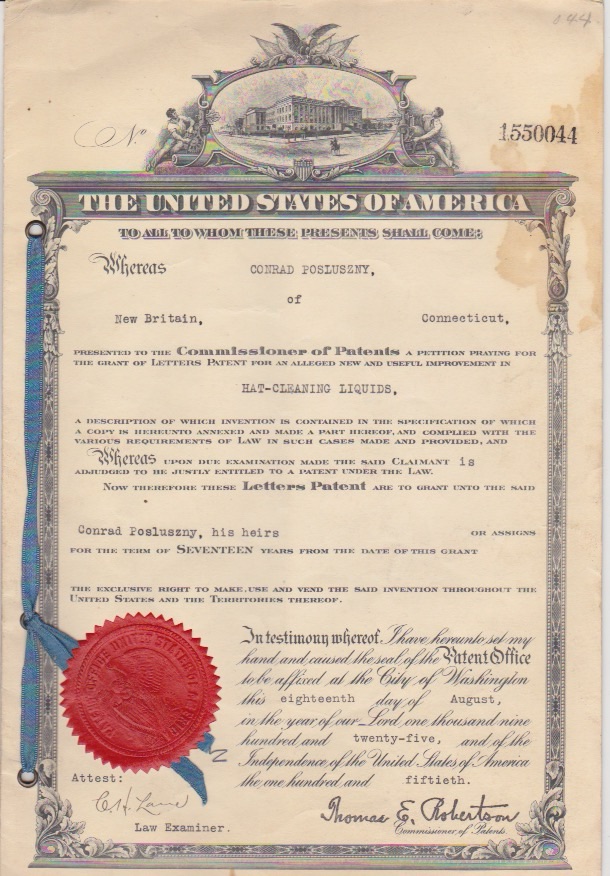
In 1924, he applied for a patent for a cleaning solution for straw hats and was awarded with the patent on 1925. I don’t know if he ever made any money from it but he still holds the patent to it.
Patent certificatePatent information
Unfortunately, in the summer of 1924, in the span of two weeks there were fires in his store.
Fire in August of 1924fire in July of 1924
I found these news clippings while researching this story and I wonder if it plays into what my Aunt Judy said in her recorded conversations about not being a business-type guy but he would have been successful if he was. She said he was too soft hearted and the politicians in New Britain would come in, have a hat made and say they’d pay him later but they never would. He couldn’t pay his insurance, had those two (suspicious!) fires a few weeks apart and had to go out of business.
The family moved to Wallingford and he went to work at the Steel Mill until his death in 1944.
This subject is number 3 on the list of “52 Ancestors in 52 weeks for 2024” created by Amy Johnson Crow. Week wise, I’m a little late to the party, but who cares – as long as I show up!
So my favorite photo is this one:
John and Steve at Baldwin Pond
This is a photo of my dad, John, and his oldest brother, Steve. It was taken approximately 1936 when my dad was 12 and Steve was 23. Look at the smiles, look at Steve’s arms over my dad’s shoulders holding him close, and look at my dad’s hands reaching back to hold his brother’s legs.
If my timing is correct, this was about a year after their father was killed in a hit and run accident not far from home. Eight years previous to that, in 1927, their mother died from pregnancy complications when my dad was not quite 3.
That hit and run left 5 children, ages 23, 21, 15, 14, and 12 orphans. Life was definitely not easy for them before their father died, but it got worse the night the policeman banged on their door to tell them their father was dead.
Steve, at 23, became their guardian. Family stories say the priest at the church they attended, St. Peter and Paul’s Catholic Church, offered to be their guardian (in name) in the event there was an attempt to break them up. John and his brother Walt were alter boys and Helen cleaned the alter during the week so he knew them well. I don’t think it ever came to that.
They continued to live in the little brown house on Prince Street in Wallingford and Steve had a job as a meat cutter nearby. In 1937, Steve married Florence whose family lived on the corner and he brought them into the marriage.
Steve was a father to all of them and I’m sure it was difficult as a newly married couple to have teenagers in the house so soon! Life wasn’t always easy but he and Florence made a home for them.
I see such true affection in their expressions and that’s what makes this my favorite photo.
This is the first of my posts for 52 Ancestors and the topic is Family Lore. The moment I read it, my mind went back to the year 2000 when I started my journey to research my Jakiela, Liro, Posluszny, and Ingram family history.
The definition of Lore is: “a body of traditions and knowledge on a subject or held by a particular group, typically passed from person to person by word of mouth.” I don’t think that rings any truer than for my Jakiela side of my family.
Charles and Antonia, my grandparents married in June of 1912. They had two children, Steven in 1913 and Edward in 1915 by the time Charles headed off for World War I in 1917. When he returned, they had three more children, Helen in 1920, Walter in 1922, and John (my dad) in 1924.
The short version: in 1927, Antonia died from a miscarriage and after a move from Southington to Wallingford, CT, Charles died in 1935 in a hit and run accident as he walked along the side of a road at night. That second family tragedy made 22 year old Steven and four siblings orphans. What would they remember of family stories and traditions? What would they pass down to their children?
Charles and Antonia JakielaAntonia Jakiela with John
The children of my Uncle Steve have give me the most information. As the oldest, Steve would have been “the keeper of family possessions”. My Uncle Eddie and my Auntie Helen both gave me information in sit-down interviews I did with them and I would ask my Auntie Helen all sorts of questions to get her talking when I would take her to the grocery store or a doctor’s visit.
Here is some of that family lore:
My grandmother Antonia and her sister Aniela in Massachusetts were twins.They were NOT twins, in fact, Aniela was born in 1871 and Antonia was born in 1890.
Charles had been a writer for a Polish newspaper in Chicago before moving to Southington. No, Charles’s destination from Poland was Southington but there’s no record he settled there before heading to Palmer, Massachusetts to work in the textile mill where he met Antonia. Now, he might not have been a newspaper writer but according to Auntie Helen, on a regular basis he would write to the government asking for his pension from WWI to be increased.
Charles was injured in WWI when a forgotten ammunition exploded under their train as they were heading home from France and he had a scar on his head from front to back. I don’t know the truth of this, but it was relayed to me by Auntie Helen. He was flung into the river and would have drowned but he was saved by fellow soldiers.
Steven left school after his grammar school graduation, after his siblings had been scattered among relatives, and gathered them together to live as a family again. Very “Party of Five”-ish but no. The story might be mistaken for what happened when their mother died in 1927. Steve and Eddie stayed with their father. Helen and Walt went to Uncle Joe Mikula who was the widower of Antonia’s sister in Palmer Mass. John was not yet 3, and he went to the home of his godmother, Amelia Marcieniec in Southington. Once Charles, Steve, and Eddie got settled in Wallingford, Charles went and brought the younger siblings back home.
Steve, at 22, kept the family together. The priest at St. Peter’s and Paul Church in Wallingford said he would sponsor them if anyone tried to break the family up. The first is very true. Eddie was 20, Helen 15, Walt 13, and John turning 11. The family remained together. John and Walt did spend time in Palmer Massachusetts with their Uncle John in the summer, and their cousins Walt and Stanley Mikula were known to have spent time in Wallingford. Eddie got married in 1936 and left the family to live in Meriden. Steve and Florence Liedke who lived on the corner of their street, got married in 1937 and Helen, Walt, and John moved in with them.
Walt, Uncle Joe Mikula, JohnAntonina’s grave in Southington
Steve “fibbed” his way into a job as a meat cutter at a market. The 1930 census when he was 16 says that he was not attending school and was working as a salesman at a meat market, so there might be truth to the story he left school after 8th grade. Very possible, as his father had trouble keeping his jobs. It’s likely that’s how he got the job and he went on to become the premier meat cutter at Caplan’s Market in Wallingford until he retired. The man knew his cuts of meat!
Cousin Steve’s Liberty Deli in Southington was in the same location that the family lived at in 1918. Oh yeah, that’s true! Not really family lore, more of a Fun Family Fact. 31 Liberty Street.
We are of Polish royalty. Well, I can’t deny that all we Jakiela girls are Queens, and Jakiela in Polish is Jagiello (Ya-GAY-wah), and The Jagiellon dynasty, family of monarchs of Poland-Lithuania, Bohemia, and Hungary became one of the most powerful in east central Europe in the 15th and 16th centuries. It was ruled by King Wladislaw II Jagiello and Queen Jadwiga. So maybe there is some truth to that tale.
This is some of the family lore that has been accumulated over the 23 years since I first started researching my family. It’s been fun putting it all in one place and I hope you enjoy it!



 It's All About Family